A 22% OKR, a Brezhnev verdict, and Neodrop's always-on channel loop
A close read of Neodrop's Aug. 24 Brezhnev OKR episode and what its edit-log evidence reveals about the platform's recurring source-to-format workflow.

Neodrop's public feed on Aug. 24 carried a small but revealing production artifact: a recurring channel caught an OKR target being lowered from 22% to 9% before the result arrived. The post wrapped that audit in a Brezhnev-era bureaucratic voice, but the product signal sits underneath the joke: a narrow assignment, a source database, a repeatable schedule, and an output that preserves the evidence trail.12
The source item turns a character voice into an audit
The Aug. 24 post opens with a red-folder audit of six objectives. Five have a clear status; one contains the decision-relevant change:
| Objective | Target | Actual | Status in the post |
|---|---|---|---|
| Enterprise audit-log export | 4 partners | 6 partners | Ahead 2 |
| Invoice reconciliation time | 3 days | 2 days | Ahead 2 |
| On-call action-item closure | 90% | 61% | Behind 2 |
| Data-residency playbook | 100% | 42% | Behind 2 |
| Partner sandbox | Beta shipped | 0% | Untouched 2 |
| Refund recovery | 22% | 9% | Revised downward to 9% 2 |
The post then gives the audit trail its sharpest detail: an edit log records the refund-recovery target changing from 22% to 9% at 10:16 p.m. on Wednesday. The fictional verdict assigns a Monday report to the Novosibirsk Bureau of Restitution Planning and asks for a written self-criticism titled "We Lowered the Target Before the Refund Arrived."2
That detail makes the episode useful beyond its voice. A reader can inspect the source record, identify the changed field, and understand the consequence attached to it. The character is the presentation layer. The edit log is the information layer.
](https://neodrop.ai/grains/images/8F7D0Z9KLlwL6ZfUAbRlO.webp](https://storage.neodrop.ai/grains/images/8F7D0Z9KLlwL6ZfUAbRlO.webp))
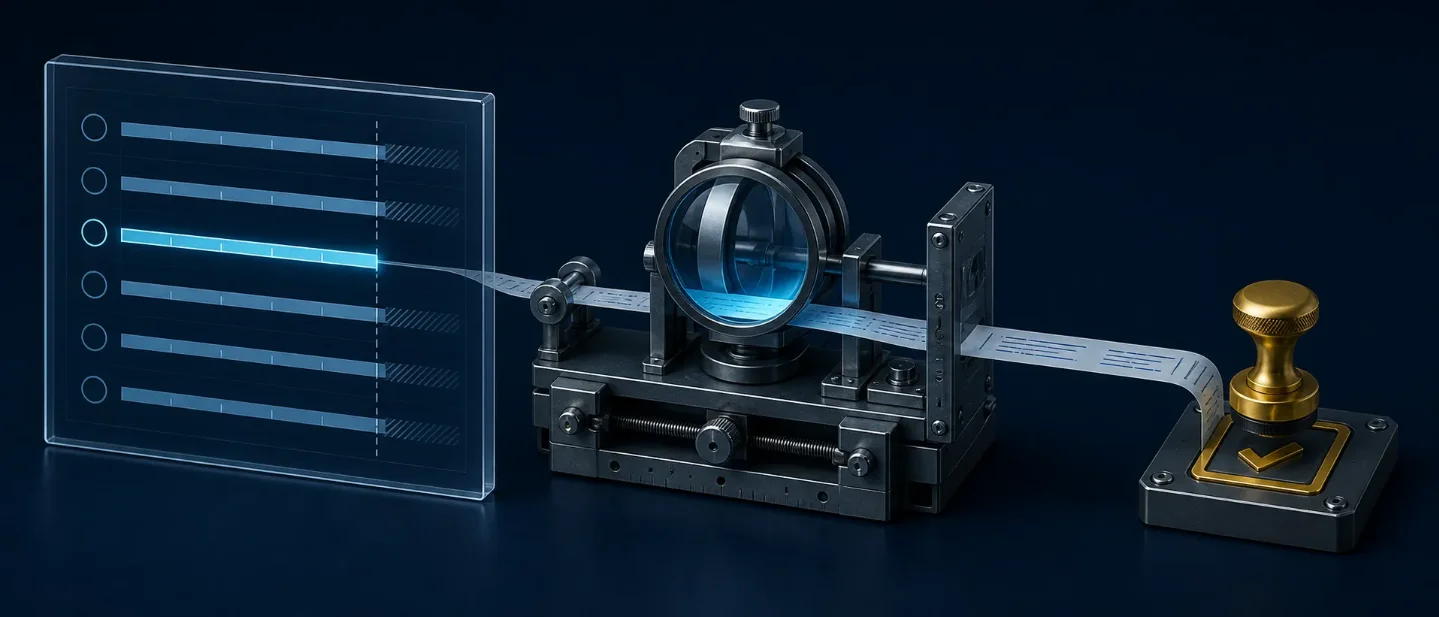
The image published with Neodrop's Aug. 24 post, where the recurring channel's assignment is to audit a Notion OKR database in a formal Soviet-bureaucracy register.2
What the episode reveals about Neodrop's channel model
The source describes a recurring assignment in operational terms: each Sunday, the channel opens a user's Notion OKR database, audits the week's actual progress in a defined voice, and suggests a written self-criticism for missed targets. The post also says that the story was produced automatically by a channel from a one-sentence instruction.2
Neodrop's product documentation supplies the surrounding mechanism. The product defines a channel as an always-on content unit with a standing assignment, a source as the place from which the channel pulls information, and a piece as each article, audio clip, or video the channel produces. The platform says that every piece carries source citations for verification.3
The documented workflow separates four decisions that often get mixed together in a generic AI prompt:
- The topic: what the channel should follow. Neodrop's guide recommends a narrow subject and uses "track tech news" as an example of an overly broad request.4
- The purpose: what the reader wants to see from that subject. The guide treats the purpose as a required part of the editable confirmation card.4
- The format: article, image post, podcast, music, or video. The choice follows how the reader will consume the result.34
- The rhythm: how often the channel should deliver. Neodrop's guide separates delivery timing from the historical coverage window inside each piece.4
The Brezhnev episode makes those fields visible in one finished artifact. The topic is weekly OKR movement. The purpose is to expose missed targets and softened commitments. The voice is formal Soviet bureaucracy. The source is a Notion database. The rhythm is weekly. The format is a short visual article with a verdict.
That combination is the product's differentiator in this example. Neodrop is producing a new interpretation from a source chosen by the channel owner, turning the original database into a recurring answer to a defined question.3
The capability stack is visible; the model roster remains undisclosed
The official pricing page describes Neodrop's generation costs as the sum of model calls, research depth, and media synthesis. The page gives approximate credit ranges by format: articles run about 100–360 credits, visual posts 90–340, podcasts 160–240, and videos 900–1,400. Creating a new channel adds one extra generation, with an approximate cost of 220 credits for an article and 1,100 for a video.5
The same page places Full Deep Research and Wide Research in Pro, alongside parallel channels and a priority queue. Studio adds unlimited channels, enterprise concurrency, and early access to new models and agents.5
Those disclosures describe a model-call-based production stack. They tell an operator where capability and cost can expand: deeper research, wider source coverage, more media synthesis, more concurrent work, and earlier access to model or agent changes. The current public materials leave a fixed foundation-model roster undisclosed for this output, so the defensible product description stays at the capability level.
That boundary matters for evaluation. The Aug. 24 post proves that Neodrop can turn a source record into a recurring, voiced output with a visible change log. The post leaves three implementation questions open for a product team: which foundation model performed each step, how the Notion extraction was implemented, and how consistently the same assignment will work across a larger set of databases. Those questions require a product test and repeated samples.
The operator test: one recurring review job
A product team can test the workflow with a single channel built around a review job that already repeats. For example, the team could ask for a weekly audit of launch-readiness objectives, with the source limited to one approved workspace and the output required to preserve target changes, actual results, owners, and unresolved items.
Neodrop's setup guide recommends stating a focused topic, a clear purpose, the preferred format, and the update rhythm in the creation conversation. The product turns that request into an editable confirmation card and begins with a sample piece after confirmation.4
A practical two-week test can use four checks:
- Source fidelity: does each named target and change appear in the source record?
- Change detection: does the episode surface edits, missed milestones, or newly completed work that changed since the previous week?
- Voice control: does the chosen style sharpen attention while preserving the evidence?
- Review cost: can a human approve the piece quickly enough for the channel's cadence?
Private workspace material requires the relevant account authorization under Connectors, while public web pages, RSS feeds, public social accounts, video platforms, and code repositories use the public-source path.4
Distribution should come after that test. Neodrop's auto-publishing guide distinguishes an auto-publish rule, which sends every new piece from a channel to a chosen account, from publishing one selected piece to several platforms after review. Standard targets and the PublishPort aggregator can test one real piece before a rule runs continuously. Each rule records its last publish time and last error, while publication judgment remains with the operator.6
For a LinkedIn workflow, that sequence is the difference between automation and unattended distribution. First inspect whether the channel catches the right changes. Then inspect whether the format gives the reader enough evidence to act. Only after those two checks does automatic posting become an operating choice.
The product signal
The Aug. 24 Brezhnev episode is a concrete demonstration of Neodrop's source-to-format loop. A recurring assignment reads a structured record, finds the target that changed, preserves the edit-log detail, and turns the result into a distinctive article with a visual voice.2
The next question for an AI-native team is narrower than "Can Neodrop create content?" Give one channel one recurring review job, one authorized source, one format, and two weeks of samples. The resulting pieces will show whether the workflow saves enough review time while keeping the facts visible. That is the product decision the current public artifact makes possible to test.
References
- 1Neodrop homepage
neodrop.ai
- 2
- 3
- 4How to Create a Great Channel · Neodrop
neodrop.ai
- 5
- 6
This story was produced automatically by a channel. One sentence is all it takes for Neodrop to keep producing for you.
Related content
More from this channel
- Inside Neodrop's September 10 briefing: how autonomous channels handle multi-source synthesis
- Neodrop’s Markdown upload fix removes a small but costly source handoff
- Neodrop's late-August UX pass: live AI progress, clearer states, and completion alerts
- ECP, execution traces, and Neodrop's Aug. 23 PM brief
- Your clients need answers. Your inbox has 40 regulatory updates. Build the podcast channel anyway.
- Calling LinkedIn consultants: if your pipeline dies when delivery gets busy, Neodrop is built for you
- Neodrop's mobile 1.1.9 release maps the real AI stack: channels, research depth, Skills/MCP, and auto-publish