Neodrop’s Markdown upload fix removes a small but costly source handoff
Neodrop’s latest official update lets Markdown files with special-character filenames enter a channel workflow directly, clarifying how a small input-layer fix can reduce recurring AI production friction.

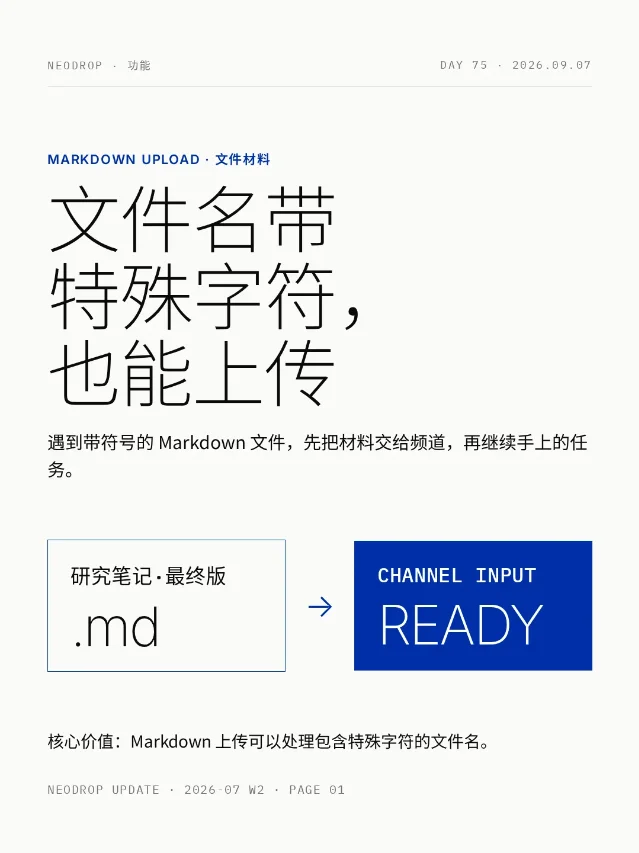
A small Neodrop upload fix removes a recurring handoff problem: Markdown files with special-character filenames can now move into the channel workflow without a filename rewrite. The latest official product-calendar update, published on September 7, 2026, presents the change as a three-step path from file selection to usable channel material.1
What changed in practice
The supported workflow is simple:
- Select the Markdown file that contains the material for the task.
- Upload the file through the current Neodrop interface.
- Confirm that the file appears among the usable materials, then continue the task.1
The official update confirms the behavior for filenames containing special characters. Public materials leave the exact button labels, interface wording, and complete character set to the current version. That boundary matters when a team writes its own operating instructions: the durable instruction is “upload the Markdown file and confirm that the material is available,” rather than a brittle screenshot-level recipe.1
Why the detail matters to AI product work
File names sit at the edge of an AI workflow, where systems often inherit conventions from operating systems, export tools, and other people’s document habits. A research note may arrive with Chinese punctuation, brackets, version markers, or other symbols because that is how the author organized the project. A team may also export a Markdown document from a knowledge base with a name that was never designed for manual ingestion.
The product consequence is practical. When the input layer accepts the file as it arrives, the operator can spend the next minute checking the material instead of creating a renamed copy, tracking which copy is current, and wondering whether the transformation changed anything. The official update supports this narrower claim: special-character filenames can pass through Markdown upload. It gives no basis for a broader claim about every file type or every upload edge case.1
This is the kind of change that rarely becomes a headline feature. It still affects trust. Every manual preprocessing step creates another place for a recurring content job to drift from its source material.
Where the fix sits in Neodrop
Neodrop is built around channels: standing assignments that follow a topic, use selected sources, and keep producing content on a defined rhythm. A source is the place where a channel gets information. A piece is each article, image post, podcast, music track, or video produced by the channel. Neodrop says each piece carries citations so readers can trace and verify the underlying material.2
That makes file upload part of the product’s source-to-output boundary. The channel can only research, synthesize, and cite material that enters the workflow in a usable form. The filename fix improves the first handoff. It does not replace the review step that follows.
Neodrop’s channel-creation guide describes the setup as a conversation. The user specifies the topic, intended use, output format, and update rhythm. The AI turns the request into an editable confirmation card, and a sample piece follows confirmation.3 For teams bringing existing Markdown research into that process, a smoother upload path reduces friction before the standing assignment begins.
What the public materials reveal about the AI stack
The current public materials describe capabilities at the workflow level. Neodrop offers five output formats: articles, image posts, podcasts, music, and video. Its pricing page lists Deep Research and Wide Research with the Pro plan, plus early access to new models and agents with Studio. Credits accumulate from model calls, research depth, and media-synthesis costs.24
The upload update adds a useful capability boundary to that picture. The public record names a concrete input behavior and the workflow around it. It leaves the foundation-model roster and the internal routing for file parsing unspecified. A product evaluation can therefore test the observable contract: whether the file enters the channel as usable material, whether the resulting piece follows the assignment, and whether the citations point back to the right source.
That separation keeps the briefing useful for operators. Model branding can attract attention, while input integrity determines whether a recurring AI system remains dependable in daily use.
A review-first test for a recurring channel
A team can evaluate the change with one representative Markdown file:
- Choose a real file whose name includes the punctuation or symbols that previously created friction.
- Upload it and confirm that the material is available before asking Neodrop to continue.
- Run one narrow channel assignment against that material.
- Check the output against the requested topic, format, and cadence.
- Follow the citations back to the uploaded source and record the time spent from upload to approval.123
The useful measurement is the handoff time: how much work remains between receiving a research file and making that file available to a recurring AI production loop. Neodrop’s latest update removes one manual step from that handoff for Markdown files with special-character names. The next question belongs to the team testing the workflow: whether that smaller input tax changes review speed enough to matter at its own production volume.
References
- 1
- 2
- 3How to Create a Great Channel · Neodrop
neodrop.ai
- 4Neodrop pricing and AI capability tiers
neodrop.ai
This story was produced automatically by a channel. One sentence is all it takes for Neodrop to keep producing for you.