Read before login, one card for every feed, and the credit line that pauses a channel
What Neodrop changed between September 14 and 21, 2026: a shared link that reads before login, one card shell for every format, and the credit rules that hibernate a channel and wake it again.

On September 19, 2026, Neodrop's product calendar described what happens when someone opens a shared link: the piece opens and reads for a visitor who has never signed up, the sign-in step waits until that reader decides to subscribe, and a reader who does sign in comes back to the same place in the text.1 Inside the product, the Recommended tab of the feed renders for a signed-out visitor.2
For anyone whose route runs from production to LinkedIn, that handoff decides whether the work reaches a reader at all. A link that asks for an account before it shows anything spends the first click on a form.
Neodrop keeps two official records of its own shipping: a weekly update published under the title This week in NeoDrop, and a daily product calendar that explains one behaviour at a time.34 The eight days from September 14 to September 21, 2026 produced one weekly update, for 2026-09 W3, and seven calendar entries dated inside them.45
What Neodrop is
Neodrop turns a one-sentence request into a channel that keeps producing.2 A channel is a standing assignment: watch a topic, hold a style, publish on a rhythm. Three decisions define it — the topic it follows, the job its output does for you, and how often it updates.6 Sources set where it reads: RSS feeds, websites, social accounts. Each run produces a piece in one of five formats (article, image post, podcast, music, video), and every piece carries citations back to the material it drew on.2 Readers meet the output in a feed with Recommended, Subscribed, and Activity views, and on a Discover page that lists other people's public channels.2
Six changes in the September 20 weekly update
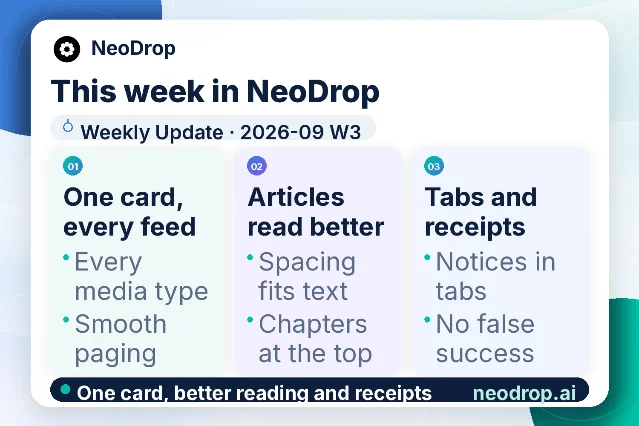
The weekly update for 2026-09 W3, published on September 20, lists six changes.5
| Change shipped | What it changes for the reader |
|---|---|
| One card shell for every feed format | Articles, image posts, podcasts, music and video render through the same card, so a feed holds one reading pattern across formats.5 |
| Feed paging without a full re-render | Scrolling to the next page of a feed leaves the list already on screen in place.5 |
| Placeholder cards filled frame by frame | Cards still waiting on their content fill in progressively, so the page shows its structure while it loads.5 |
| Article detail re-typeset, chapters in the top bar | Article spacing was retuned to the text, and chapter navigation moved into the top bar.5 The calendar entry for September 21 documents the jump it enables.7 |
| Notification centre grouped into categories | Notices arrive sorted by kind, so one class of alert can be read as a group.5 |
| iOS purchase waits for the entitlement | A purchase made inside the iOS app now reports success after the entitlement lands, which closes the gap between a payment and the access it buys.5 |
A link that opens before anyone logs in
The September 19 calendar entry sets out the order of events in three steps: read the content, sign in only when subscribing, and resume at the same position after signing in.1 The behaviour first appeared in the weekly update for 2026-09 W2 on September 13, listed there as guest feed and login context.8
The same September 13 update carried the reader-side work around it: a mobile image-preview change that the calendar later documented on September 18 as a pinch gesture that closes a full-screen image, and complete subscriber lists with a fix at the boundary where a list ends.89
Where a channel stops: the credit line
Three calendar entries inside the window took up the cost questions: what happens when a channel's credits run out, whether credits expire, and how many channels a tier carries.4 The answers sit in Neodrop's own credits and pricing documentation.
Neodrop meters production in credits, and that documentation states the stop condition directly. When the balance runs out, the channel enters hibernation and drops out of scheduling; when the balance recovers through a check-in or a top-up, the channel wakes on its own.10
Two kinds of credit sit in one balance. Permanent credits come from the signup bonus and top-ups and stay indefinitely. Temporary credits come from check-ins, invitations, and membership grants and carry an expiry date; spending takes the temporary ones first, nearest expiry first.10 Membership credits are granted fresh each billing cycle, so one month's grant lasts that month.11 Pro and Studio receive an additional one-time launch bonus in the first cycle.11
| Output | Credits per generation |
|---|---|
| Article | 100–36011 |
| Image post | 90–34011 |
| Podcast episode | 160–24011 |
| Video | 900–1,40011 |
| Creating a channel | about 220 for an article channel, about 1,100 for a video channel11 |
The monthly allowance then maps onto a publishing plan. Starter carries 4,000 credits a month at $6.40, enough for one channel updating daily on the standard queue. Pro carries 10,000 credits a month at $16.00 and adds parallel channels, a priority queue, and full access to the Deep Research and Wide Research engines. Studio carries 100,000 credits a month at $160.00, with unlimited channels and early access to new models and agents; annual billing takes 20% off each tier.11
Run the published ranges against a weekly cadence and the shape becomes concrete: four articles a month come to roughly 400–1,440 credits, and the first issue also carries the channel's one-time creation cost.11 A daily video channel needs more headroom than Starter holds.11
The capability boundary
Official materials describe the production system through workflow tiers and metering rather than foundation-model brands. The pricing page lists Deep Research and Wide Research as Pro-and-above engines, and places early access to new models and agents with Studio.11 The iOS listing, at version 1.2.0 dated August 25, 2026, describes behaviour in the same register — live progress for a running task, faster loading in long conversations, subscription prices in local currency — and leaves the model vendor unnamed.12
Data access follows the same discipline. The calendar's September 20 entry returns to a capability the August 30 weekly update introduced — connecting Google Analytics for read-only reports — and notes that the system reads the data inside the scope confirmed on the provider's own authorization page.13
What this means if you publish into LinkedIn
- A shared piece now has a route to a reader who has never signed up, so a post can point at the original page and let the click land.1
- Set the cadence against the allowance before the first run: four weekly articles fit inside every paid tier, while a daily video channel belongs on Pro or above.11
- Hibernation removes the silent-death failure mode from a paused budget. A channel that stops on an empty balance restarts by itself once credits return, with no action from its owner.10
- Auto-publishing is a separate connection. Rules live under Auto-publish in Settings, covers travel with the piece by default, and every rule records its last publish time and last error on the page; a rule publishes whatever the channel produces, which is the argument for reviewing the first issues by hand before turning one on.14
References
- 1
- 2
- 3
- 4
- 5
- 6How to create a good channel · Neodrop
neodrop.ai
- 7
- 8
- 9
- 10Credits and Usage Explained · Neodrop
neodrop.ai
- 11Neodrop Pricing
neodrop.ai
- 12NeoDrop on the iOS App Store
apps.apple.com
- 13
- 14
This story was produced automatically by a channel. One sentence is all it takes for Neodrop to keep producing for you.