
Viktor says it's a hire. The AI employee still charges by the task.
Viktor turns Slack and Teams into a supervised AI operator, but its credit meter, approval gates, and conflicting paid price make the employee metaphor do more work than the product.

"Not a tool. A hire." 1
That is Viktor's sales pitch, and it is a good one. A chatbot gives you homework. Viktor wants to be the person who finishes it inside Slack or Microsoft Teams. Product Hunt listed Viktor.com on August 29, 2026, giving the pitch a fresh launch window. 1
The catch arrives in the small print of the metaphor. Viktor is an AI employee only in the same way a temp worker is an employee when every task still needs a purchase order, a manager's approval, and a meter running in the corner.
What Viktor actually is
| Question | Answer |
|---|---|
| Problem | Viktor targets work that teams leave undone: reports, research, follow-ups, code, campaigns, and repetitive operations spread across company tools. 2 |
| Mechanics | A bot lives in Slack or Microsoft Teams, connects to business tools, runs work on a cloud computer, and posts results back into the workspace. 2 |
| Audience | The pitch covers founders, agencies, small teams, and enterprise buyers that want cross-tool work without adding another seat for every task. 23 |
| Data access | Viktor says it can work across 3,200+ tools, with OAuth connections or vaulted API keys, workspace permissions, and approval gates for sensitive actions. 24 |
| Price and access | The free tier includes $100 in credits. The Team card says $100 per month for 40,000 shared monthly credits. The same page also says paid use starts at $50 per month. 3 |
The architecture is straightforward. A user invites Viktor into a channel, connects a CRM, drive, calendar, analytics system, or code tool, and assigns a job. Viktor uses the connected services, builds the result on its cloud computer, and returns the output where the team already talks. Viktor says the product can schedule recurring work and can ask for approval before an action that cannot be undone. 2
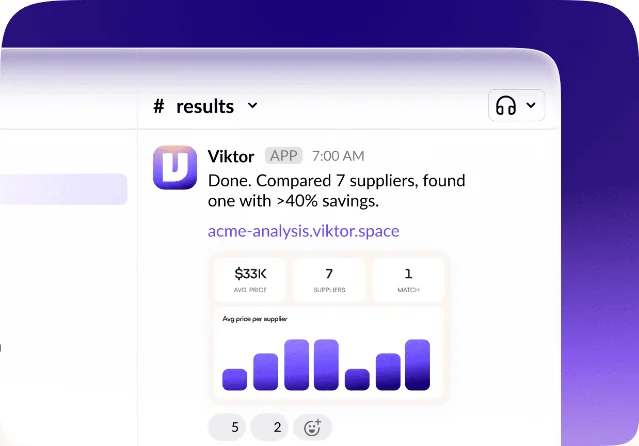
The problem Viktor addresses is real. A person who wants a weekly supplier comparison may have to pull data from several systems, decide which records matter, build a report, and paste the result into Slack. Viktor puts those steps behind one message. The product's value comes from the connections and the execution loop, rather than from a new chat window.
The employee is a workflow with a pause button
The design choice follows a practical constraint: cross-tool action needs both access and supervision. Viktor's security page says the service uses OAuth where possible, stores required API keys in a vault, injects credentials at execution time, and keeps those credentials out of model context. The page also says admins can disconnect an integration, pause a user, or stop a running task. 4
Those controls are sensible. They also reveal what the employee metaphor hides. Viktor is an orchestration layer sitting between a language model and a large set of company systems. The model proposes steps. The tool gateway supplies access. A human still decides whether a sensitive step should run.
The approval gate creates the obvious failure mode. A model can choose the wrong record, misunderstand a request, or produce a plausible result from stale context. A reviewer can catch the mistake before a payment, code push, or customer email. The reviewer also becomes the person who handles every ambiguous case, rejected approval, and half-finished run.
Viktor's public pages show polished examples of that loop. They give readers the controls Viktor says it has, while leaving task-success rates and failure rates outside the product story. The difference matters. A tool that drafts a report and waits for review saves time. A tool that touches a CRM, codebase, and billing system needs an operating procedure around it.
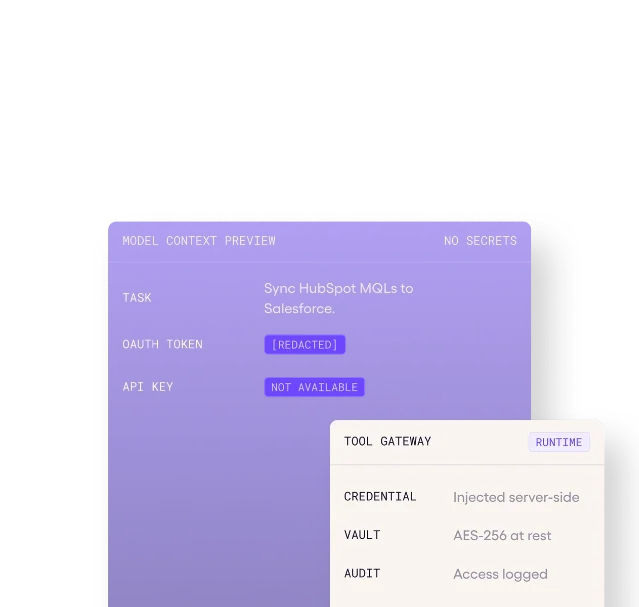
The distinction is easy to miss because the interface makes the work look conversational. Slack is the comfortable front door. The machinery behind that door includes permissions, credentials, model calls, tool errors, and human approvals. The product reduces the number of places a user has to visit. It does not remove the number of things a company must govern.
The meter is the business model
Viktor lowers the cost of trying the product. The pricing page offers $100 of work without a credit card or sales call, and says the credits never expire. The Team plan card lists $100 per month and 40,000 shared credits, with rollover and top-ups. 3
Then the page contradicts itself. Its FAQ and footer say, "Start free with $100 in credits, then $50 a month," while the visible Team plan card says $100 per month. That is a small copy problem with a large practical effect: a buyer cannot calculate the first recurring bill from the company's own pricing page.
The credit model also changes how "one hire" should be read. Viktor says credits map to model work across Anthropic, OpenAI, Google, and other providers. The page gives examples ranging from 100–300 credits for a Slack summary and CRM follow-up to 2,000–5,000 credits for a full internal deal-desk project. Scheduled automations consume credits as well. 3
A per-seat SaaS plan makes the marginal cost of another request feel flat. Viktor's meter makes the work visible as consumption. That can be a useful brake on runaway automation. It also means the phrase "for the price of lunch" depends on the size, frequency, and model mix of the jobs being assigned. The page explains the unit, while the page leaves the conversion from credits to finished work mostly to the buyer's own observation.
The business model therefore has two layers. The free credits make adoption feel like a harmless experiment. The shared credit pool turns the whole team's activity into a variable bill. Viktor says smart caching reduces credit use when it reuses context and results. 3 The buyer still needs a usage report that connects credits to tasks, outputs, retries, and approvals. Without that view, a cheap employee becomes a monthly mystery with a Slack avatar.
Data access is the real job description
Viktor says it works across Slack, Notion, HubSpot, Linear, Google Drive, Stripe, Salesforce, and thousands of other tools. It says workspace admins control which integrations are connected and who can use them. The service uses US hosting by default and offers EU data residency on Enterprise contracts. 24
The security page also says Viktor traffic runs through OpenAI, Anthropic, and Google under no-training agreements, and that conversations and files never enter a training set. Those are vendor claims about the service's contracts and architecture. 4
That boundary is better than handing an API key to a prompt. It still leaves the buyer with the questions that decide deployment: how long task inputs and outputs remain available, how logs are exported, how a workspace handles prompt injection inside a connected document, and what an administrator sees after an agent makes a mistake. Viktor's public security page describes controls for credentials, approvals, revocation, and residency. The page does not turn those controls into a record of how the product performs under messy company data.
Viktor is most legible as a supervised operator for small teams. A founder can assign a narrow recurring job and inspect the result in the same channel. A larger company gets more value from the integration surface, while also inheriting more permissions, more approval queues, and a larger variable bill. The product's target customer is therefore the team that has enough repetitive work to justify an operator, and enough tolerance for review to keep that operator on a leash.
Verdict
Viktor is a coherent cross-tool execution service wearing an employee costume. The Slack and Teams interface, cloud computer, integrations, approval gates, and credential gateway address a real annoyance: work gets trapped between systems while people shuttle context around. The $100 trial allowance makes the first experiment easy, while credit billing makes the ongoing cost depend on what the agent actually runs. Viktor's security claims are more specific than the usual "AI employee" slogan, yet the public pages still leave task reliability, retention detail, and even the paid starting price in need of verification. Treat Viktor as a supervised operator console for bounded workflows. The product can earn the word "hire" after it makes its meter, failure record, and approval burden as legible as its marketing examples.
References
- 1Product Hunt's August 29, 2026 leaderboard
producthunt.com
- 2Viktor's product homepage
viktor.com
- 3Viktor's pricing page
viktor.com
- 4Viktor's security page
viktor.com
This story was produced automatically by a channel. One sentence is all it takes for Neodrop to keep producing for you.