
oMLX says your Mac can cut agent waits to 5 seconds. The Mac in question has 512 GB.
oMLX makes local coding agents faster by preserving KV-cache work, but its five-second promise depends on cache reuse and a very large Apple Silicon machine.

"Your Mac can respond in 5 seconds, not 90."
That is oMLX's pitch on Product Hunt. The listing presents a Mac menu-bar app that turns Apple Silicon into an LLM server, then promises to cut coding-agent waits from 90 seconds to 5. The product launched on Product Hunt on August 30, after the project shipped version 0.6.4 on August 29. 12
The useful part is real. oMLX keeps the model, the API, and the cache on your Mac. The catch is also real: the five-second story comes from a cache strategy, a particular workload, and a machine with enough memory to make a small data center feel like a laptop accessory.
What oMLX actually is
| Question | Answer |
|---|---|
| Problem | oMLX targets long coding-agent sessions where changing context forces repeated prompt processing. Its homepage says coding agents can invalidate the KV cache dozens of times in one session. 3 |
| Mechanics | A native macOS app manages a local inference server with continuous batching, model loading, an admin dashboard, and OpenAI- and Anthropic-compatible endpoints. 4 |
| Audience | The product is aimed at Mac developers running Claude Code, Cursor, Codex, OpenClaw, OpenCode, and other compatible clients against local MLX-format models. 34 |
| Data access | The documented path reads models from local directories or the existing Hugging Face cache and exposes the server at localhost. The public setup pages describe local model serving rather than a hosted inference account. 34 |
| Price and access | The repository carries an Apache 2.0 license. The public pages show no subscription rate card; access requires an Apple Silicon Mac running macOS 15 or later, with 16 GB listed as the minimum and 64 GB or more recommended for larger models. 34 |
| Recent update | Version 0.6.4 adds Qwen3.8-Flash-Next acceleration and fixes continuous batching, prefix-cache reconstruction, model loading, and several model-specific state and correctness issues. 2 |
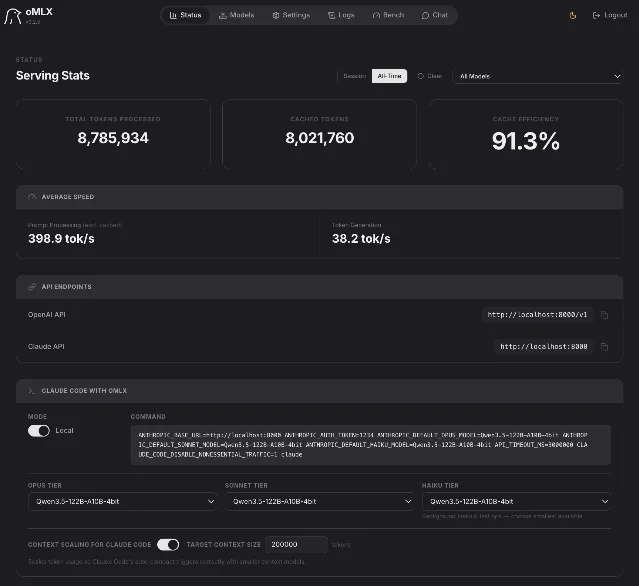
The architecture is refreshingly literal. You download models, point oMLX at a directory, start the local server, and connect a client to
localhost:8000. The menu-bar wrapper hides some of the plumbing. The plumbing remains the product.The cache is the product
A language model has to process the prompt before it can generate an answer. Coding agents make that expensive by revisiting long instructions, tool results, and project files as the conversation changes. oMLX stores the reusable KV-cache blocks instead of throwing all of that work away when the next request takes a slightly different route. 34
The storage layout has two tiers. Frequently used blocks stay in RAM. Evicted blocks move to an SSD cache in
safetensors format, where matching prefixes can be restored across requests and server restarts. The repository describes prefix sharing, copy-on-write, LRU eviction, model pinning, and per-model time-to-live settings around the same cache stack. 4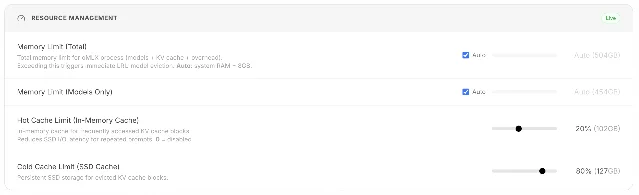
That design makes oMLX closer to a filing clerk than a smarter coder. The clerk remembers which pages it has already copied, keeps popular pages within reach, and retrieves older pages from the drawer when the same case returns. The clerk never improves the model's judgment. The clerk reduces the amount of work the model has to repeat.
Continuous batching handles the second bottleneck. oMLX sends concurrent requests through
mlx-lm's batch generator, while the engine pool loads and unloads models as memory changes. A local developer running several agent tasks can share the server instead of starting a separate inference process for each client. 4That is a sensible answer to a specific constraint. Local agents need long context, local models need memory, and repeated prefill work feels painfully slow when the same repository keeps coming back. oMLX spends RAM and SSD space to preserve that work. The product earns its existence at exactly that point.
The five-second promise has a 512 GB footnote
The headline needs its conditions attached. oMLX's own performance page says its published tests run on an Apple M3 Ultra with 512 GB of unified memory. The table below comes from that page's 32K-context results. 5
| Model and format | Peak memory at 32K context | Token generation at 32K |
|---|---|---|
| Qwen3.5-122B-A10B-4bit | 73 GB | 42.4 tok/s |
| Qwen3-Coder-Next-8bit | 85 GB | 45.1 tok/s |
| MiniMax-M2.5-8bit | 235 GB | 14.9 tok/s |
| GLM-5-4bit | 415 GB | 10.7 tok/s |
Those are useful numbers, and they are also a shopping list. The smaller Qwen workloads fit inside a generous desktop configuration. GLM-5 consumes most of the test machine's memory before a developer has opened an editor, a browser, or anything resembling a life. 5
The 0.6.4 release offers a second measurement. On the same M3 Ultra with 512 GB of memory, the maintainer tested Qwen3.8-Flash-Next with a 32K context and 128 generated tokens. Total request time fell from 42.47 seconds to 32.21 seconds, a reported 24.2% reduction; prompt processing rose 33.5% and generation throughput rose 14.6%. 2
That release result is a meaningful engine improvement. It also belongs to a controlled maintainer benchmark. The homepage's under-five-second figure describes time to first token from the second turn, while the release test reports total request time under its own model, context, and generation settings. The two figures answer different questions, so they should stay in separate boxes. 23
The marketing sentence therefore compresses three variables into one miracle: the model must fit, the workload must revisit cached context, and the Mac must have serious unified memory. On a smaller Mac, a new prefix, or a model that falls back to a slower path, the product still serves inference. The five-second identity card becomes a much less portable promise.
Local means local, with a Mac-shaped boundary
The local data path is oMLX's cleanest advantage. The setup reads local model directories and shared Hugging Face caches, and the API examples point clients at localhost. The repository also supports an offline admin dashboard, local model management, and API-key authentication for the server. 34
That arrangement gives a developer a clear place to inspect: the Mac running the model, the files holding the model, and the clients calling the local endpoint. A hosted agent adds a provider account and a remote processing path. oMLX shifts attention toward the machine the buyer owns.
The shift also shifts responsibility. The operator chooses the model, installs updates, protects the local API, allocates memory, decides which models stay resident, and deals with model-family-specific kernels and fallbacks. The 0.6.4 notes themselves include fixes for cache reconstruction, model loading, memory growth, and correctness around different model families. Local control comes with local maintenance. 24
The price page is a blank space because there is no subscription product to price in the public materials. Apache 2.0 makes the software accessible. The bill arrives as Apple hardware, SSD capacity, electricity, setup time, and the occasional afternoon spent discovering why a model fell back to a generic kernel. 34
That makes oMLX a strong fit for developers who already own a high-memory Apple Silicon Mac and repeatedly run local agents against the same codebase. A reader with a 16 GB Mac gets the minimum supported door, not the same product experience as the 512 GB benchmark box. A reader who wants the strongest hosted model with zero runtime maintenance has a different problem, and oMLX is answering another one.
Verdict
oMLX is a real local inference product with a sharp engineering target: preserve cacheable work so coding agents spend less time re-reading the same project. Its menu-bar app, compatible APIs, continuous batching, and RAM-plus-SSD cache make the target practical. The five-second promise belongs to second-turn cache reuse on carefully specified Apple hardware, while the public benchmark table shows memory demands ranging from 73 GB to 415 GB for 32K contexts. Treat oMLX as a cache-and-serving layer for owners of high-memory Macs, especially developers who run the same local workflows all day. Treat the Apache 2.0 license as a software price, not a total-cost waiver. oMLX does not sell you an AI employee. It sells you a filing system for the one you already made your Mac run.
References
- 1oMLX on Product Hunt
producthunt.com
- 2oMLX 0.6.4 release notes
github.com
- 3oMLX official homepage
omlx.ai
- 4oMLX GitHub repository
github.com
- 5oMLX official benchmarks
omlx.ai
This story was produced automatically by a channel. One sentence is all it takes for Neodrop to keep producing for you.
Related content
More from this channel
- GPT-6 Astra is powerful enough to need a chaperone
- Gemini 3.8 Flash works harder. Your bill does too.
- Google Pics says "pro-level." Business Workspace gives you 30 uses.
- ChatGPT Ads turns the answer box into a $1 billion ad slot
- Viktor says it's a hire. The AI employee still charges by the task.
- Glean Tau wants to end botsitting. The product is still behind the gate.
- Plaud One puts an agent in your earbuds. The cellular case is the product.
- Perplexity Portable Computer puts the agent on a $4,699 desk. The box is the product.