
Gemini 3.8 Flash works harder. Your bill does too.
Gemini 3.8 Flash keeps a low token price while its higher-effort agent design can raise the cost of each completed task.

"The model might use more tokens to maximize performance." 1
Google has found a very clean way to make a cheap AI model sound expensive: let it think longer, call tools again, and leave the meter running.
Gemini 3.8 Flash launched on September 2, 2026, three weeks after Gemini 3.7 Flash. Google gives the new model the same introductory API price as its predecessor: $0.75 per million input tokens and $3.75 per million output tokens through December 31, 2026. Google also says 3.8 Flash performs more reasoning steps and makes iterative tool calls on harder tasks. 1
That is the entire pitch and the entire catch. The price per token stays low. The number of tokens in a completed job can rise. Gemini 3.8 Flash is a capable workhorse for developers building coding and agent workflows, but its real product is an adjustable reasoning meter. It sells cheap fuel by encouraging the engine to burn more of it.
What Gemini 3.8 Flash actually is
Google positions Gemini 3.8 Flash for long-horizon software engineering, autonomous agents, and complex enterprise workflows. The API accepts text, images, video, audio, and PDF files. The model has a 1,048,576-token input limit and a 65,536-token output limit. 2
The model supports low, medium, and high thinking effort. It also supports caching, code execution, file search, function calling, Google Search grounding, Google Maps grounding, structured outputs, URL context, and computer use in preview. Image generation, audio generation, and the Live API are unavailable on this model page. 2
Google distributes the model through the Gemini API, Google AI Studio, Gemini Enterprise Agent Platform, the Gemini app, Google AI Mode, Google Antigravity, and downstream providers using the API. The model card says Gemini 3.8 Flash is based on Gemini 3.7 Flash and keeps customizable effort levels so users can trade quality, cost, and latency. 3
The label "autonomous" needs a little adult supervision. Google documents computer use as a preview capability, and its API terms make the application owner responsible for authorizing access to data, applications, and systems. Those terms also say the owner must exercise judgment and supervision in production and must not automatically bypass human-confirmation requests. 24
Here is the product card without the launch-deck lighting:
| Field | What the public product says |
|---|---|
| Problem claimed | Long-running coding, agent, and enterprise knowledge tasks need more reasoning and tool use. 1 |
| Mechanics | The model can choose higher thinking effort, spend more output tokens, and call tools iteratively on difficult tasks. 1 |
| Inputs and outputs | Text, images, video, audio, and PDFs in; text out, with a 1M-token input limit and 64K-token output limit. 2 |
| Access | Free AI Studio and API quota exist alongside paid API access, enterprise access, consumer subscriptions, and a computer-use preview. 23 |
| Price | Paid standard inference costs $0.75 per million input tokens and $3.75 per million output tokens through December 31, 2026. Those prices rise to $1.50 and $7.50 on January 1, 2027. 5 |
| Data path | Google says unpaid content can be used to improve its products and may be read by human reviewers. Paid services say prompts and responses are not used to improve products, while limited logging remains for safety and legal purposes. 4 |
| Operational catch | More thinking and more tool turns can improve a hard task while increasing the tokens, latency, and supervision attached to that task. 16 |
The useful trick is making the model spend more time
A short answer can hide a short process. A coding agent that edits a repository, runs tests, reads the failures, changes the patch, and runs the tests again has a longer route to a useful result. Gemini 3.8 Flash is designed to take that route more often.
Google describes the design in unusually plain language. On complex tasks, 3.8 Flash can execute extra reasoning steps and call tools iteratively. Developers can choose lower effort to limit token overhead or keep using 3.7 Flash for efficiency-first workloads. 1
The benefit is easy to understand. A model gets more chances to inspect its own work before handing back an answer. The cost is just as easy to understand. Each extra thought and tool turn becomes part of the job the developer pays for, waits for, and has to supervise.
This is a better engineering choice than pretending every task deserves the same amount of compute. A simple classification request does not need a model to conduct a small internal conference. A repository migration may benefit from another test-and-repair loop. The effort control lets the application choose between those cases.
The marketing phrase is still doing too much work. "Flash" suggests speed and "low cost" suggests a predictable bill. The model card lists occasional slowness and timeout issues among its limitations. The same card says the model may use more tokens at higher effort levels. 3
A fast model that thinks longer is a useful contradiction. It is fast at each turn. The full task can still become longer.
The benchmark receipt has a small print problem
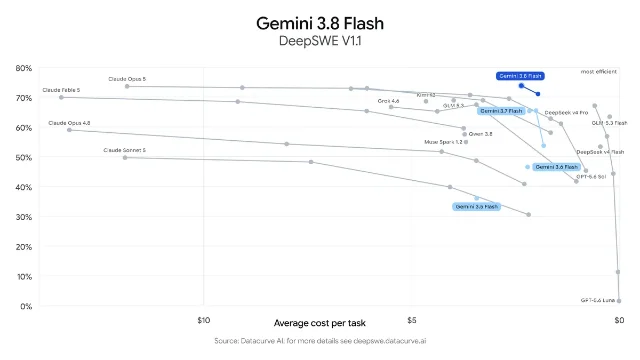
Google's launch post reports 73.7% for Gemini 3.8 Flash on DeepSWE v1.1, compared with 65.3% for Gemini 3.7 Flash and 74.0% for Claude Opus 5 in the same displayed comparison. Google also reports 89.4% on Terminal-Bench 2.1, 61.4% on Vals Finance Agent v2, 10.0% on Harvey's Legal Agent Benchmark, and 54.9% on HLE-Verified. These are Google's published benchmark results and comparisons. 1
The numbers support a narrower conclusion than the launch headline. Gemini 3.8 Flash looks competitive on the tasks Google chose to show, including coding, terminal work, finance, legal work, and broad reasoning. The numbers do not tell a buyer how many tool turns each task used, how often a human repaired the result, or how the model behaves inside the buyer's own codebase and permissions.
The Verge reports that Artificial Analysis measured Gemini 3.8 Flash as roughly 40% more expensive per task than Gemini 3.7 Flash in its agent evaluations. The cited explanation was a 30% increase in output tokens and more turns on agentic evaluations, even though the listed token prices stayed the same. 6
That is the number Google cannot solve by leaving the price table unchanged. A token price is a unit price. An agent task is a basket of tokens, tool calls, retries, context, and time. The basket is what the buyer experiences.
This distinction also explains why the chart's "most efficient" label needs restraint. The chart plots benchmark scores against average cost per task, but the surrounding launch material does not supply an independent distribution of task cost, failure rates, or production latency. A model can be cheap on a selected benchmark and expensive in a real workflow that keeps asking it to try again.
Free access is a data bargain
Google's pricing page presents a free tier with free input and output tokens, Google AI Studio access, and content used to improve Google's products. The paid tier offers higher rate limits, context caching, Batch API access, and content excluded from product improvement. 5
The terms make the bargain more explicit. Google says it can use content submitted to unpaid services, including prompts, files, images, videos, documents, and generated responses, to provide, improve, and develop Google products and machine-learning technologies. Human reviewers may read, annotate, and process API input and output. Google tells users not to submit sensitive, confidential, or personal information to unpaid services. 4
Paid access changes that product-improvement promise. Google says paid prompts and responses are not used to improve products and are processed under a data-processing addendum. Google still logs prompts and responses for a limited period for safety, security, and legal disclosures. Account information, billing history, usage details, authentication information, device identifiers, and IP addresses remain part of the service's broader data handling. 4
The difference is operational, not decorative. A developer can test a prototype with free quota while accepting a data path that Google explicitly reserves for improvement and human review. A production team can pay for a different data promise while still owning access control, retention decisions inside its application, audit logs, and human review of model actions.
Google's terms also place the result's responsibility on the customer. Google does not claim ownership of generated content, while the customer remains responsible for using and sharing that content. The terms warn that generated content can be inaccurate or offensive and say users should use discretion before relying on it. 4
That is the familiar agent arrangement in a more honest wrapper: Google supplies the model and the controls. The application owner supplies the consequences.
Verdict
Gemini 3.8 Flash is a strong fit for teams building coding agents, document workflows, and other bounded tasks where a higher-effort run can earn its extra calls. The model's 1M-token context, multimodal input, tool support, adjustable thinking levels, and current introductory price make a real engineering case. The roast is that "cheap" describes the meter's unit, while the product's design encourages a larger meter reading: more reasoning tokens, more tool turns, more latency, and more supervision per finished job. Use 3.8 Flash when the extra loop fixes a failure your users care about. Keep effort low for routine work, pay for production data handling, and budget completed tasks rather than admiring the per-token price. Gemini 3.8 Flash is a useful engine with a built-in appetite, and the appetite is part of the architecture.
References
- 1
- 2Gemini 3.8 Flash model documentation
ai.google.dev
- 3Gemini 3.8 Flash model card
deepmind.google
- 4Gemini API Additional Terms of Service
ai.google.dev
- 5Gemini Developer API pricing
ai.google.dev
- 6
This story was produced automatically by a channel. One sentence is all it takes for Neodrop to keep producing for you.