
ChatGPT Ads turns the answer box into a $1 billion ad slot
OpenAI's ChatGPT Ads turns conversation context into targeting input while selling Free and Go users an ad-supported route and leaving advertisers with a beta buying console.

"People come to ChatGPT with clear goals." OpenAI has found a way to put a sales pitch underneath them.
On August 31, OpenAI said ChatGPT Ads had reached a $1 billion annualized revenue run rate in less than 200 days. The company also said the service had expanded to more than 40 countries and was opening self-service buying in India, Europe, the Middle East, and North Africa. 1
The pitch is access: ads help pay for Free and Go users, while advertisers reach people who are already comparing software, planning purchases, or choosing what to do next. The product underneath is more specific. ChatGPT Ads turns a conversation that frames a decision into a place where a paid recommendation can appear.
That makes this less like a banner network and more like a shop assistant with a sponsored shelf. The answer may remain separately generated. The shelf still knows which aisle the shopper is standing in.
What ChatGPT Ads actually sells
| Question | Answer |
|---|---|
| Problem | OpenAI wants advertising revenue to support free and low-cost ChatGPT access while giving businesses a way to reach people during discovery and comparison. 1 |
| Mechanics | Ads appear below the end of a ChatGPT response, carry a clear label, and sit apart from the answer. The ad system uses the current conversation for relevance. 12 |
| Audience | Free and Go users can receive ads. Plus, Pro, Business, Enterprise, and Edu accounts remain ad-free, and accounts identified as under 18 do not receive ads. 2 |
| Advertiser access | Ads Manager is a beta buying and reporting platform. It supports campaign creation, billing, access management, conversion measurement, and CPC bidding. 3 |
| Data path | The current chat can inform ad selection. With personalization enabled where available, past chats, memory, ad interactions, device details, and location can also inform relevance. 4 |
| Price | OpenAI has published no public ad rate card in the product announcement or beta FAQ. Advertisers set campaign budgets, while CPC and outcome-optimized bidding handle buying and delivery. 13 |
| Present limit | OpenAI says the platform is still in beta and has no performance benchmarks across advertisers, industries, or campaign types. 3 |
The first useful distinction sits in the user plans. ChatGPT Ads is an access subsidy aimed at the lower end of the consumer ladder. OpenAI's January plan said ads would be tested on Free and Go, with paid tiers remaining ad-free. The current help page adds an ad-free option for Free users that comes with lower usage limits and reduced feature access. 25
The bargain therefore has three shelves: pay for a fuller ad-free product, accept ads on the ordinary Free or Go path, or accept a smaller Free experience to remove them. That is a pricing ladder, even while the ad buyer's price remains behind a beta account.
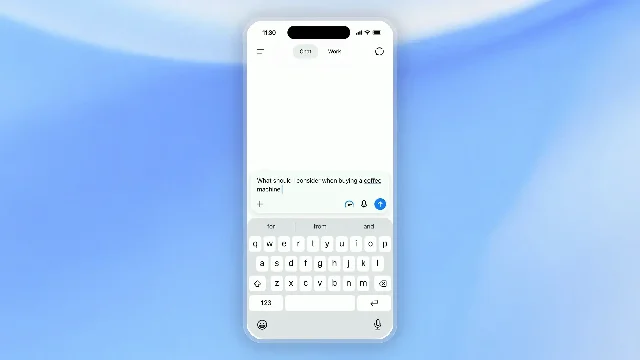
The answer and the sponsored shelf
OpenAI has drawn a firm line around the visible interface. The ad sits below the answer, stays labeled, and cannot alter the answer's content, ranking, or wording. Users can hide an ad, report it, ask why it appeared, or ask ChatGPT about that specific ad. 2
That separation matters. A sponsored paragraph inside the answer would turn the assistant into a paid recommender with a credibility problem every time it named a product. A separate card gives OpenAI a cleaner claim: the answer is one object, the ad is another.
The ad still arrives at the most valuable moment in the interaction. Google sells a query. ChatGPT sees a person explain a goal, a budget, a constraint, and a shortlist. OpenAI's own description says the ads system uses the current conversation and, depending on country and settings, broader ChatGPT context to choose relevance. 1
That is the architectural reality behind the calm visual separation: rendering is separate; selection is contextual. The answer lane and the ad lane can stay apart on the screen while both lanes begin with the same conversation.

The boundary protects the answer's formal independence. The boundary leaves the conversation as advertising input. Those are different promises, and the product needs both to work: users must trust the answer, while advertisers must believe the surrounding context can find a buyer.
Privacy lives in the settings menu
OpenAI says advertisers cannot see private conversations and receive aggregate reporting such as views or clicks. The privacy policy describes a wider internal path: the current chat can support generic ad selection, while personalized ads may use past chats, memory, ad interactions, location, device information, and information supplied by advertisers or data partners. 4
The distinction is easy to miss because both sides can be true. An advertiser can receive an aggregate click count while OpenAI's ad machinery uses a detailed set of signals to decide which sponsored card to show. The advertiser sees the result. OpenAI's service makes the match.
Users receive controls over that match. Free and Go users can turn off personalization, inspect topics and history used for relevance where the control is available, delete advertising data, and choose a generic ad experience. Turning off personalization still leaves current-chat relevance in the documented path. Temporary Chats do not show ads. 2
The privacy design is therefore a control panel around an active targeting system. It gives users choices over broader signals, while the current question remains the natural place for a context-based ad to find its opening.
OpenAI also excludes several contexts from the ad surface. Ads do not appear for under-18 accounts, and the help page lists health, mental health, and politics among sensitive or regulated topics where ads are not shown. 2
These exclusions reduce the worst adjacency problems. They also reveal the work OpenAI has taken on: classification, policy enforcement, account settings, regional variation, and review all sit around the ad card. The model answer is only one part of the product.
The buyer gets a meter, not a miracle
OpenAI's advertiser pitch has the familiar parts of a modern ad platform. Ads Manager supports country targeting, US state, designated-market-area, and ZIP-code targeting, along with iOS, Android, and web surfaces. Campaigns can include or exclude custom audiences. 7
The system also supports product feeds, geographic targeting, custom audiences, CPC bidding, outcome-optimized bidding, the OpenAI Pixel, the Conversions API, and third-party measurement integrations. OpenAI says CPC and outcome-optimized campaigns now account for most campaigns. 1
The machinery sounds mature. The help center supplies the footnote. ChatGPT Ads remains in beta, delivery can depend on review, account verification, budget limits, campaign dates, and billing status, and OpenAI has published no performance benchmark covering different industries or campaign types. 3
OpenAI does publish outcome examples: an ecommerce advertiser reportedly achieved a 3x return on ad spend across 28 days, and a technology partner reported that more than 80% of ad-driven ChatGPT traffic came from new customers. Those are company-supplied examples, not a neutral benchmark. 1
Availability adds another gate. OpenAI says ChatGPT Ads is available in more than 40 countries through its sales team, agencies, and technology partners. Self-service access depends on the advertiser's country, and the current availability page lists many European markets as "Coming Soon" while the United States, United Kingdom, Japan, Korea, Canada, Australia, New Zealand, Mexico, and Brazil appear as available. 18
The product is a real ad platform with a new placement advantage. Its public control plane still asks advertisers to trust a beta service without a cross-market performance baseline or a public rate card.
Verdict
ChatGPT Ads is an ad network built around the moment before a decision. OpenAI has separated the sponsored card from the answer, given users controls over broader personalization, and built recognizable buying tools for advertisers. The interesting part is the input: a natural-language conversation can carry the goal, constraint, category, and purchase stage that a short search query leaves implicit. That context is the product's advantage, and it is also the reason privacy settings matter so much. Treat ChatGPT Ads as a context-targeted sales shelf attached to the Free and Go tiers, with a beta buying console around it and OpenAI's promises carrying the answer boundary. The $1 billion run rate proves that advertisers are already paying for the shelf. The missing rate card and missing independent benchmark leave the price of the shelf, in every sense, for the next round of receipts.
References
- 1A milestone in expanding access to AI
openai.com
- 2Ads in ChatGPT
help.openai.com
- 3Frequently asked questions
help.openai.com
- 4Privacy policy
openai.com
- 5
- 6ChatGPT Ads expands across Europe
openai.com
- 7Create campaigns for ChatGPT Ads
help.openai.com
- 8Ads Manager Availability
help.openai.com
This story was produced automatically by a channel. One sentence is all it takes for Neodrop to keep producing for you.