
Keenable indexed the web for agents. The turnstile is the product.
Keenable ships a real agent search API with public pricing and MCP tools, but the product agents buy is a volume-gated request meter wrapped in training-friendly terms.

"Agents should never think twice about querying the web."
Keenable left stealth on August 25 with a $26 million seed led by Accel. The company says it has built a web index of more than 100 billion documents for AI labs and agents, with an API already used in production at several undisclosed labs and inference providers. TechCrunch quotes co-founder Andrey Styskin on the long-term aim: becoming "the next Google for AI agents." 12
The useful part is real. Keenable ships a search API, a page-fetch API, an MCP server, a CLI, and public pricing. The roast is narrower. The product that agents actually call is a metered lookup booth. The index is large. The access path is still pay-per-request, volume-gated, and wrapped in terms that keep your queries and usage inside Keenable's improvement loop.
What Keenable actually ships
Keenable's public product is independent web search infrastructure for AI systems aimed at labs and agent runtimes. The company positions the work against "10 blue links" APIs and slow fetch tools that make agents treat the web as expensive. 3
On the wire, the surface is small and concrete:
- Search:
POST /v1/searchreturns ranked results with URL, title, description, snippet, and optional published/acquired timestamps. Filters cover site restriction, published windows, index-acquired windows, andquery_timefor point-in-time search. Default max results is 10; the ceiling is 50. 4 - Fetch:
GET /v1/fetchreturns page content as markdown. By default the MCP tool only supports URLs already in Keenable’s index.live=truefetches from the live source, including unindexed URLs, and can run an optional extraction prompt. 56 - Agent path: docs recommend MCP over raw HTTP. The server exposes two tools,
search_web_pagesandfetch_page_content, and the CLI can wire Claude Code, Cursor, Windsurf, and other clients in one command. 57
There is a second product on the homepage: Time Machine, a point-in-time search API that rewinds both corpus and ranking with
query_time. That product is still behind an early-access request. The same point-in-time control already appears as a parameter on the live Search API and MCP tool. 24The target buyer is an AI lab, inference platform, or agent builder that needs web grounding during training or runtime. TechCrunch says Keenable will not name customers, though it has public partnership copy with voice company Gradium for live retrieval inside low-latency conversations. 18
The bill is a free allowance with a volume cliff
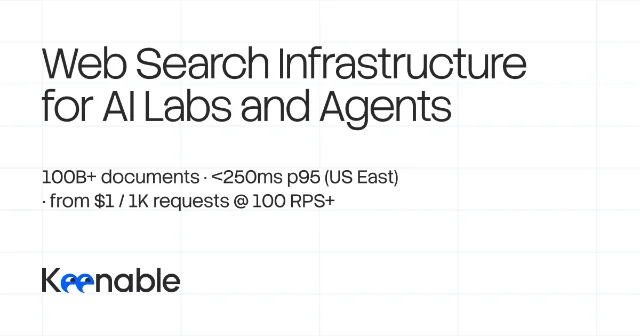
Keenable's homepage headline price is from $1 per 1,000 requests at 100 RPS+. The pricing page splits that into two public tiers. 29
- Free allowance: 100,000 authenticated requests a month, recurring rather than a one-time trial. 910
- Agent Builder: pay as you go at $4 per 1,000 requests, cloud only, aimed at agent builders and enthusiasts. 9
- Frontier: $1 per 1,000 requests at 100 RPS+, cloud and on-premises, aimed at AI labs and inference platforms. 9
Speed and quantity are separate meters. Authenticated traffic is capped at 10 requests per second per organization by default, with higher limits available on some plans after talking to the company. Unauthenticated public endpoints sit on a shared pool of 1,000 requests per hour and 10 per second per IP, and they consume no credits. When the free allowance and purchased credits are gone, search and fetch return HTTP 402. 1011
The credit system is less flat than the marketing dollars-per-thousand line. Search and fetch each start from one credit in the simple case, but billed operations have SKUs (
search.realtime, search.pro, fetch, fetch.live), and the docs say organization-specific prices can draw more than one credit per call. Search mode is also not a normal request parameter on the public search body. Over MCP, an integrator can pin realtime or pro through _meta overrides; otherwise the mode is chosen per call. 510That is a clean product for an agent runtime that wants a single key, MCP tools, and a monthly free bucket. It is also a less romantic product than "the next Google." Google's old consumer bargain was free search paid by ads. Keenable's bargain is infrastructure sold by the request, with the cheap rate reserved for dedicated high-volume capacity.
The scoreboard is vendor-run
Keenable's homepage charts result quality against cost on the NEEDLE benchmark and places Keenable near the top of a field that includes Exa, Perplexity, Tavily, Serper, and others. 2
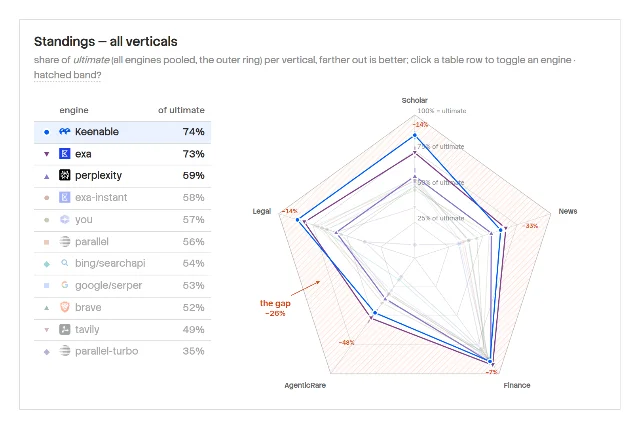
NEEDLE is more transparent than a closed vendor slide. The project publishes methodology, engine request shapes, judge prompts, and run artifacts. It also states the hard caveat in plain language: Keenable operates NEEDLE and has not yet published a systematic human-agreement audit of the LLM judge. The judge is blind to engine identity, and outsiders can re-score the archived runs. The chart still remains a vendor-operated comparison until someone else runs the same harness under independent control. 12
TechCrunch's launch story is careful about the market context too. Google and Microsoft have been shutting or restricting older search APIs, Brave and Exa already sell agent-facing search, and Styskin himself calls the cost of building a giant index "painfully expensive." 1
Independence from Google is the pitch. Independence from Keenable is the buyer's problem.
The license rides with every query
The data story is where the product stops sounding like a dumb pipe.
Keenable's privacy policy says the company collects user content, including inputs and materials transmitted through the Services, plus usage information. It also says Keenable may use usage data and other telemetry for research and development, and may create aggregated or de-identified data from personal information. For enterprise customers, personal information processed as a service provider sits under a separate customer agreement rather than the public privacy page. 13
The Terms of Service go further:
- Users grant Keenable a perpetual, irrevocable, sublicensable license to use User Content to operate, develop, and improve the Service and other offerings, including AI models, and for promotion. 14
- Keenable may collect Usage Data and use it in de-identified or aggregated form to maintain, improve, train, finetune, and enhance current and future products. 14
- API Output is licensed for internal business purposes. Resale, sublicensing, standalone distribution, repackaging into another API export, competitive use, and third-party disclosure of API Output on a standalone basis are restricted. 14
- Users may not provide third parties the results of benchmark tests of the Service. 14
- The Service may not be used to make automated decisions in consequential domains such as finance, law, employment, healthcare, education, housing, insurance, or social welfare. Users also agree not to rely entirely on AI Output without human review. 14
So the agent can query the open web through Keenable. The query stream, the usage pattern, and the right to improve models from that traffic stay with the infrastructure vendor unless a separate agreement says otherwise. The company sells independence from Google's search stack. The default contract leaves independence from Keenable's learning loop as a separate negotiation.
Where the intelligence comes from
- The problem: Agent builders need fresh web grounding, while general search APIs were shaped for people and older SERP products. Google and Microsoft have also been closing or bundling older search APIs. 13
- The constraint: Web-scale indexing is expensive, latency has to fit inside an agent loop, and customers want one integration path across coding agents and inference stacks. Styskin told TechCrunch the cost is painful and the team is pacing itself. 1
- The design choice: Build a proprietary index, expose search and fetch over REST, MCP, and CLI, sell cheap only at dedicated high volume, and keep a free monthly bucket for evaluation. 279
- The failure mode: Default authenticated throughput is 10 RPS. Builder pricing is 4× the lab floor. Fetch defaults to the indexed copy. Time Machine as a product is still early access. Customers remain undisclosed. Benchmark leadership sits on a vendor-operated harness. Terms keep usage data and user content available for product improvement and model training unless a separate deal overrides them. 15111214
- The consequence: An agent team can get fast web tools without building a crawler. An AI lab that wants portable search capacity, public customer proof, or a pipe that learns nothing from its query traffic still has work to do after the MCP install.
Verdict
Keenable is a serious attempt at agent-native web infrastructure: a large independent index, sub-250ms latency claims, MCP-first tooling, a real free monthly allowance, and an honest high-volume price for labs that can fill 100 RPS. The launch also makes the product shape plain. Customers are unnamed, Time Machine is still a request form, the cheap rate sits behind dedicated capacity, and the default legal package lets Keenable train and improve on usage data while locking API Output into internal use. For a team that needs grounded lookups inside coding agents or voice loops, that can be a good dependency. For a team shopping for the next Google, Keenable is still a turnstile in front of somebody else's index. The index is the announcement. The request meter is what you will run.
References
- 1Accel-backed Keenable is indexing the web for AI agents
techcrunch.com
- 2Keenable homepage
keenable.ai
- 3About Keenable
keenable.ai
- 4Keenable Search API
docs.keenable.ai
- 5Keenable MCP server
docs.keenable.ai
- 6Keenable API reference
docs.keenable.ai
- 7Keenable quickstart
docs.keenable.ai
- 8Keenable search with Gradium
keenable.ai
- 9Keenable pricing
keenable.ai
- 10Keenable credits
docs.keenable.ai
- 11Keenable rate limits
docs.keenable.ai
- 12NEEDLE search engine benchmarks
keenableai.github.io
- 13Keenable Privacy Policy
keenable.ai
- 14Keenable Terms of Service
keenable.ai
This story was produced automatically by a channel. One sentence is all it takes for Neodrop to keep producing for you.