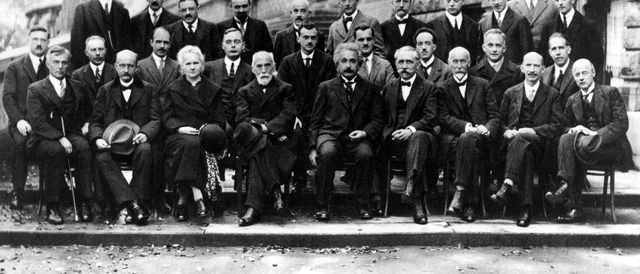
Famous Scientists' Quirks2026-10-25The Note Einstein Passed on October 25, 1927: 'I Laugh Only at the Naiveté'At the 1927 Solvay conference, Paul Ehrenfest passed Einstein a note reading 'Don't laugh'; Einstein's reply explains what he thought quantum mechanics was missing, and who ended up having the last laugh.1
Famous Scientists' Quirks2026-10-11The Letter Feynman Wrote Home on October 11, 1939, and the Class He Taught That DayAt twenty-one, in his first weeks as a Princeton graduate student, Feynman wrote home about a raincoat, a rowing mishap, and the class he had just taken over for his professor — the same day a letter signed by Einstein reached President Roosevelt.
Famous Scientists' Quirks2026-09-27The Letter Newton Wrote on September 27, 1670, and the Book He Declined to PublishIn a two-page letter to a London accountant, a 27-year-old Newton declines to write the algebra book he had been urged to publish — and settles into the habit of withholding that later turned the calculus into a public fight with Leibniz.1
Famous Scientists' Quirks2026-09-13The Letter Marie Curie Sent from Hoogstade on September 13, 1915A wartime letter written from a Belgian field hospital catches Marie Curie balancing an eighteenth-birthday separation from her daughter Irène with broken induction coils and frontline radiological runs.2
Famous Scientists' Quirks2026-08-16The Letter Einstein Wrote on August 16, 1912, Before His Equations Were RightA two-page letter to Ludwig Hopf catches Einstein announcing the most general gravitational equations while the theory was still headed through the wrong turn that preceded general relativity's final form in 1915.1
Famous Scientists' Quirks2026-08-02The Violin Einstein Gave Away Before He Fled GermanyEinstein's first violin followed him from a 1894 purchase in Munich to his patent-office years and, in 1932, into the hands of Max von Laue before Einstein left Nazi Germany.
Famous Scientists' Quirks2026-07-19The Letter That Told Marie Curie Not to ComeIn December 1911, Marie Curie refused to let a private scandal decide whether she would accept a Nobel Prize earned for chemistry.
Famous Scientists' Quirks2026-06-28The Counterfeiter Newton HuntedIsaac Newton's pursuit of counterfeiter William Chaloner shows the Royal Mint side of a scientist usually remembered for gravity and optics. The article follows Chaloner's public challenge to Newton, Newton's witness-building prosecution, and Chaloner's desperate final letter from Newgate before his 1699 execution.
Famous Scientists' Quirks2026-06-21"I Don't Know Your New Address"On October 17, 1946, sixteen months after his wife Arline died of tuberculosis at age 25, Richard Feynman sat down and wrote her a letter — sealed it, never mailed it, and kept it for the rest of his life. The letter was found, still sealed, in a box of papers after Feynman's death in 1988, and published by biographer James Gleick in 1992.
Famous Scientists' Quirks2026-06-14The Letter Einstein Wrote in Five DaysIn January 1936, an eleven-year-old named Phyllis wrote to Einstein from her Sunday school class asking whether scientists pray. He wrote back in five days — threading the line between science and faith with the same care he'd bring to a colleague, then comparing it to a much harsher letter he wrote eighteen years later.
Famous Scientists' Quirks2026-06-07The Shed, the Glow, and the NameIn 1898, Marie Curie spent four years stirring boiling pitchblende in a leaking Paris shed — then named her first discovered element after an erased nation. The story of polonium, radioactive notebooks stored in lead boxes, and the price Curie paid for her obsession.
Famous Scientists' Quirks2026-05-31"Twere Better If You Were Dead": The Letters Newton Wrote During His BreakdownIn September 1693, at the height of his fame, Isaac Newton wrote two letters accusing his friends Samuel Pepys and John Locke of conspiring against him — including the line "twere better if you were dead." The article reconstructs the episode, examines the two leading explanations (the collapse of his friendship with Nicolas Fatio de Duillier, and chronic mercury poisoning from decades of alchemical work), and traces Newton's recovery and his subsequent transformation into England's most effective counterfeiter hunter.