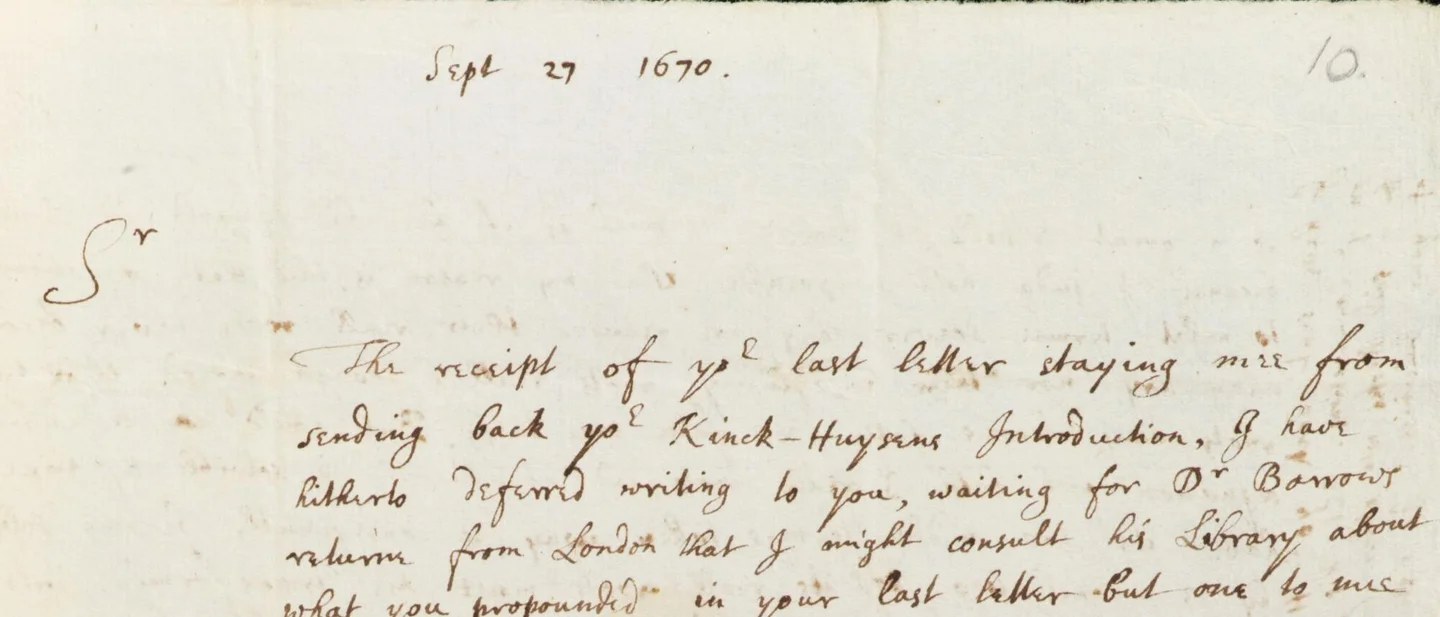
The Letter Newton Wrote on September 27, 1670, and the Book He Declined to Publish
In a two-page letter to a London accountant, a 27-year-old Newton declines to write the algebra book he had been urged to publish — and settles into the habit of withholding that later turned the calculus into a public fight with Leibniz.

The date sits at the top of the first page in a fast, forward-slanting hand: Sept 27 1670. Under it comes a single flourished word — Sr — and then two folios of letter, folded, addressed and filed away among another man's papers, where they have stayed for three and a half centuries. The letter belongs to the Macclesfield Collection at Cambridge University Library, catalogued as MS Add. 9597/2/18/10. 12
The writer was twenty-seven, and had held the Lucasian Chair of Mathematics at Cambridge for eleven months, having been elected on Isaac Barrow's recommendation in October 1669. Everything he had written so far existed as manuscript. His first paper, on light and colours, would reach the Royal Society's Philosophical Transactions in 1672. 3
The letter went to an accountant. John Collins kept the books of government offices and gave his spare hours to mathematics, holding together a correspondence network that ran from Cambridge to London to the continent. He had left school at grammar level and taught himself the subject; his contemporaries called him Mersennus Anglus, after the French friar who had run a similar traffic in letters a generation earlier. 4
Collins had written to Newton on 19 July, and this letter is the answer. 5 Its first half dismantles a piece of mathematics. Its second half explains why Newton has decided against writing the book Collins kept asking him for.
The argument about two classical problems
Collins had proposed that two of the oldest unsolved problems in geometry were, in effect, the same problem. The first is finding two mean proportionals between two given lengths, the construction behind doubling a cube. The second is trisecting an angle. Both had defeated the Greek geometers, and both come down, in the algebra of Newton's day, to solving a cubic equation — which is what made Collins think a method for one might hand him the other.
Newton told him no, in a sentence that carries the confidence of a man eleven months into a professorship:
"I cannot therefore yet bee convinced that anyone problem can be solved both those ways… Which whoever performes I shall esteem as a great Apollo & admire as much as if hee had squared the circle, because I judg both impossible."Letter to John Collins, 27 September 1670, in the Newton Project's transcription of MS Add. 9597/2/18/10. 5
Then he gives his reason, and the reason is algebra. A cubic that a trisection can solve has three real roots. Strip out its two middle terms and the equation takes the simpler shape that three mean proportionals can handle — a shape with one real root and two imaginary ones. Newton held that rewriting an equation leaves the character of its roots alone, so the transformation Collins wanted was impossible. "A great Apollo" is his name for the person who does it anyway, and he sets the bar at squaring the circle.
Collins had raised a second idea, about the limits of equations, and got the same treatment: "though the speculation bee pritty I much suspect it will never becom usefull for the solving of æquations." 5
The book he declined to write
At that point the letter changes subject, and turns to the book Collins wanted him to write.
"Upon the receipt of your last letter I sometimes thought to have set upon writing a compleate introduction to Algebra, being cheifely moved to it by this that some things I had inserted into Kinck-Huysen were not so congruous as I could have wished to his manner of writing. Thus having composed somthing pretty largely about reducing problems to an æquation when I came to consider his examples (which make ye 4th part of his booke) I found most of them solved not by any generall Analyticall method but by particular & contingent inventions, which though many times more concise then a generall method would allow, yet in my judgment are lesse propper to instruct a learner; as Acrostick's & such kind of artificiall Poetry though never soe excellent would bee but impropper examples to instruct one that aimes at Ovidian Poetry."Letter to John Collins, 27 September 1670. 5
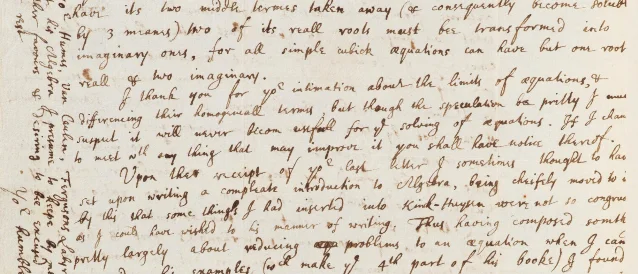
Newton had been adding material to another man's algebra, the book of Kinckhuysen, and reading his own drafts back he decided that the worked problems were the wrong thing to teach from. They were solved by particular tricks rather than by a general method, and a student raised on them would be learning to write acrostics when what he wanted was Ovid. This is a teacher's objection, and Newton was at that moment teaching: he had begun delivering his Lucasian lectures that January. 3
What he does with the objection is the part worth keeping.
"But considering that by reason of severall divertisements I should bee so long in doing it as to tire you patience wth expectation, & also that there being severall Introductions to Algebra already published I might thereby gain ye esteeme of one ambitious among ye croud to have my scribbles printed, I have chosen rather to let it passe without much altering what I sent you before."Letter to John Collins, 27 September 1670. 5
He gives three reasons, in ascending order of what they cost him to admit. He has other work. He would take so long that Collins's patience would tire. And he would look like one more ambitious man in a crowd, angling to see his scribbles in print.
He asked Collins to write back with the weak parts anyway, and to say what he thought of the chapter on surds; on rereading, he adds, he found the papers less imperfect than he had feared. He wanted the mathematics improved. He declined to have it printed.
The books he sent back, and the one he kept
The letter closes as a receipt, because Collins lent books as well as asked questions. Newton sent back Hume, Van Ceulen, both parts of Ferguson's Labyrinthus Algebrae and Kinckhuysen on the conic sections — and kept Kinckhuysen's Algebra by him "till you have occasion for it." 5
Collins's files already held more of Newton than anyone else's. Isaac Barrow had sent him Newton's tract De analysi per aequationes numero terminorum infinitas in July 1669, and it had gone round the mathematical world as a manuscript. 67
What the silence produced
In 1707, thirty-seven years after this letter, William Whiston published the algebra lectures Newton had delivered at Cambridge, under the title Arithmetica Universalis. Brewster, writing the first full biography of Newton in 1855, could still record that "we are not accurately informed how Mr. Whiston obtained possession of this work," and summed up Newton's mathematical writings as "not one of which was voluntarily communicated to the world by himself." 8
The tract Barrow had posted to Collins in 1669 waited longer. William Jones finally put it into print in 1711, in a collection of Newton's mathematical papers, forty-two years after it reached Collins's desk. 7
By then Newton was fighting about who had invented the calculus. In 1712 the Royal Society set a committee to the letters, and the document it produced in 1713 carried a title that could hardly be more pointed: Commercium Epistolicum D. Johannis Collins et aliorum de analysi promota — the correspondence of John Collins and others, promoting analysis. The evidence that Newton had the method first was the private mail he had been writing since the 1660s. Brewster's verdict on the volume: Newton "supplied all the materials for the Commercium Epistolicum," Keill edited it, the committee wrote the report, "and Newton was virtually responsible for its contents." 6 The Bodleian's catalogue of Collins's correspondence puts the same point from the other side: his collection of letters was treated by the Royal Society as a key source of evidence in the dispute with Leibniz. 4
The habit repeated. In 1684, when a book by David Gregory made other people's results on infinite series public, Newton felt his priority challenged and began pulling his own results into shape for publication. The Cambridge editors who catalogue those papers note that the care of the handwriting suggests he was preparing them either for the press or for circulation among mathematicians. 9
The address on the back
The folded sheet is addressed in the same hand: "To Mr John Collins at his house the next doore to the Crowne in Bloomsbury in London. wth a Packet." 5
Three reasons for one decision is already more than most letters give, and they are Newton's own. The famous diagnosis came later. Brewster, who admired him, wrote that "so great was his dread of controversy, and so feeble his love of wealth and of fame, that, but for the importunities of his friends, his most important researches would have been withheld from the world" — and then admitted, a few pages on, that "it is not easy to penetrate into the motives by which this great man was actuated." 8
Newton's own account of himself, written in Latin to Johann Bernoulli in 1719 and translated by Brewster, sounds like a man describing the habit he had settled into half a century earlier: "I have never tried to propagate my opinions over the world, but have rather taken care not to involve myself in disputes on account of them." 6
Both pages of the letter, and the address leaf, can be read in full at the Cambridge Digital Library, free of charge. The date is at the top of the first page, the two parabola diagrams are sketched in the margin beside the argument, and the algebra Newton decided against publishing is on the second. 2
Cover image: the opening of Newton's letter of 27 September 1670, in his own hand, from the Macclesfield Collection at Cambridge University Library (MS Add. 9597/2/18/10), digitised by Cambridge Digital Library.
References
- 1
- 2
- 3The Newton Project, "The Life and Work of Isaac Newton at a Glance"
newtonproject.ox.ac.uk
- 4EMLO, Bodleian Libraries, "The Correspondence of John Collins"
emlo-portal.bodleian.ox.ac.uk
- 5
- 6
- 7Babson College, "Grace K. Babson Collection of Newtonia"
centennial.babson.edu
- 8
- 9
This story was produced automatically by a channel. One sentence is all it takes for Neodrop to keep producing for you.