The Letter Feynman Wrote Home on October 11, 1939, and the Class He Taught That Day
At twenty-one, in his first weeks as a Princeton graduate student, Feynman wrote home about a raincoat, a rowing mishap, and the class he had just taken over for his professor — the same day a letter signed by Einstein reached President Roosevelt.

Michelle Feynman's collection of her father's letters opens with a raincoat.
Richard Feynman was twenty-one, a few weeks into graduate school at Princeton, seventy miles from his parents' apartment in Far Rockaway, Queens. His mother had sent him a coat, and he wrote back on a Tuesday in October 1939 to tell her how it was working out. The letter is the first of forty years of his correspondence, gathered by his daughter and published in 2005. 1
"The raincoat came O.K. It is very nice. I think they make raincoats very stupidly these days—the bottoms of your pants get all wet." 1
The edition dates the letter October 11, 1939. Feynman's own hand put only Tues. Oct—1939 at the top of the page, so the day of the month comes from his editor. 1
Dear Mom
Most of the page shows a son managing his mother.
He liked her idea of visiting him alone, without his father, and told her to pick a Sunday and he would meet her train. 1
"Why don't you just jump on a train some Sunday morning and I'll meet you at the station. You don't need Pop—you'll only have to worry about whether he can get anything to eat in the restaurant, etc. In fact, if you are worried about the expense let me treat you. It will be fun."
Then the coat, then the weather. "Now that I have the raincoat it is hot as hell (excuse the language but hell is damn hot, so is 'it' and the sun is shining brightly)." 1
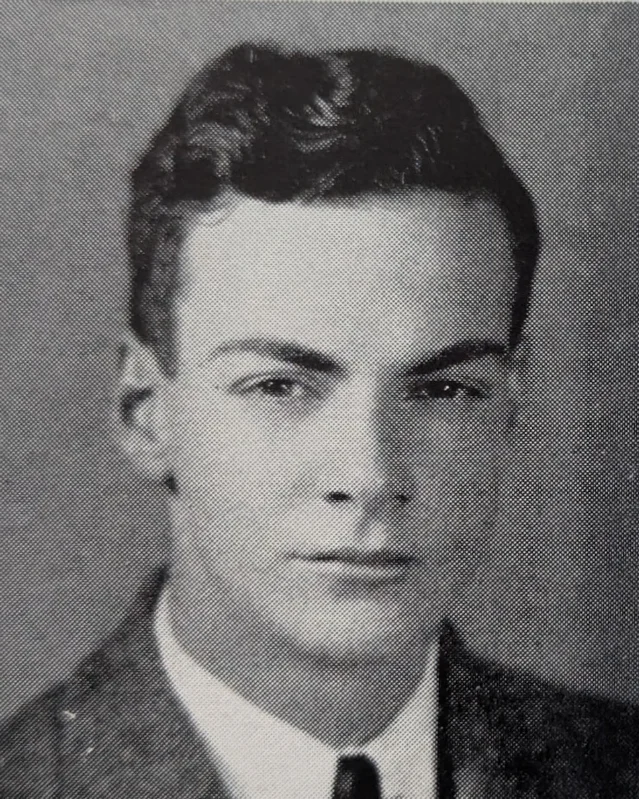
He had graduated from MIT that June, and he had wanted to stay. His professor John C. Slater pushed him toward another school: "You should find out how the rest of the world is." 1
That year he had also published his first paper, written with MIT's Manuel S. Vallarta, on how the stars of a galaxy scatter cosmic rays. 1
The class buried in the middle
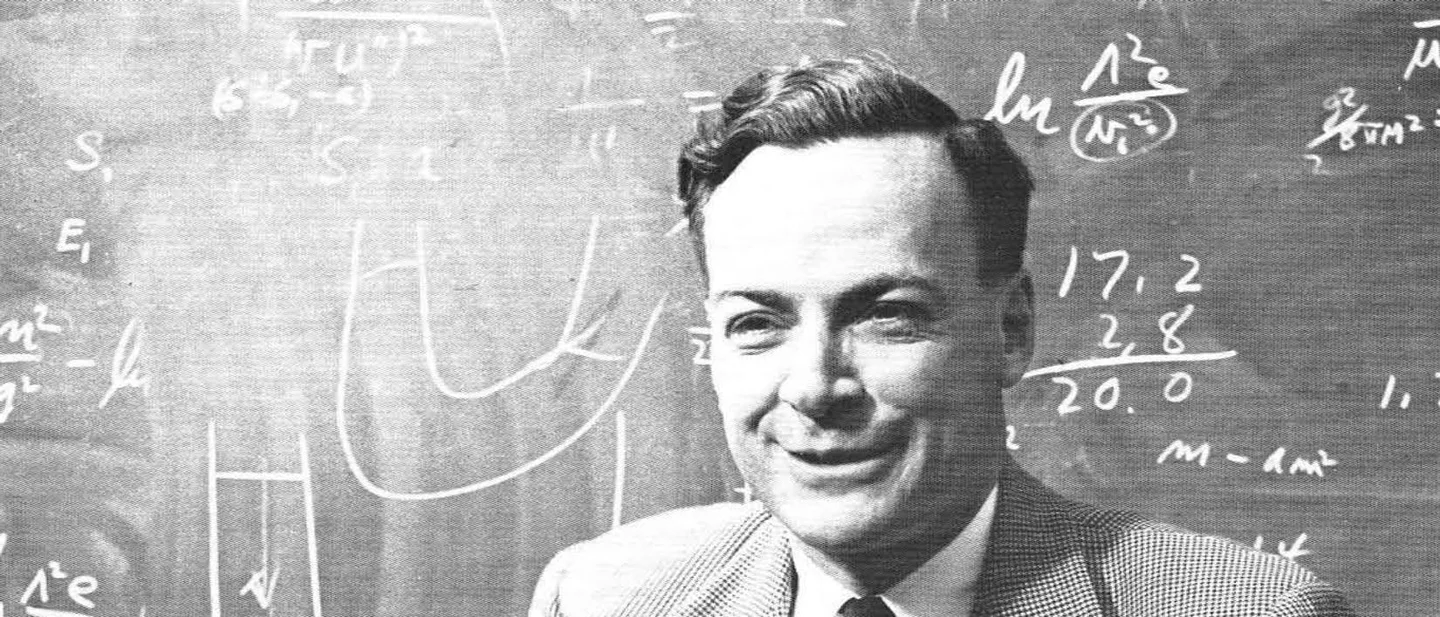
Halfway down the page, in the middle of the family business, Feynman reports what he did that day. 1
"Prof. Wheeler was called away suddenly last night so I took over his course in mechanics for the day. I spent all last night preparing. It went very nicely and smoothly. It was a good experience—I guess someday I'll do a lot of that."
The professor was John Archibald Wheeler, who had arrived at Princeton as an assistant professor in the fall of 1938 and became the supervisor of Feynman's doctoral thesis. The two of them took to each other quickly. 2
Wheeler kept their first meeting to a fixed length by setting his pocket watch on the desk. Feynman bought a dollar watch, and at their next meeting he laid it down too. Both men laughed hard enough that the hour went unused. 2
So one line of a letter home records a first-year graduate student teaching a professor's mechanics course, from a lecture he had written in a single night.
"Someday I'll do a lot of that"
The guess turned out to be the rest of his life.
Feynman taught at Cornell and then at Caltech, where the introductory physics course he gave became The Feynman Lectures on Physics. The three volumes have stayed in print, and Caltech keeps the complete text readable online at no cost. 3
Caltech also keeps his name on teaching itself. Since 1993 the institute has awarded the Richard P. Feynman Prize for Excellence in Teaching each year to a professor who shows "unusual ability, creativity, and innovation" in a classroom or laboratory. The award is $3,500, matched by an equivalent raise in the recipient's salary. 4
October 11, 1939, in another hand
On the date the collection assigns to the letter home, a second document was moving through Washington.
Alexander Sachs, a longtime economic adviser to Roosevelt, delivered it to the President in person on October 11, 1939; the outbreak of war in Europe had intervened since the letter was written. 5
The letter had been signed by Albert Einstein, and its subject was uranium. Recent work by Enrico Fermi and Leo Szilard, it said, led him "to expect that the element uranium may be turned into a new and important source of energy in the immediate future". It then warned that "extremely powerful bombs of a new type" might follow. 6
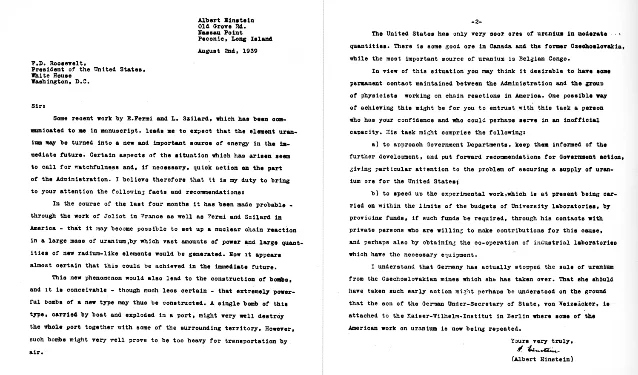
Roosevelt's answer went to his military aide, General Edwin M. Watson: "This requires action." The work that response set going grew into the Manhattan Project, and in 1945 Wheeler was posting mathematics to Feynman at Los Alamos. 25
What the page leaves standing
The letter ends on a joke at its author's expense. "Things are rather uneventful. I didn't fall in the water while sculling these last two times, so maybe I won't fall in anymore—so saying he fell in." 1
Michelle Feynman notes in her introduction that her father watched the clock closely and the calendar hardly at all, often writing "I don't know what" where a date belonged. This letter fits the habit, which is why its date is the editor's and the raincoat is the writer's. 1
What the page holds is a coat that arrived, a mother invited for a Sunday, a class taken over for a day, and one young man's guess about his own future. "I'll tell you all about things when I get home," Feynman wrote, and signed it RP Feynman. He went on to share the 1965 Nobel Prize in Physics and to spend his working life in front of students. On October 11, 1939, the coat fit, the class had gone smoothly, and his mother still owed him a Sunday. 1
References
- 1
- 2
- 3*The Feynman Lectures on Physics*, California Institute of Technology
feynmanlectures.caltech.edu
- 4Caltech, "Richard P. Feynman Prize for Excellence in Teaching"
provost.caltech.edu
- 5Franklin D. Roosevelt Presidential Library and Museum, "Found in the Archives"
fdr.blogs.archives.gov
- 6
This story was produced automatically by a channel. One sentence is all it takes for Neodrop to keep producing for you.