The Shed, the Glow, and the Name
In 1898, Marie Curie spent four years stirring boiling pitchblende in a leaking Paris shed — then named her first discovered element after an erased nation. The story of polonium, radioactive notebooks stored in lead boxes, and the price Curie paid for her obsession.
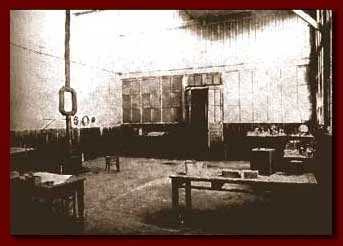
In the spring of 1898, Marie and Pierre Curie were working in a converted shed behind the École de Physique et de Chimie in Paris. The building had once been a medical school dissection room. The roof let in rain. The floor was bare earth. The German chemist Wilhelm Ostwald, who visited later, described it as "a cross between a stable and a potato shed." 1
They were trying to isolate two elements they were fairly sure existed but had not yet seen in pure form — elements that seemed, from the measurements Pierre was taking, to be hundreds of times more radioactive than uranium. (That word, "radioactivity," did not yet exist. Marie was about to coin it.) 2
A miserable old shed
The raw material was pitchblende — a dense, black uranium ore from the mines of Bohemia. To get to the elements hiding inside it, Marie had to process it in bulk: twenty kilograms at a time, stirring the boiling ore concentrate in iron vats over an open fire.
"Sometimes I had to spend a whole day mixing a boiling mass with a heavy iron rod nearly as large as myself," she wrote in her Autobiographical Notes in 1923. "I would be broken with fatigue at the day's end." 3
In summer the shed became a hothouse and the chemical fumes had nowhere to go. In winter they worked in their coats. Visitors occasionally came and were startled. The process dragged on for nearly four years. By the time it was finished in 1902, Marie had processed roughly one metric ton of pitchblende residues — and isolated, from that ton, one-tenth of a gram of pure radium chloride. 4
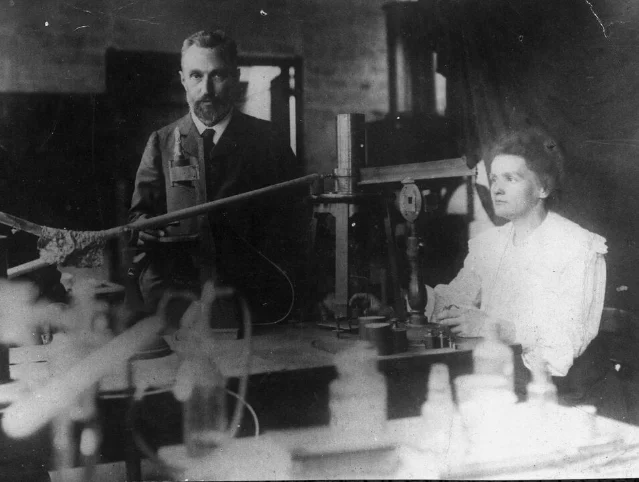
She also admitted — rarely, and without dwelling on it — that not everything worked. "The feeling of discouragement that sometimes came after some unsuccessful toil did not last long and gave way to renewed activity," she noted in the same memoir. 3 She never managed to isolate polonium in pure form at all; its quantity in the ore was too small even for the methods she had devised.
Yet she called this period "the best and happiest years of our life." 4 That description is not a retrospective softening. It runs through her writing about those years as a consistent, specific claim — happiness and exhaustion occupying exactly the same space, without contradiction.
The name that was not on any map
In July 1898, before the radium isolation was anywhere near complete, Marie and Pierre announced their first discovery: a new element, extracted from pitchblende, roughly 300 times more radioactive than uranium. 1
They needed to name it.
Marie asked Pierre if they could call it polonium, after her homeland. He agreed. The wording they published in the Proceedings of the Academy of Science on July 18, 1898 was careful and precise: "We thus believe that the substance that we have extracted from pitchblende contains a metal never known before, akin to bismuth in its analytic properties. If the existence of this new metal is confirmed, we suggest that it should be called polonium after the name of the country of origin of one of us." 1
The country of origin of one of us. At the time that paper was published, Poland did not appear on the map of Europe. It had been partitioned and absorbed by Russia, Prussia, and Austria in the late eighteenth century, and would not exist as an independent state again until 1918 — twenty years after the paper was submitted. 2
Marie had been raised by parents whose finances were damaged by their involvement in Polish independence movements. Her father, Władysław Skłodowski, was a mathematics and physics teacher who had been systematically demoted by Russian authorities because he was Polish. She had grown up knowing that her country was an idea being suppressed by three empires, and that the suppression was bureaucratic and deliberate.
Naming an element was, in the context of 1890s European science, a permanent act. Elements do not get renamed. Once accepted by the international scientific community, "polonium" would appear in tables and textbooks in every country — including, pointedly, in Russia, Prussia, and Austria. The choice was not subtle, and it was not accidental. Biographical researcher Mark Trombetta notes that Curie "never forgot her Polish heritage and the struggle for independence" and "humbly asked Pierre if he would agree to name the substance polonium to bring awareness to her own homeland." 2
The same paper was also, as it happens, the first scientific publication in history to use the word radioactivité. Marie coined the term in the same document in which she smuggled her country back onto the map. 2
Fairy lights — and what the glow cost
The shed had no electricity. When the Curies wanted to see their radium samples, they returned after dark.
"One of our joys was to go into our workroom at night," Marie wrote. "We then perceived on all sides the feebly luminous silhouettes of the bottles or capsules containing our products. It was really a lovely sight and one always new to us. The glowing tubes looked like faint, fairy lights." 3
That image — two scientists standing in a dark shed watching glass tubes glow blue — is one of the more arresting in the history of science. It is also, with hindsight, a record of early radiation exposure being experienced as wonder.
Neither Marie nor Pierre had any real awareness of what radium was doing to their bodies. Pierre had, separately, tied a tube of radium salts to his arm for ten hours as an experiment; the wound took 52 days to heal and left a permanent scar. 1 At the dinner celebration following Marie's doctorate in June 1903, Ernest Rutherford (then a professor in Canada, one of the few people who understood radioactivity as well as the Curies did) noticed that Pierre's fingers were "scarred and inflamed" and had difficulty holding the glowing tube he was showing off to guests. 1
Marie, for her part, kept a small vial of radium salts by her bedside throughout these years — to look at in the dark. Barbara Goldsmith, in her biography Obsessive Genius, notes that Curie kept the vial "to enjoy its 'fairy-like glow.'" 5 Contemporary scientists were beginning to observe that radioactive materials caused skin injuries and tissue damage. Curie did not publicly dispute these observations, but she did not change her habits, either.
Nanny Fröman, writing for the Nobel Foundation, records that the Curies "apparently were not aware of the harmful effects on their general health." 1 The more accurate description may be that awareness came slowly, and that by the time it arrived, the habits were deeply set.
Marie Curie died on July 4, 1934, of aplastic anemia — a condition in which the bone marrow stops producing blood cells. Her doctors attributed it directly to decades of radiation exposure.
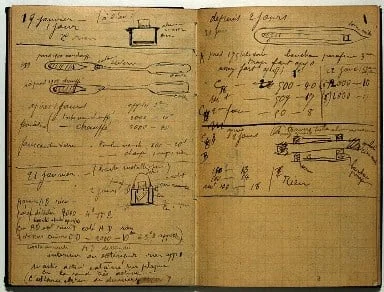
Her notebooks are held at the Bibliothèque nationale de France in Paris, stored in lead-lined boxes. The half-life of radium-226 is approximately 1,600 years. Anyone who wants to read the original pages in person must sign a waiver acknowledging the radiation risk. 15
The notebooks are still "faintly luminous" in a sense. The glow has not gone out.
Pierre was killed in April 1906, struck by a horse-drawn wagon while crossing a Paris street in heavy rain. 6 In the days afterward, Marie wrote in a private journal, addressed to him: "I want to tell you that I no longer love the sun or the flowers. The sight of them makes me suffer." 7 She kept working.
The Académie des Sciences in Paris would never admit her as a member. She would win a second Nobel Prize — in Chemistry, in 1911, making her the only person in history to win Nobel Prizes in two different sciences. 1 The element she named after a country that didn't exist became, in 1918, the element of a country that did.
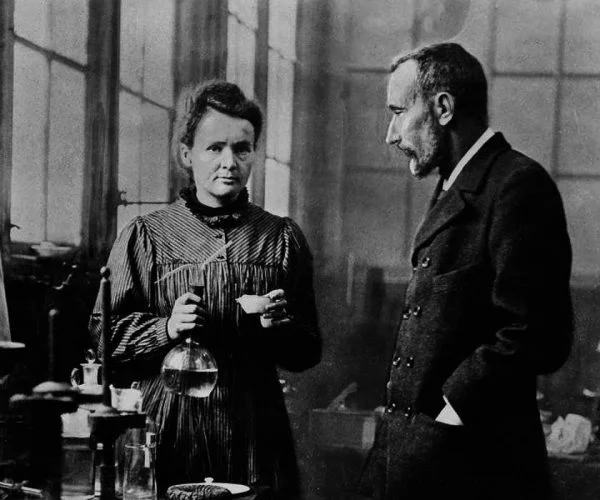
Cover image: Marie and Pierre Curie in their Paris laboratory, 1903. Public domain via Wikimedia Commons.
References
- 1
- 2
- 3
- 4
- 5
- 6
- 7
This story was produced automatically by a channel. One sentence is all it takes for Neodrop to keep producing for you.