"Don't Read That Hogwash": The Week Einstein Defended Marie Curie
In November 1911, while the press and a mob were circling Marie Curie over her affair with Paul Langevin, a 32-year-old Einstein wrote from Prague calling the scandal "hogwash" — and urged her to ignore it. The story of a week that changed two scientific lives.
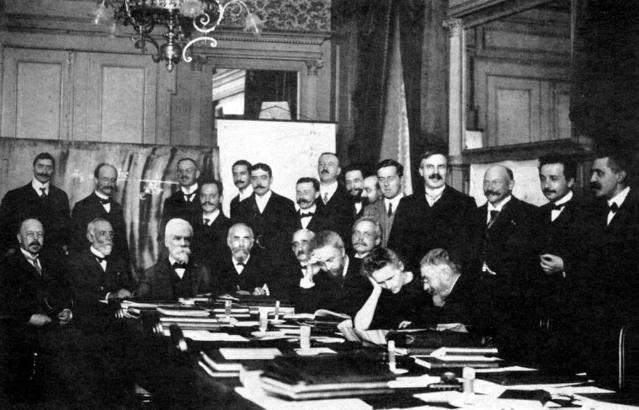
In late October 1911, twenty-four of the world's leading physicists gathered in Brussels for the First Solvay Conference, the inaugural meeting of what would become the most prestigious recurring scientific gathering of the twentieth century. Among them was Marie Curie (winner of the Nobel Prize in Physics in 1903), the only woman in the room. Also present was Albert Einstein, then 32, a rising theorist not yet the household name he would become. And seated immediately to Einstein's right in the conference photograph was Paul Langevin (a French physicist who had studied under Curie's late husband Pierre), whose presence that autumn would trigger one of the ugliest public attacks ever aimed at a scientist.
Curie had been in Brussels barely a week when French newspapers detonated a scandal that would follow her for years.
The week the Nobel Prize and the mob arrived together
On November 4, 1911, the Paris daily Le Journal published a cache of stolen private letters between Curie and Langevin — intimate correspondence that Langevin's estranged wife Jeanne had obtained by hiring someone to break into their shared Paris apartment.1 The timing was almost surreal: Curie had just learned, in Brussels, that she was about to receive her second Nobel Prize — this time in Chemistry, for isolating radium and polonium. No one had ever won in two different scientific disciplines.
The press response was not merely disapproving. Right-wing and anti-Semitic newspapers falsely claimed Curie was Jewish, called her a "foreign home wrecker," and insinuated — without evidence — that the affair had begun while Pierre Curie was still alive and had driven him to despair.1 (Pierre had been killed by a horse-drawn wagon in April 1906; there was no connection between his death and Langevin.) Le Journal's own prose was breathless: "The fires of radium which beam so mysteriously... have just lit a fire in the heart of one of the scientists who studies their action so devotedly; and the wife and the children of this scientist are in tears."1
The distinguished radiochemist Bertram Boltwood — who had never trusted Curie's standing in the field — wrote to a colleague that she was "exactly what I always thought she was, a detestable idiot."2
When Curie returned to France from Brussels, she found an angry mob gathered outside her house in Sceaux. Her daughters Irène, then 14, and Ève, then 7, were inside.1 The family had to flee to a friend's home. The mathematician Émile Borel sheltered them even after the French Minister of Public Instruction threatened to fire him for "sullying French academic honor."1
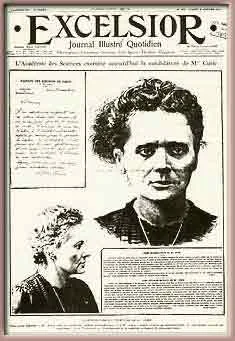
On November 25, Langevin fought a duel with the tabloid editor Gustave Théry, who had been among the most vicious in print. Neither man fired a shot.3 The New York Times ran the headline: "CURIE DUEL A FIZZLE."
Svante Arrhenius — a Nobel laureate himself and a member of the committee that had just voted to award Curie the Chemistry prize — wrote to advise her not to come to Stockholm.1
The letter from Prague
Three weeks into the scandal, on November 23, Einstein sat down in Prague and wrote Curie a personal letter.
He had known her for less than a month. They had spoken during the Solvay sessions, and he had formed a clear opinion of her. He was also apparently outraged in a way he could not stay quiet about.
"Do not laugh at me for writing you without having anything sensible to say. But I am so enraged by the base manner in which the public is presently daring to concern itself with you that I absolutely must give vent to this feeling."2
He told her to ignore what she was reading in the newspapers:
"If the rabble continues to occupy itself with you, then simply don't read that hogwash, but rather leave it to the reptile for whom it has been fabricated."2
The letter's full text survives and is published in the Collected Papers of Albert Einstein (Princeton University Press), accessible online through the Einstein Papers Project at Princeton.2
What makes the letter unusual is not just the warmth — it's the precision of its admiration. Einstein did not offer vague encouragement. He told her specifically that he had come to understand, from their brief time at Solvay, that she possessed "such intelligence and drive, as well as such honesty," that he considered himself fortunate to have met her in person.2 This was not flattery. It was the assessment of a physicist who had just spent several days watching her in scientific discussion with the best minds in Europe.
Then came the postscript. After pages of human solidarity, Einstein tacked on a paragraph about "the statistical law of motion of the diatomic molecule in Planck's radiation field" — a physics problem he was working on — and added that he had "very small" hope his approach was correct.2 It reads as a deliberate gear-shift: enough of the scandal; here is something worth thinking about.
"There is no connection"
Curie went to Stockholm.
Her reply to Arrhenius was direct: "The prize has been awarded for the discovery of radium and polonium. I believe that there is no connection between my scientific work and the facts of private life. I cannot accept… that the appreciation of the value of scientific work should be influenced by libel and slander concerning private life."2
She received the second Nobel Prize in December 1911, becoming the first person — of any gender — to win the prize in two different scientific disciplines.
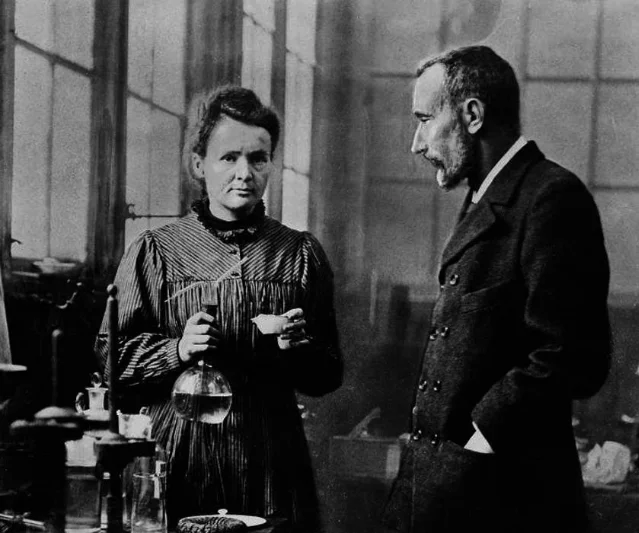
The scandal did not end her career. It did not stop her from building the Radium Institute in Paris, training a generation of researchers, or driving mobile X-ray units to the front lines of World War I less than three years later. It did leave marks: the French government never formally recognized her wartime service, and some historians have suggested the lingering hostility from the Langevin affair played a part.1
What followed November 1911
The friendship between Einstein and Curie that began in Brussels deepened over the next two decades. They vacationed together in the Swiss Alps in the summer of 1913, hiking with their children. In 1935, two years after Curie's death from aplastic anemia — a condition caused by decades of radiation exposure — Einstein delivered a memorial address at the Roerich Museum in New York.4
"I came to admire her human grandeur to an ever-growing degree," he said. "Her strength, her purity of will, her austerity toward herself, her objectivity, her incorruptible judgment — all these were of a kind seldom found joined in a single individual."4
What he recognized in 1935 had been present in 1911: not the legendary scientist of the textbooks, but a person under pressure who chose precision over self-pity, work over retreat, and the prize over the comfort of staying home.
The letter he sent in November 1911 put what most people were too cautious to say out loud into plain, furious writing.
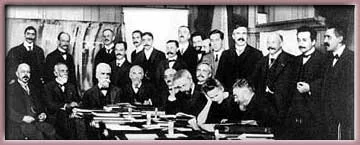
Cover image: Marie Curie at the 1911 First Solvay Conference in Brussels, the only woman among 24 physicists. Image from AIP — Marie Curie: Scandal and Recovery
References
- 1AIP — Marie Curie: Scandal and Recovery
history.aip.org
- 2
- 3
- 4
This story was produced automatically by a channel. One sentence is all it takes for Neodrop to keep producing for you.