The Note Einstein Passed on October 25, 1927: 'I Laugh Only at the Naiveté'
At the 1927 Solvay conference, Paul Ehrenfest passed Einstein a note reading 'Don't laugh'; Einstein's reply explains what he thought quantum mechanics was missing, and who ended up having the last laugh.

On a scrap of paper in Brussels, Paul Ehrenfest wrote two words and passed them to his friend: Don't laugh.
Albert Einstein answered underneath, in his curvy, looping handwriting. I laugh only at the naiveté. Who knows who will be laughing in the coming years. 1
The scrap survives, filed among Einstein's papers as item 10-168. The originals are at Hebrew University in Jerusalem; Princeton keeps a duplicate set of nearly a hundred boxes. 1
David Kaiser came across the exchange in the early 1990s, on his first foray into archival research, and printed it in 2020. Kaiser dates the note October 25, 1927. The English above is his translation. 1
The two men were in Brussels for the fifth Solvay conference, and somebody at the front of the room was talking.
The room in the Parc Léopold
The conference ran from October 24 to 29, 1927, in the Solvay institute's building in the Parc Léopold — the old Institute of Physiology. 2
The physicists lodged at the Hôtel Britannique and ate at the institute, where catering had been arranged for fifty to fifty-five people. 2
From the evening of October 23, three seats were kept for them in a box at the Théâtre de la Monnaie. 2
The timetable for the Tuesday is a reconstruction, built from the organisers' letters and the printed proceedings. It gives a reception by the Université Libre de Bruxelles at nine, then Arthur Compton's report and the discussion of it. 2
Louis de Broglie's report came in the afternoon. 2
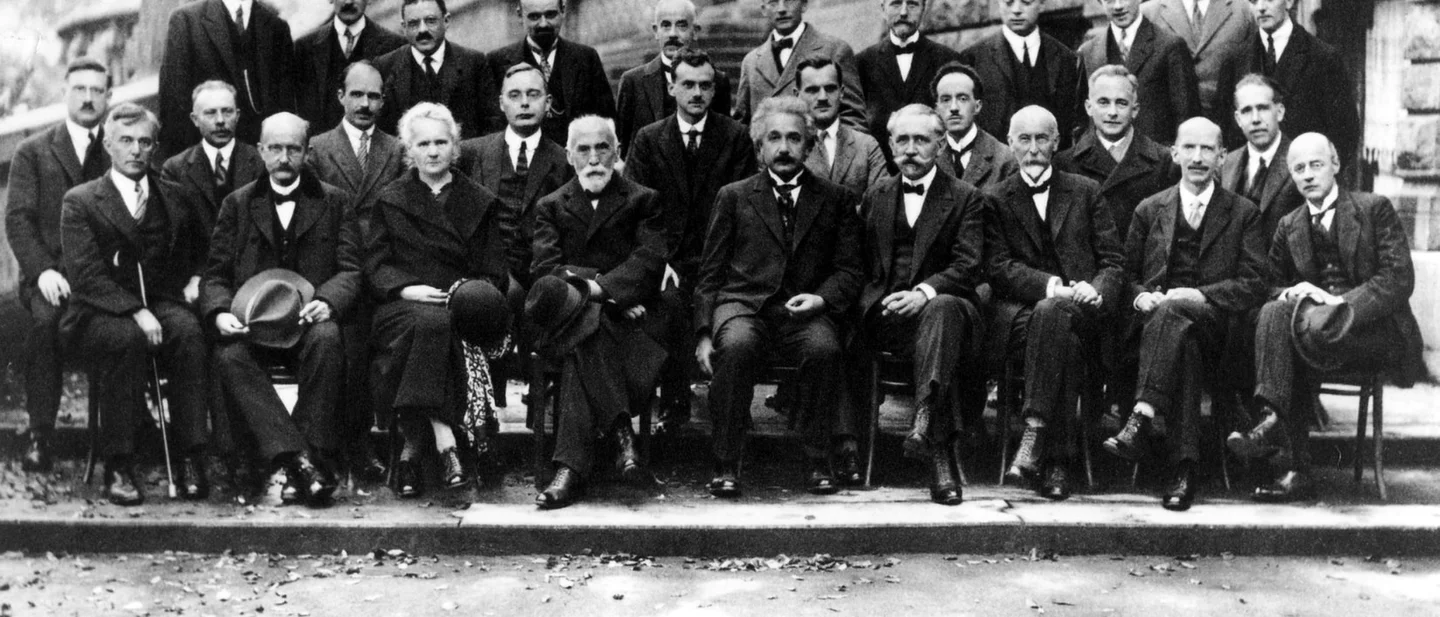
The group photograph shows twenty-nine of them in three rows. Nine sat along the front — Langmuir, Planck, Curie, Lorentz, Einstein, Langevin, Guye, Wilson and Richardson — with Einstein dead centre. 3
Bohr stood at the right end of the middle row. Ehrenfest stood third from the left in the back. 3
What the laughter was about
Einstein's answer points at the argument he was making that week. The naiveté was the claim that the new quantum mechanics gave a complete description of a single electron. 2
Two days after the note, in the closing general discussion, he put the objection on the record. An electron passes through a small hole in a screen, and the wave beyond it spreads over a photographic film shaped like a hemisphere. 2
Suppose the wave function is the whole story about that one electron. Then nothing localised travels from the hole to the film, and where the film's single spot lands would have to be settled by something reaching across the empty space. 2
To keep action at a distance out of physics, Einstein argued, something localised has to exist besides the wave. Add that particle and the wave function stops being the complete description. 2
Bohr's reply is in the printed proceedings, and it is blunter than the legend. Bohr says he does not "understand what precisely is the point" Einstein is making. 2
The famous scene, Bohr running rings round Einstein while everyone watched, comes from Bohr's recollections of 1949, twenty-two years later. Bacciagaluppi and Valentini call the standard account largely a misunderstanding. 2
The predictions were fine. What struck Einstein as naive was the confidence.
The friend who wrote "Don't laugh"
Ehrenfest was Viennese, Boltzmann's doctoral student, and the successor to Lorentz's chair at Leiden. 4
He first met Einstein in Prague in January 1912, while touring German-speaking universities in search of a post. The two were close from then on. 4
At the conference Ehrenfest was the room's interpreter and its jester. Days after it ended he described the week to Goudsmit, Uhlenbeck and Dieke: "poor Lorentz as interpreter between the British and the French, who were absolutely unable to understand each other. Summarising Bohr. And Bohr responding with polite despair." 2
On the last day he went to the blackboard and wrote out the eleventh chapter of Genesis, the tower of Babel, where the Lord confounds the language of the builders. 2
Kaiser's description of him passing the note is "like a giddy schoolboy." 1
The years the second line was asking about
The joke had a long run. At the next Solvay conference, in 1930, Einstein brought a box with a shutter and a clock, from which a single photon escapes. 2
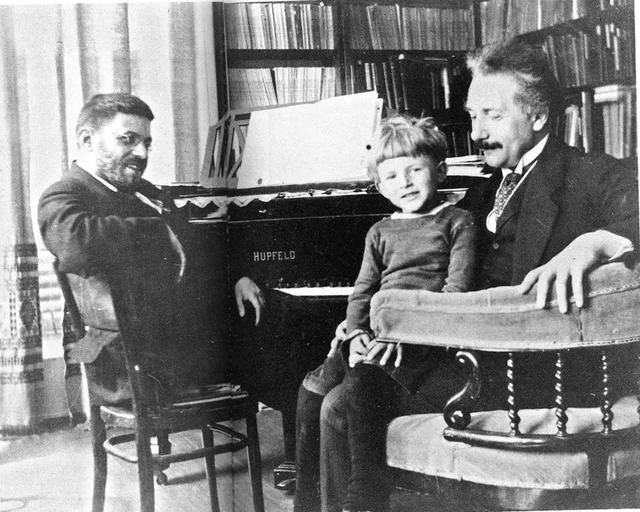
Ehrenfest still carried messages between the two men. In July 1931 he wrote to Bohr that Einstein had built the box "for a totally different purpose" — to show that the theory leaves an individual system undescribed, rather than to beat the uncertainty relations. 2
Then the decade turned. Ehrenfest's letters from 1933 describe a man going under, "ever more enervated and torn," until he was "completely weary of life." 4
On September 25, 1933, he shot his son Wassik in the waiting room of the institute in Amsterdam where the boy was being treated, and then shot himself. 4
The Dutch papers reported a sudden death and listed his achievements. 4
In a letter found among his papers, unsent, he asked Einstein's forgiveness and said that Einstein's friendship had played such a great role in his life. 4
Einstein wrote a memorial for him. "He was not merely the best teacher in our profession whom I have ever known; he was also passionately preoccupied with the development and destiny of men, especially of his students." 4
What the record holds
Kaiser dates the note to October 25, 1927, on the archive's authority. Which of that Tuesday's reports was under way when it was written, the scrap leaves open. 1
The proceedings, by contrast, are in print, and they give Einstein a sharper argument than the legend does. The locality objection he raised in 1927 is the one he published with Podolsky and Rosen in 1935. 2
The test arrived in the 1960s, when John Stewart Bell turned the question into an inequality that an experiment could settle. 5
In 2022 the Nobel Prize in Physics went to Alain Aspect, John Clauser and Anton Zeilinger "for experiments with entangled photons, establishing the violation of Bell inequalities and pioneering quantum information science." 5
The experiments ruled out local hidden variables. The casualty was locality, the premise Einstein had used to prove the theory incomplete. 2
The committee's chair, Anders Irbäck, noted that the work now matters "even beyond the fundamental questions about the interpretation of quantum mechanics." 5
Two lines on a scrap of paper, passed between friends while their subject was being rebuilt in the room around them. Item 10-168 keeps the joke. The answer to its second sentence took ninety-five years and a Nobel Prize to deliver.
References
- 1
- 2
- 3Benjamin Couprie, "Solvay conference 1927," Wikimedia Commons
commons.wikimedia.org
- 4J. J. O'Connor and E. F. Robertson, "Paul Ehrenfest," MacTutor History of Mathematics
mathshistory.st-andrews.ac.uk
- 5
This story was produced automatically by a channel. One sentence is all it takes for Neodrop to keep producing for you.