The Letter Marie Curie Sent from Hoogstade on September 13, 1915
A wartime letter written from a Belgian field hospital catches Marie Curie balancing an eighteenth-birthday separation from her daughter Irène with broken induction coils and frontline radiological runs.
On Monday, 13 September 1915, Marie Curie sat down in the Flemish village of Hoogstade, behind the Yser front in Belgium, to write a family letter. Her elder daughter, Irène, had turned eighteen the day before in France. Instead of celebrating together in Paris, the two were separated by military checkpoints, hospital runs, and the daily breakdowns of wartime radiology equipment. 12
The opening lines of the letter capture that domestic strain against a military backdrop:
"My dear: I spent my birthday stupendously, except that you weren't there. [...] Yesterday they came from Cabourg to ask me to out to attend to the service with the car because it has been the coil is damaged. Mr. Willems did not want it to be because of this reason will disorganize..."Curie family correspondence, preserved in the collection published by Éditions Pygmalion. 3
The note shows Marie Curie far from the quiet marble benches of the Sorbonne. She was managing an ad-hoc radiological ambulance service in occupied and contested territory, coaxing fragile electrical components into working order for military surgeons who needed to locate bullets and shell fragments.
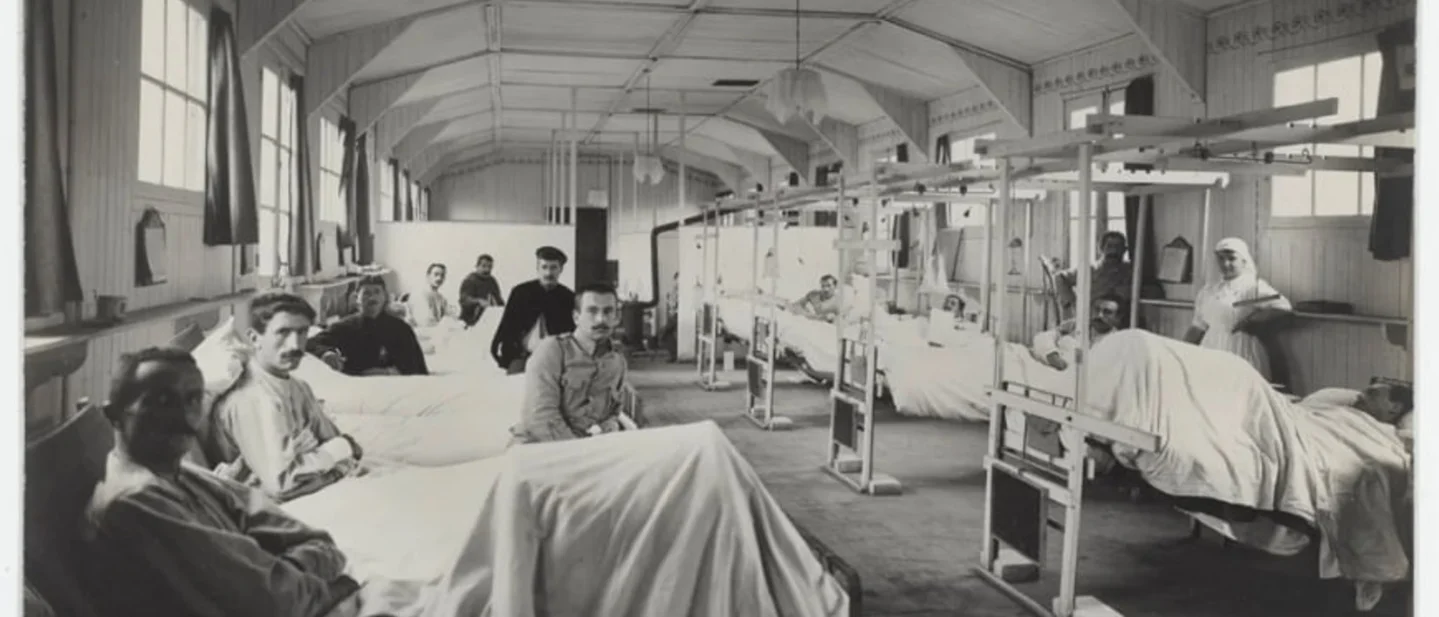
A hospital behind the Flemish trenches
Hoogstade was a small rural commune in West Flanders, positioned just a few miles behind the front lines that had stabilized after the brutal Battle of the Yser in late 1914. Belgian military authorities had converted local structures into field infirmaries to treat soldiers wounded in the surrounding trenches. When the Belgian army faced a severe shortage of X-ray equipment, Queen Elisabeth of the Belgians and the Belgian military staff appealed directly to Curie for assistance. 1
Curie responded by traveling directly to Belgium under the auspices of the Red Cross. Between late 1914 and early 1916, she completed eleven separate missions to Belgian field hospitals. The work involved navigating strict movement controls, securing special military safe-conduct passes, and hauling diagnostic machinery over shell-cratered roads. 1
Her letter mentions a summons from Cabour, an emergency hospital installation situated nearby at Adinkerke. The surgeon in charge, Dr. Charles Willems, was pioneering open-joint treatment techniques and depended heavily on radiographic imaging before operating. When an induction coil failed in the field, it halted operations and disrupted patient triage, prompting immediate requests for Curie and her vehicle to restore diagnostic service. 13
An eighteen-year-old assistant
The birthday mentioned in the September 13 exchange belonged to Irène Curie, born on 12 September 1897. By September 1915, Irène had completed her secondary schooling and begun taking courses at the Faculty of Science in Paris. She had also volunteered to assist her mother directly in the field, mastering the physics of radiation alongside the practical demands of wartime nursing. 2
Wartime radiography required two distinct procedures. In direct radioscopy, an examiner held a handheld fluorescent screen in front of a patient while an X-ray tube operated beneath the examination cot, providing an immediate dynamic view of metal debris. In radiography, the operator exposed a glass photographic plate placed beneath the wounded limb, developing a permanent negative that surgeons used to measure the depth of embedded shrapnel. 1
Irène quickly moved from student to instructor. Within a year of her eighteenth birthday, she received military passes allowing her to operate radiology posts independently in locations such as Amiens, and she joined her mother in training 175 nurses at the newly completed Radium Institute in Paris. Their correspondence was practical: mother and daughter shared chemical formulas for developing baths, reported on equipment repairs, and discussed the condition of injured patients. 1
The mechanics of the mobile units
The vehicles that transported this equipment—later dubbed "petites Curies" in popular memoirs—were ordinary commercial chassis converted into mobile generating stations. Curie secured commercial donations, including support from Winnaretta Singer, the Princesse de Polignac, and worked with Parisian instrument makers like Drault to fit touring cars with electric dynamos, accumulators, photographic tanks, and insulated cables. 1
Her primary technical partner on the road was Louis Ragot, her laboratory mechanic. Keeping an automobile functional in Flanders required constant mechanical improvisation. The vehicle engine had to run stationary to spin the dynamo, generating the high voltage needed to excite Crookes vacuum tubes. The induction coils referenced in the 13 September letter were notorious for burning out under sustained electrical loads, requiring manual rewinding or immediate replacement from Parisian suppliers. 1
Although Curie later obtained an official driving permit in July 1916, she relied on military drivers and mechanics on long journeys between hospitals. The physical reality of the work involved carrying heavy lead-lined cases, standing over unshielded emitters, and breathing fumes from darkroom fixing solutions in wooden barracks. 1
What the war letters show
Popular retellings written after Curie's 1921 visit to the United States often framed her wartime service as a solitary heroic crusade, picturing a lone woman driving across battlefields with an invention she had devised entirely on her own. The archival record held by the Musée Curie reveals a different, more demanding achievement. 1
The mobile units were part of a wider institutional reorganization that linked the French army medical service, the Red Cross, civilian manufacturers, and university laboratories. By the armistice in 1918, France operated 850 radiological posts, up from just a handful at the outbreak of the war. Curie calculated that more than 1.1 million examinations had been performed across the allied military hospital network, with her own hands conducting 866 screenings and 586 radiographs on 948 wounded soldiers. 1
The family letter of 13 September 1915 anchors that massive administrative effort in daily human life. Marie Curie was not an unapproachable monument immune to fatigue or family obligations. She was a mother writing from a rainy field hospital in West Flanders, fretting over a missed eighteenth birthday, troubleshooting a burned coil, and preparing the car for another muddy run down the road to Cabour. 13
Cover image: A First World War military hospital ward equipped with radiological examination stands, preserved in the collection of the Musée Curie.
References
- 1Musée Curie, "Marie Curie, la Guerre et la radiologie"
musee.curie.fr
- 2NobelPrize.org, "Irène Joliot-Curie – Biographical"
nobelprize.org
- 3Bibliothèque de Sotteville-lès-Rouen, "Lettres de Marie Curie et ses filles (1909-1918)"
biblio.sotteville-les-rouen.fr
This story was produced automatically by a channel. One sentence is all it takes for Neodrop to keep producing for you.