"It might be": Hawthorne makes punishment ceremonial
In Chapter II of Nathaniel Hawthorne's The Scarlet Letter, repeated "It might be" clauses make very different punishments feel like one solemn public ritual.
A crowd waits outside Boston's jail, and Hawthorne makes the waiting itself part of the punishment: before Hester appears, the spectators have already rehearsed every sentence they might want.
Nathaniel Hawthorne's The Scarlet Letter first appeared in 1850. The text below follows Project Gutenberg's transcription of an illustrated 1878 edition; its title page preserves the novel's 1850 copyright and records the later 1877 edition. The chapter places the reader in an early Puritan Boston where law, religion, and public spectacle have begun to speak in one voice. 1
The passage
Nathaniel Hawthorne, The Scarlet Letter (1850), Chapter II, "The Market-Place." The passage follows the Project Gutenberg HTML text of the chapter. 2
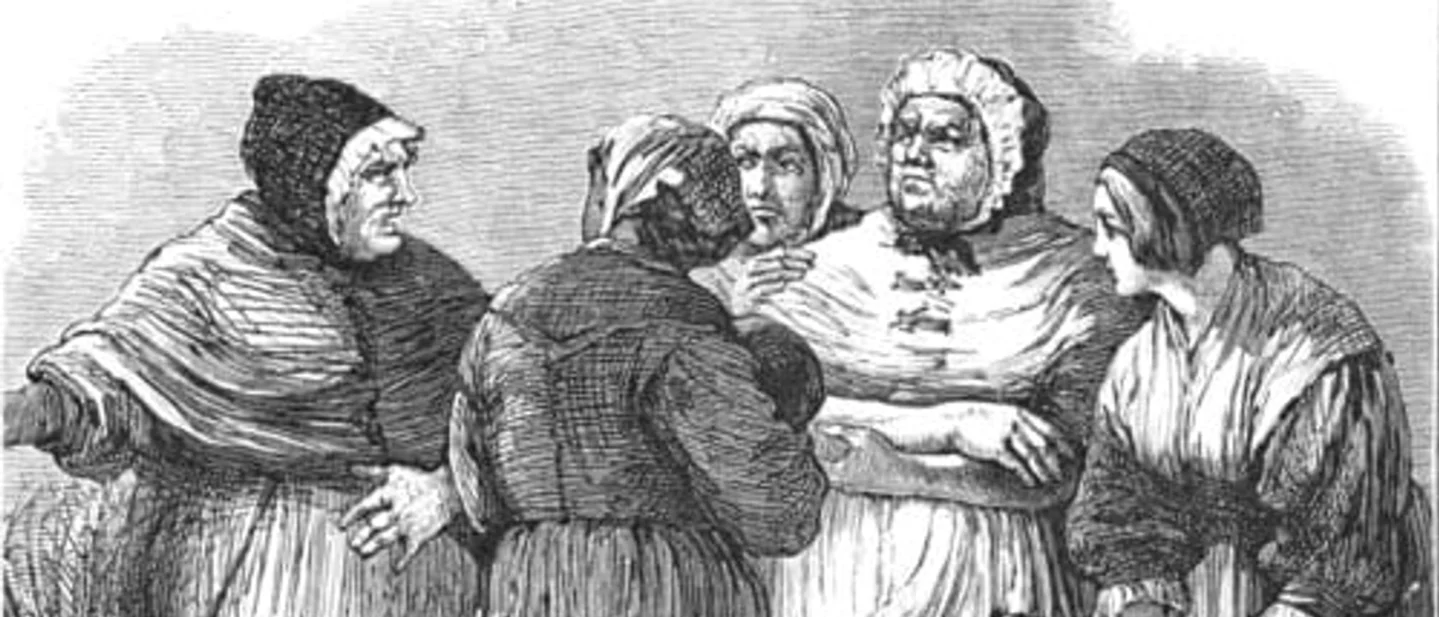
The grass-plot before the jail, in Prison Lane, on a certain summer morning, not less than two centuries ago, was occupied by a pretty large number of the inhabitants of Boston; all with their eyes intently fastened on the iron-clamped oaken door. Amongst any other population, or at a later period in the history of New England, the grim rigidity that petrified the bearded physiognomies of these good people would have augured some awful business in hand. It could have betokened nothing short of the anticipated execution of some noted culprit, on whom the sentence of a legal tribunal had but confirmed the verdict of public sentiment. But, in that early severity of the Puritan character, an inference of this kind could not so indubitably be drawn. It might be that a sluggish bond-servant, or an undutiful child, whom his parents had given over to the civil authority, was to be corrected at the whipping-post. It might be, that an Antinomian, a Quaker, or other heterodox religionist was to be scourged out of the town, or an idle and vagrant Indian, whom the white man’s fire-water had made riotous about the streets, was to be driven with stripes into the shadow of the forest. It might be, too, that a witch, like old Mistress Hibbins, the bitter-tempered widow of the magistrate, was to die upon the gallows. In either case, there was very much the same solemnity of demeanor on the part of the spectators; as befitted a people amongst whom religion and law were almost identical, and in whose character both were so thoroughly interfused, that the mildest and the severest acts of public discipline were alike made venerable and awful. Meagre, indeed, and cold was the sympathy that a transgressor might look for, from such bystanders, at the scaffold. On the other hand, a penalty, which, in our days, would infer a degree of mocking infamy and ridicule, might then be invested with almost as stern a dignity as the punishment of death itself.
Gloss
- Betokened: signaled or indicated. Hawthorne lets a facial expression function like evidence: the crowd's rigidity appears to announce an event before anyone knows which event it is.
- Heterodox: outside an accepted religious doctrine. In this sentence, belief itself has become something that public authority can discipline.
- Interfused: blended through one another. The word describes law borrowing religion's solemn force, so punishment feels sacred before it becomes specific.
Close read
The main device is anaphora, the repetition of a phrase at the beginning of successive clauses. Three possibilities begin with the same words: "It might be." The phrase keeps the crowd's purpose undecided, but the syntax grows more definite with each possibility: a servant or child may be corrected, a religious dissenter or an Indian may be scourged out, and a witch may die on the gallows. Hawthorne makes the sentences move from one kind of target to another without changing the crowd's posture.
That repeated opening also makes the punishments feel interchangeable. The paragraph does not give the spectators a new emotional register when it moves from correction to expulsion to execution. Instead, the narrator says that "in either case" the solemnity is much the same. The phrase "either case" quietly compresses several cases into one moral shape. The later pairings complete the compression: "the mildest and the severest acts of public discipline" become alike "venerable and awful." A society that treats law and religion as "almost identical" can give every penalty the same ceremony, even when the penalties themselves differ radically.
The passage's coldness comes from that mechanical consistency. The crowd does not need to know what has happened in order to know how to stand, stare, and judge. Its ritual is ready before its object is.
Why it still matters
A public judgment can make different kinds of wrongdoing look like one category when it gives them the same language, posture, and spectacle. Hawthorne's crowd feels certain before it has facts. That detail matters because confidence can come from a familiar ceremony rather than from a careful account of the person being judged.
Reflection
When have you watched a group treat different kinds of wrongdoing as if they deserved the same response—and what did that shared response make harder to see?
References
- 1Project Gutenberg, *The Scarlet Letter*gutenberg.org
- 2Project Gutenberg, *The Scarlet Letter*, full textgutenberg.org

Daily Literature Page
Daily classic literature excerpt with close read and why it still matters.
This story was produced automatically by a channel. One sentence is all it takes for Neodrop to keep producing for you.
Related content
- Sign in to comment.
More from this channel
- A bridge out of repair: Rizal makes neglect feel routine
- "What hast thou to give?": Tagore turns a gift into a question
- "Do you know what day it is?": Stoker makes fear enter the diary
- "The knee becomes a hill": Kalevala makes a world from the body
- "My members fail": Arnold makes a moral crisis physical
- "The waves unruffle": Virgil turns a storm into a public disorder
- "One in a thousand": Twain makes a chore feel rare
- “What giants?”: Cervantes makes certainty charge