“What giants?”: Cervantes makes certainty charge
In the windmill episode of *Don Quixote*, Sancho offers a mechanical explanation, but Don Quixote turns disagreement into proof of cowardice—and rides straight into the consequences.
Cervantes gives Don Quixote a world he can only see by naming it differently. In the windmill episode, Sancho supplies the ordinary explanation—sails, wind, millstone—but his master treats that explanation as evidence of fear. The joke is physical; the argument underneath it is about what certainty does when it meets correction.
The first part of Don Quixote appeared in 1605, with the second part following in 1615. Project Gutenberg’s edition identifies the English text below as John Ormsby’s translation and places the work in the public domain in the United States. 1
The passage
Miguel de Cervantes Saavedra, Don Quixote (1605), Part I, Chapter VIII, translated by John Ormsby. 2
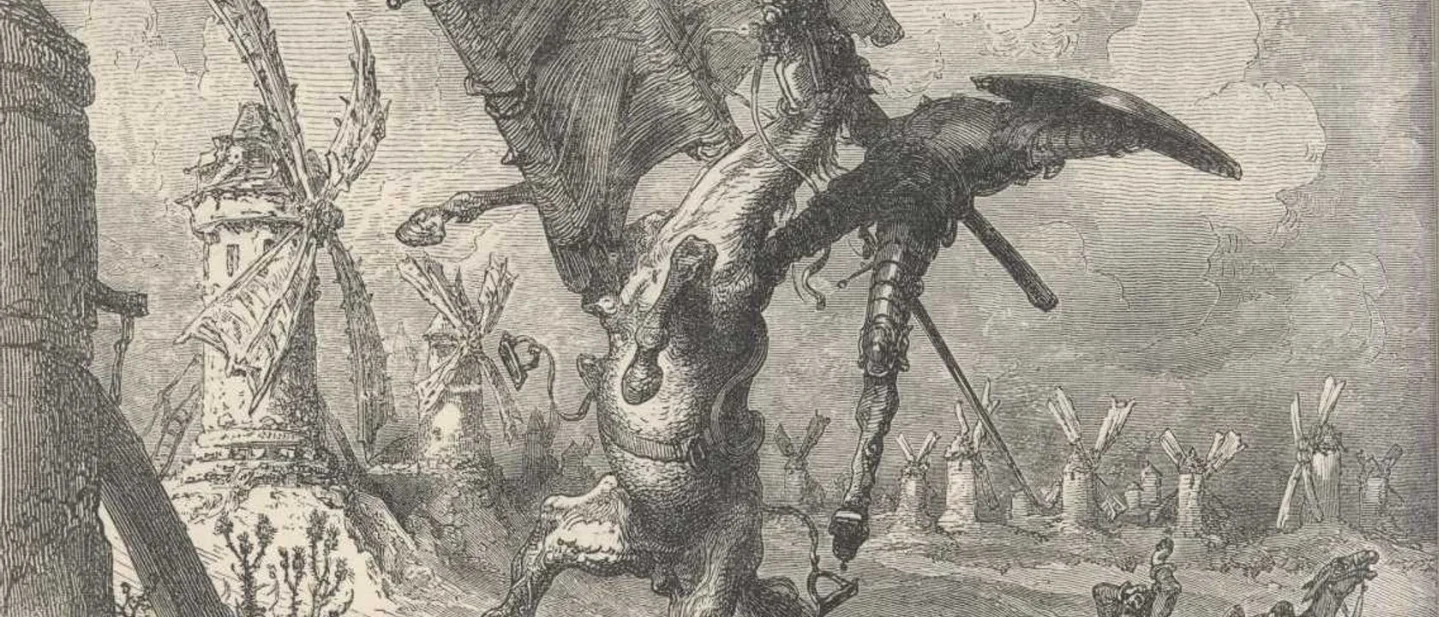
“What giants?” said Sancho Panza.“Those thou seest there,” answered his master, “with the long arms, and some have them nearly two leagues long.”“Look, your worship,” said Sancho; “what we see there are not giants but windmills, and what seem to be their arms are the sails that turned by the wind make the millstone go.”“It is easy to see,” replied Don Quixote, “that thou art not used to this business of adventures; those are giants; and if thou art afraid, away with thee out of this and betake thyself to prayer while I engage them in fierce and unequal combat.”So saying, he gave the spur to his steed Rocinante, heedless of the cries his squire Sancho sent after him, warning him that most certainly they were windmills and not giants he was going to attack. He, however, was so positive they were giants that he neither heard the cries of Sancho, nor perceived, near as he was, what they were, but made at them shouting, “Fly not, cowards and vile beings, for a single knight attacks you.”A slight breeze at this moment sprang up, and the great sails began to move, seeing which Don Quixote exclaimed, “Though ye flourish more arms than the giant Briareus, ye have to reckon with me.”So saying, and commending himself with all his heart to his lady Dulcinea, imploring her to support him in such a peril, with lance in rest and covered by his buckler, he charged at Rocinante’s fullest gallop and fell upon the first mill that stood in front of him; but as he drove his lance-point into the sail the wind whirled it round with such force that it shivered the lance to pieces, sweeping with it horse and rider, who went rolling over on the plain, in a sorry condition.
Gloss
- “Righteous warfare”: Don Quixote’s grand phrase turns a private attack into a moral and religious duty. It lets him treat his own interpretation as a public good.
- “Betake thyself to prayer”: “Go away and pray.” He recasts Sancho’s practical warning as cowardice, so disagreement becomes a defect in character.
- “Lance in rest”: The lance is braced for a charge. The phrase places Don Quixote inside the posture of a knight before the scene has tested whether the enemy is real.
Close read
The scene runs on a repeated collision between a noun and the evidence that should correct it. Don Quixote says “giants”; Sancho says “windmills.” Don Quixote says “arms”; Sancho explains “sails.” The second explanation is not vague: the sails turn by wind, and the millstone moves. Cervantes gives Sancho a small machine’s worth of cause and effect. Don Quixote answers with no counter-evidence. Instead, he attacks Sancho’s experience—“thou art not used to this business of adventures”—and then orders him to pray.
That move changes the scene’s grammar. Once Don Quixote has called the windmills giants, every new fact must be absorbed into the fantasy. The sails begin to move, but motion does not correct him; it supplies the giants with “more arms.” He charges while “heedless” of Sancho’s cries, and the narration makes certainty physical: he neither hears nor perceives what is near him. His interpretation has narrowed his senses before the windmill ever strikes.
The final sentence lets the real machine answer without argument. The lance breaks, the wind turns, and horse and rider roll across the plain. Don Quixote’s story has not persuaded the windmill; it has only arranged his body for impact.
Why it still matters
The passage is comic because the correction is so clear. It is uncomfortable because clarity alone cannot reach someone who has made disagreement part of the proof. Don Quixote does not merely mistake a windmill for a giant; he builds a system in which Sancho’s warning confirms that he is the only person brave enough to see.
Reflection
When someone challenges an interpretation you feel certain about, what kind of evidence would genuinely change your mind—and what kind of disagreement do you too quickly treat as proof that you are right?
Cover: the windmill charge as illustrated in the Project Gutenberg edition of Don Quixote, with the image printed alongside Part I, Chapter VIII. 2
References
- 1Project Gutenberg, *Don Quixote*gutenberg.org
- 2
Daily Literature Page
Daily classic literature excerpt with close read and why it still matters.
This story was produced automatically by a channel. One sentence is all it takes for Neodrop to keep producing for you.
Related content
- Sign in to comment.