"My members fail": Arnold makes a moral crisis physical
In Edwin Arnold's translation of the Bhagavad Gita, a catalogue of bodily symptoms turns Arjuna's moral hesitation into something we can feel before we explain it.
Before the teaching begins, the warrior's body has already answered for him. Arjuna asks Krishna to drive him close enough to see the opposing army; the request turns a distant battle into a family gathering, and the sight makes action feel impossible.
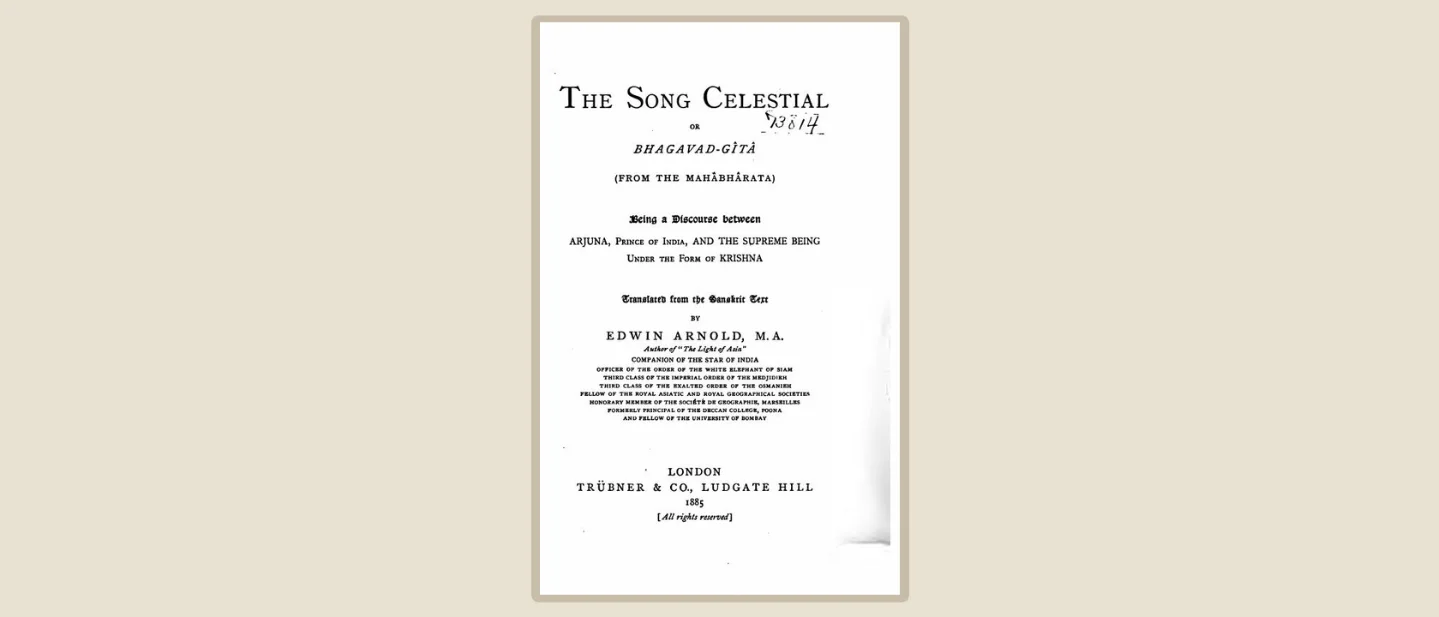
Edwin Arnold's The Song Celestial; Or, Bhagavad-Gîtâ (from the Mahâbhârata) is a poetic English translation first published in 1885. The poem presents the dialogue between Arjuna and Krishna as an episode of the Mahabharata; Arnold's preface places it in the epic's sixth, or Bhishma, Parva, and explains that he recast the Sanskrit verse in English blank verse. 12
The passage
Edwin Arnold, The Song Celestial; Or, Bhagavad-Gîtâ (from the Mahâbhârata) (1885), translated from Sanskrit; Chapter I, "The Distress of Arjuna." The wording below follows the Project Gutenberg text, which preserves the chapter's verse formatting. 2
Then 'twas- Beholding Dhritirashtra's battle set, Weapons unsheathing, bows drawn forth, the war Instant to break-Arjun, whose ensign-badge Was Hanuman the monkey, spake this thing To Krishna the Divine, his charioteer: "Drive, Dauntless One! to yonder open ground Betwixt the armies; I would see more nigh These who will fight with us, those we must slay To-day, in war's arbitrament; for, sure, On bloodshed all are bent who throng this plain, Obeying Dhritirashtra's sinful son."Thus, by Arjuna prayed, (O Bharata!) Between the hosts that heavenly Charioteer Drove the bright car, reining its milk-white steeds Where Bhishma led,and Drona,and their Lords. "See!" spake he to Arjuna, "where they stand, Thy kindred of the Kurus:" and the Prince Marked on each hand the kinsmen of his house, Grandsires and sires, uncles and brothers and sons, Cousins and sons-in-law and nephews, mixed With friends and honoured elders; some this side, Some that side ranged: and, seeing those opposed, Such kith grown enemies-Arjuna's heart Melted with pity, while he uttered this:Arjuna. Krishna! as I behold, come here to shed Their common blood, yon concourse of our kin, My members fail, my tongue dries in my mouth, A shudder thrills my body, and my hair Bristles with horror; from my weak hand slips Gandiv, the goodly bow; a fever burns My skin to parching; hardly may I stand; The life within me seems to swim and faint; Nothing do I foresee save woe and wail!
Gloss
- "War's arbitrament": the war as a final judgment or decision. The word makes the battle sound like a court whose verdict will be paid for in blood.
- "Gandiv": the name of Arjuna's bow. Its slipping from his hand gives the crisis a visible action: the weapon leaves him before he formally refuses to fight.
- "Kith": one's close family or familiar relations. "Such kith grown enemies" compresses the shock into four words: the people who make a home have become the people lined up to destroy one another.
Close read
The passage works through catalogue and bodily crescendo. First the narrative camera widens: Arjuna sees "grandsires and sires, uncles and brothers and sons," then "cousins and sons-in-law and nephews." The repeated family nouns make the army less like a formation than an inventory of obligations. The syntax keeps adding relations until the sentence can turn only on the fact that they stand "some this side, / Some that side ranged." The battle's geometry has split the family.
Arjuna's speech then repeats that widening movement inside the body. "My members fail, my tongue dries," followed by the shudder, the bristling hair, the slipping bow, the fever, and the failure to stand: each coordinated clause adds a new physical consequence. The repeated possessive "my" makes the argument measurable in sensations rather than principles. Before Arjuna explains why killing kin is wrong, his body has already made the cost legible. The final sentence, "Nothing do I foresee save woe and wail!", gathers those symptoms into a forecast. His vision has narrowed from a field full of relatives to a future containing only grief.
That is why the passage still feels immediate. It does not begin with a doctrine about duty. It shows a person trying to look clearly and discovering that clearer sight can make action harder.
Why it still matters
We often call a decision rational after we have removed the people it will affect. Arjuna's catalogue puts those people back into view: a plan that looked simple at the scale of armies becomes unbearable at the scale of names, bodies, and family roles. The passage leaves the reader with a useful pressure point: sometimes hesitation is confusion, and sometimes it is the first accurate account of what a choice will touch.
Reflection
When has seeing the human consequences of a decision changed what seemed, from a distance, like the obvious thing to do?
References
- 1Project Gutenberg, *The Song Celestial*gutenberg.org
- 2Project Gutenberg, *The Song Celestial*, full textgutenberg.org

Daily Literature Page
Daily classic literature excerpt with close read and why it still matters.
This story was produced automatically by a channel. One sentence is all it takes for Neodrop to keep producing for you.
Related content
- Sign in to comment.
More from this channel
- "What hast thou to give?": Tagore turns a gift into a question
- "Do you know what day it is?": Stoker makes fear enter the diary
- "The knee becomes a hill": Kalevala makes a world from the body
- "It might be": Hawthorne makes punishment ceremonial
- "The waves unruffle": Virgil turns a storm into a public disorder
- "One in a thousand": Twain makes a chore feel rare
- “What giants?”: Cervantes makes certainty charge
- "A proper human room": Kafka makes the impossible ordinary