"One in a thousand": Twain makes a chore feel rare
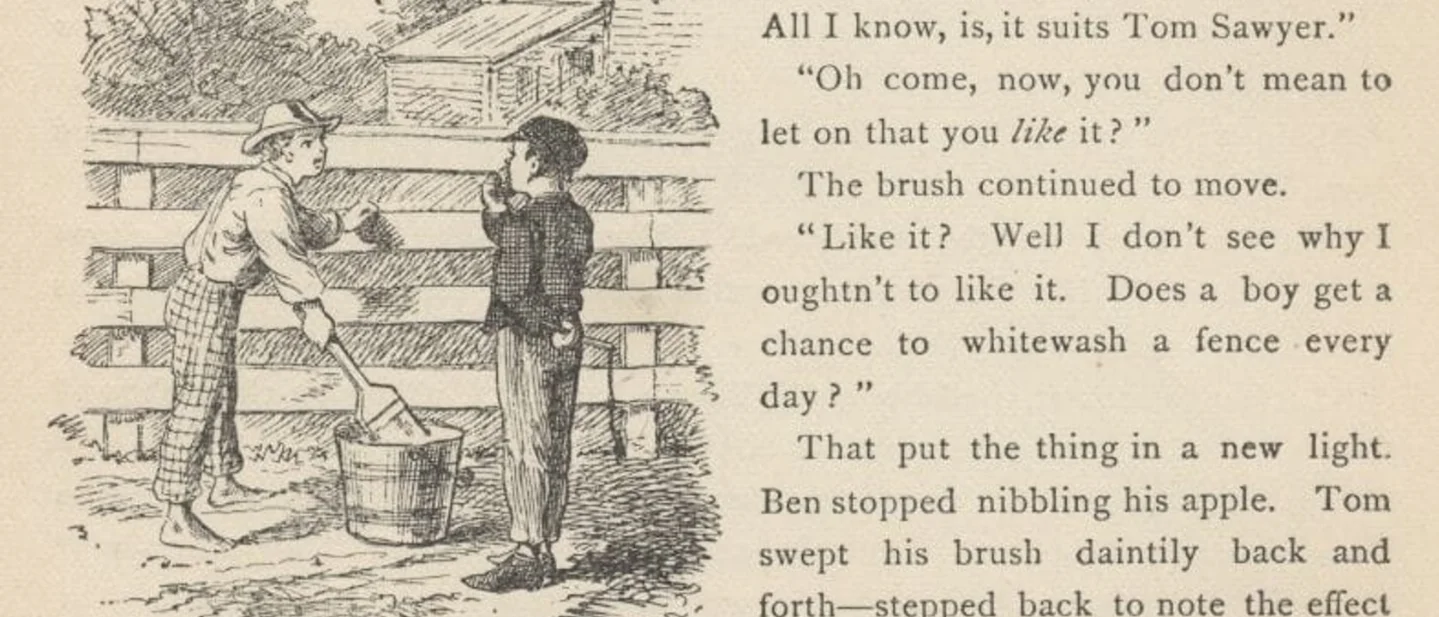
In Chapter II of *The Adventures of Tom Sawyer*, Tom turns Aunt Polly's punishment into a scarce privilege, until Ben offers his apple for a turn at the brush.

The fence is a punishment, the morning is bright, and Ben Rogers is on his way to go swimming. Tom's problem is simple: how can he make an unwanted task look like a choice someone else would pay to make?
Mark Twain published The Adventures of Tom Sawyer in 1876. The novel follows boyhood in the Mississippi River world of the 1830s and 1840s; this scene comes from the second chapter, where Aunt Polly assigns Tom a stretch of fence to whitewash. 1
The passage
Mark Twain (Samuel Langhorne Clemens), The Adventures of Tom Sawyer (1876), Chapter II, the whitewashing scene. The wording below follows the Project Gutenberg text of the novel. 2
“Say, Tom, let me whitewash a little.”Tom considered, was about to consent; but he altered his mind:“No—no—I reckon it wouldn’t hardly do, Ben. You see, Aunt Polly’s awful particular about this fence—right here on the street, you know—but if it was the back fence I wouldn’t mind and she wouldn’t. Yes, she’s awful particular about this fence; it’s got to be done very careful; I reckon there ain’t one boy in a thousand, maybe two thousand, that can do it the way it’s got to be done.”“No—is that so? Oh come, now—lemme just try. Only just a little—I’d let you, if you was me, Tom.”“Ben, I’d like to, honest injun; but Aunt Polly—well, Jim wanted to do it, but she wouldn’t let him; Sid wanted to do it, and she wouldn’t let Sid. Now don’t you see how I’m fixed? If you was to tackle this fence and anything was to happen to it—”“Oh, shucks, I’ll be just as careful. Now lemme try. Say—I’ll give you the core of my apple.”“Well, here—No, Ben, now don’t. I’m afeard—”“I’ll give you all of it!”Tom gave up the brush with reluctance in his face, but alacrity in his heart. 2
Gloss
- “Awful particular”: extremely strict or fussy. Here, Tom makes Aunt Polly's ordinary demand sound like a technical standard.
- “One boy in a thousand, maybe two thousand”: an obvious exaggeration. Tom turns scarcity into evidence that the job requires rare skill.
- “Honest injun”: a dated oath meaning “I am telling the truth,” built from racist language. The phrase belongs to the period voice of the novel; it is worth hearing as part of the scene's childish performance rather than repeating as a neutral expression. 2
Close read
The device here is dramatic irony: readers know that the fence is Aunt Polly's punishment, while Ben sees only Tom's controlled reluctance. That gap lets Tom sell the task without ever openly praising it.
Watch the mechanics of the exchange. Tom first refuses in the language of risk: Aunt Polly is “awful particular,” the fence is exposed to the street, and only one boy in a thousand could do the work properly. He does not claim that whitewashing is pleasant. He claims that access to it is rare and that failure would be dangerous. The chore becomes a privilege through scarcity and restricted entry.
Ben's language then follows the new frame. He stops mocking Tom and begins negotiating: first he asks to try, then he promises care, then he offers the core of his apple, and finally the whole apple. Tom's pauses are part of the performance. “I’m afeard—” keeps the price rising; the narration exposes the trick by separating his face from his heart. Reluctance is visible, but “alacrity” is the truth underneath it. The brush changes hands only after Tom has made desire do the work of persuasion.
Why it still matters
Tom's small scheme is funny because the object never changes. The fence remains a fence, and the work remains work. What changes is the story attached to it: a punishment becomes a rare chance to demonstrate skill. Twain catches a durable feature of persuasion here—people may want an unwanted thing once someone makes it look chosen, difficult, and almost unavailable.
Reflection
What ordinary task in your life has changed shape when someone else treated it as a privilege—and did the new frame alter the task, your willingness, or both?
References
- 1Project Gutenberg, *The Adventures of Tom Sawyer*gutenberg.org
- 2

Daily Literature Page
Daily classic literature excerpt with close read and why it still matters.
This story was produced automatically by a channel. One sentence is all it takes for Neodrop to keep producing for you.
Related content
- Sign in to comment.