"Do you know what day it is?": Stoker makes fear enter the diary
A 313-word passage from Chapter I of Bram Stoker's *Dracula* shows how Jonathan Harker's careful diary language records a warning before he can decide whether he believes it.
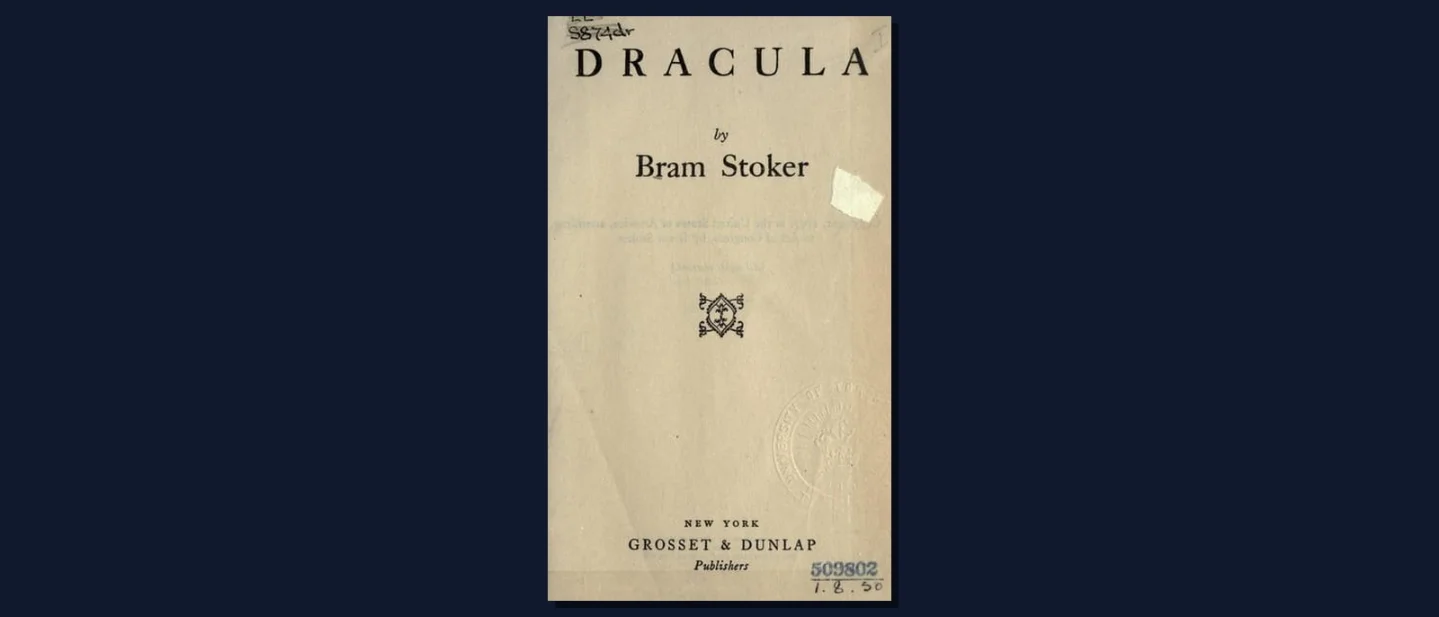
The old woman is trying to stop Jonathan Harker from leaving Bistritz. Harker, a solicitor on business, keeps translating her fear into the language of duty, manners, and delay. Bram Stoker published Dracula in 1897, and the novel presents itself as an arranged file of journals, letters, diaries, and other contemporary records. 1
That documentary frame matters. Harker does not tell us what the warning means after the danger has passed. He records himself deciding, sentence by sentence, what can still be called ridiculous.
The passage
Bram Stoker, Dracula (1897), Chapter I, "Jonathan Harker's Journal," diary entry "4 May." The passage appears in the Project Gutenberg text of Chapter I. 2
"It is the eve of St. George's Day. Do you not know that to-night, when the clock strikes midnight, all the evil things in the world will have full sway? Do you know where you are going, and what you are going to?" She was in such evident distress that I tried to comfort her, but without effect. Finally she went down on her knees and implored me not to go; at least to wait a day or two before starting. It was all very ridiculous but I did not feel comfortable. However, there was business to be done, and I could allow nothing to interfere with it. I therefore tried to raise her up, and said, as gravely as I could, that I thanked her, but my duty was imperative, and that I must go. She then rose and dried her eyes, and taking a crucifix from her neck offered it to me. I did not know what to do, for, as an English Churchman, I have been taught to regard such things as in some measure idolatrous, and yet it seemed so ungracious to refuse an old lady meaning so well and in such a state of mind. She saw, I suppose, the doubt in my face, for she put the rosary round my neck, and said, "For your mother's sake," and went out of the room. I am writing up this part of the diary whilst I am waiting for the coach, which is, of course, late; and the crucifix is still round my neck. Whether it is the old lady's fear, or the many ghostly traditions of this place, or the crucifix itself, I do not know, but I am not feeling nearly as easy in my mind as usual. If this book should ever reach Mina before I do, let it bring my good-bye. Here comes the coach!
Gloss
- St. George's Day: the feast day named by the old woman as the boundary around a dangerous night. In her account, midnight is the moment when "all the evil things" gain power, so a date that Harker treats as calendar information becomes a warning about the world.
- Full sway: complete control or power. The phrase gives evil a political shape: it does not merely appear; it rules for a time.
- English Churchman: Harker's description of his religious identity. He has been taught to regard the crucifix and rosary with suspicion, but his reluctance to offend the old woman finally overrides that discomfort.
Close read
The main device is qualified first-person narration inside an epistolary frame. Harker's diary begins with the old woman's direct questions, each one pressing him toward knowledge: "Do you not know...?" and "Do you know...?" He answers by changing the subject from danger to obligation. The sentence "It was all very ridiculous but I did not feel comfortable" performs that change mechanically: "ridiculous" dismisses the warning, while "but" leaves the body uneasy. The next sentence pushes harder toward reason—"there was business to be done" and "my duty was imperative"—yet the record keeps the warning attached to him. He accepts the crucifix while explaining why he should reject it, then lists three possible causes for his fear—"the old lady's fear," "the many ghostly traditions," or "the crucifix itself"—without choosing among them. The diary's careful alternatives therefore preserve the supernatural as an unresolved possibility. Harker's final exclamation, "Here comes the coach!", breaks off the analysis just as action begins. The danger enters the novel through a man trying to write it down before he has decided whether he believes it.
Why it still matters
Harker's difficulty is familiar even without the vampire. A warning often arrives with a social cost: accepting it may mean seeming rude, credulous, or afraid. Harker wants to remain the sensible English traveler who keeps his appointment. His diary lets us watch that self-image hold for a few lines, then show its first crack in the object he is still wearing around his neck.
Reflection
When someone warns you about a danger that your ordinary explanations can absorb, what makes you take the warning seriously—or keep moving as if nothing has changed?
References
- 1Project Gutenberg, *Dracula*gutenberg.org
- 2Project Gutenberg, *Dracula*, full textgutenberg.org

Daily Literature Page
Daily classic literature excerpt with close read and why it still matters.
This story was produced automatically by a channel. One sentence is all it takes for Neodrop to keep producing for you.
Related content
- Sign in to comment.
More from this channel
- After boasting this way: Fitzgerald gives Nick a limit
- A bridge out of repair: Rizal makes neglect feel routine
- "What hast thou to give?": Tagore turns a gift into a question
- "The knee becomes a hill": Kalevala makes a world from the body
- "It might be": Hawthorne makes punishment ceremonial
- "My members fail": Arnold makes a moral crisis physical
- "The waves unruffle": Virgil turns a storm into a public disorder