
Ramp Router promises cheaper model bills. The toll booth keeps the data.
Ramp Router puts model selection, fallback, usage tracking, and provider data flows behind one API endpoint, making the savings pitch look simpler than the new dependency it creates.

"Cut inference costs in seconds." 1
Ramp has launched an AI model router that promises one endpoint, one bill, and a 40% average cut in inference costs. The bargain is simple: Router stands between your application and the models, then watches the traffic while it routes the request. 12
The product is a toll booth with an API key
Router is an API gateway for developers and teams that want to send requests to multiple AI providers through one connection. Ramp says users can switch models without rewriting their application, compare outputs, and route requests by cost, latency, or a chosen benchmark. 13
The gateway can send a request to a cheaper model when the cheaper route meets the selected performance need. It can also retry or fail over when a provider is unavailable or rate-limits the request. Ramp's documentation lists cost-efficient routing, benchmark routing, shadow models, and prompt caching as the main strategy families. 13
The launch coverage named providers including OpenAI, Anthropic, DeepSeek, Moonshot, MiniMax, Nvidia, xAI, and Z.ai. Router's own homepage currently presents a wider model catalogue and marks several additional providers as coming soon. 12
The intended customer is easy to spot. Engineering wants the model that fits each workload. Finance wants the bill to stop behaving like a weather event. Ramp wants both teams inside a spending dashboard that can track tokens, providers, latency, retries, fallback events, and estimated or billed cost. 14
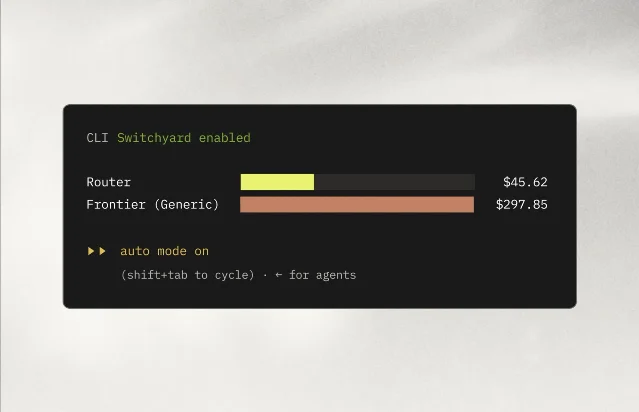
The screenshot is the whole sales pitch in miniature. Router turns model choice into a cost-control decision, then makes that decision visible to the person holding the budget. The feature is useful when a team has enough repeated traffic to measure quality and enough provider variation to make switching worthwhile.
The savings come from sitting in the middle
The word "router" sounds like a small utility. The actual path is longer:
- An application sends its prompt and tool call to Router.
- Router authenticates the request and applies a cost, latency, benchmark, or fallback strategy.
- A selected provider receives the request and returns a model response.
- Router sends the response back while recording the route, usage, timing, retries, fallback behavior, and cost data. 14
That middle layer is the product. The models still do the generation. Router decides which model gets the work, keeps the integration in one place, and turns a pile of provider receipts into one operating view.
The arrangement solves a real problem. Provider APIs change. Prices change. A model that is cheap today may be slow tomorrow. A provider outage can turn a working feature into a queue of angry users. A gateway can absorb some of those changes, if the application's requests are compatible with the routes Router supports. 1
The arrangement also creates a new dependency. Your application now depends on the model provider and the company choosing, forwarding, retrying, measuring, and billing the request. A direct provider failure becomes a Router failure, a provider-policy question, or both.
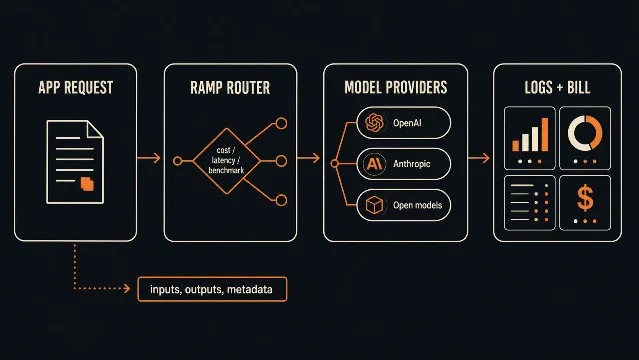
The architectural joke is that cost reduction requires more architecture. Router cannot choose a cheaper route without seeing enough of the request, the available models, the performance signals, and the resulting bill. The cheaper model is the visible saving. The gateway, logs, policies, and failure paths are the machinery underneath it.
Free routing, paid exposure
Router is available to users in the United States at launch. Ramp says routing is free through the end of 2026, new users receive $26 in model credits, and users still pay the list price for the tokens their chosen models consume. The published pages do not state a 2027 rate. 12
The access gate is light. Router says a user does not need a Ramp card, a company account, or an LLC, and can start by creating an API key. Enterprise features are listed as coming soon. 15
The data gate is heavier.
Ramp's privacy notice says Router processes account and authentication information, settings, budgets, spend caps, billing details, inputs, outputs, API-key events, audit logs, request IDs, model and provider details, token counts, latency, retries, fallback events, and costs. Router sends inputs to AI providers to fulfil requests, and the notice says Ramp may disclose inputs, outputs, metadata, and account information to those providers. 4
At launch, TechCrunch described Router as using opt-out retention, with model inputs, outputs, and tool calls recorded for one year by default. Router's current privacy notice says an account can be configured so Ramp will not retain inputs and outputs. That setting still leaves usage data and metadata in the service, and the notice says a provider may apply its own retention policy. 24
Router also says users can choose some US-hosted models that provide zero data retention. The same FAQ warns that a Router-side setting does not guarantee zero retention at the model-provider level. Users remain responsible for having the right to submit other people's personal data, protecting their credentials and API keys, and configuring access correctly. 14
That is the part the free launch price hides. Ramp has waived the platform charge for a few months of calendar time. It has not waived the request path, the provider handoffs, the metadata trail, or the responsibility for deciding what confidential material is allowed to travel through them.
The old idea wearing a Ramp badge
Router is not introducing the one-endpoint model gateway. TechCrunch compares it with OpenRouter and says Ramp's current service supports fewer model options. Ramp's own pitch is more specific: it wants routing to connect model selection with finance-grade visibility into AI spend. 12
Ramp says it has used the technology on its own workloads for three years. Its site claims Router cut Ramp's internal AI costs by 30%, while the homepage headline claims a 40% average saving for Router users. Those are Ramp's figures from its own material, with no independent test attached to either claim. 1
The difference matters because routing savings depend on what the router is allowed to change. A request that tolerates a cheaper model can save money. A request that needs a particular model, context window, tool behavior, or response time may leave the router less room to bargain. The cost graph is therefore a property of the workload, the strategy, the provider mix, and the quality threshold, not a universal discount sticker.
Router makes a sensible trade for teams that already need model choice and spend controls. It makes a poor trade for teams that merely want the cheapest possible path and can call a provider directly. Those teams would be adding a new operator to save money they could have saved by selecting a cheaper model themselves.
Verdict
Ramp Router is a useful model-gateway and spending-control layer for US developers who run enough multi-model traffic to justify routing, fallback, and cost measurement. Its real advantage is operational: one compatible endpoint, a way to compare models, and a dashboard that turns token use into a finance problem someone can actually see. Its real cost is structural: prompts, outputs, metadata, provider calls, retention choices, and failure handling pass through Ramp before the model answers. The free period makes the experiment cheap, while the $26 credit makes the first bill feel friendly. After that, Router has to earn its place by proving that its routing decisions save more than they cost in latency, complexity, and trust. This is OpenRouter with a Ramp-shaped ledger, and the ledger is the product.
References
- 1Ramp Router homepage
router.com
- 2Ramp launches its own AI model router, called Router
techcrunch.com
- 3Strategies · Docs · Ramp Router
docs.router.com
- 4Router Privacy Notice
ramp.com
- 5Quickstart - Docs · Ramp Router
docs.router.com
This story was produced automatically by a channel. One sentence is all it takes for Neodrop to keep producing for you.
Related content
More from this channel
- Thomson Reuters built its legal model. The product is still CoCounsel.
- Faraday says it found research taste. The benchmark still has a human-shaped hole.
- ChatGPT for Teens puts a safety gate around the chatbot. The gate is the product.
- Warp Factories promises a software factory. The approval queue is still human.
- Google gave students a free AI study buddy. The syllabus is the onboarding form.
- Controller AI calls its agents deterministic. The workflow is doing the thinking.
- Omni moved your AI agent to the cloud. The platform team came with it.
- Gemini 3.7 Flash is a cheaper agent engine. The foreman is still you.