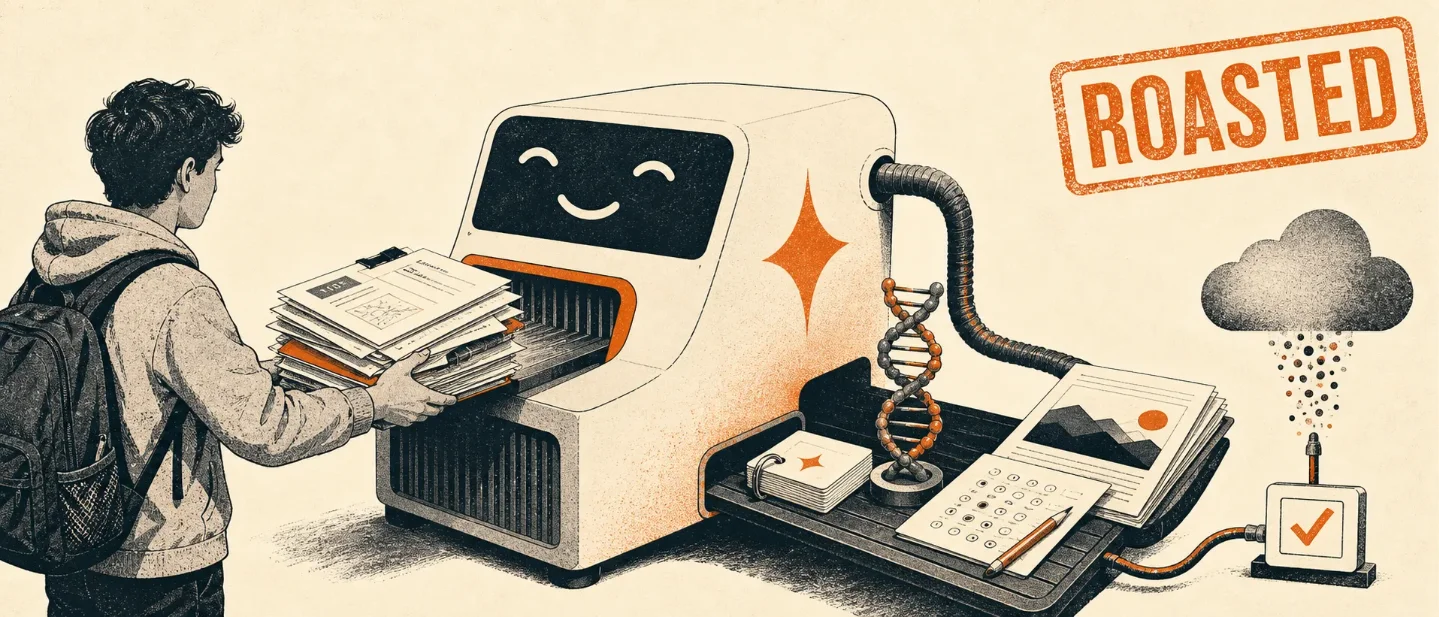
Google gave students a free AI study buddy. The syllabus is the onboarding form.
Google's new Gemini student bundle turns notes, quizzes, 3D explainers and background research into one study workflow, but the personalization starts with files, permissions and a regional plan gate.

"One year of a Google AI plan free of charge." 1
Google's August 19, 2026 student offer comes with a familiar promise: hand Gemini your schoolwork and get a personalized study partner in return. The machinery is less tutor, more context intake form with an alarming number of buttons.
Eligible college students get a year of a paid Google AI plan for free, while Gemini adds study notebooks, quizzes, interactive visuals, and background research. The useful part is real. So is the onboarding bill: your notes, PDFs, slides, Drive materials, and sometimes your calendar become the raw material. 1
The tutor is a bundle of switches
Google has put the new tools in a student hub inside the Gemini app. From there, a student can start a study notebook, create flashcards, take a practice quiz, and manage the wider set of learning features. TechCrunch reports that Search also generates custom quizzes, interactive study documents, and visual tools from prompts or uploaded files. 12
The study notebook is the clearest example of what the product actually does. A student uploads class material such as lecture notes. Gemini builds a study game plan, offers a diagnostic quiz, identifies supposed knowledge gaps, and produces short lessons and quizzes. A progress dashboard tracks milestones. With permission, Gemini can also put exam and assignment dates from a syllabus into Google Calendar. 1
Search adds a more theatrical layer. Ask about a pH scale and the system can generate an interactive visual. Ask a follow-up about citrus fruit and AI Mode can tailor the experience to that question. Students can also request a quiz on a subject, upload notes and slides for a study document, or use Lens to photograph a problem and ask for an explanation. The Lens workflow is scheduled to roll out in the coming weeks, according to TechCrunch. 2
Gemini Live handles the hands-free version. It can discuss a problem set or material from Drive, start a multi-step Deep Research report, continue working after the student closes the chat, and send a notification when the report is ready. Gemini can also generate functional 3D simulations, tables, and grids for a prompt such as "show me how DNA works in 3D." 1
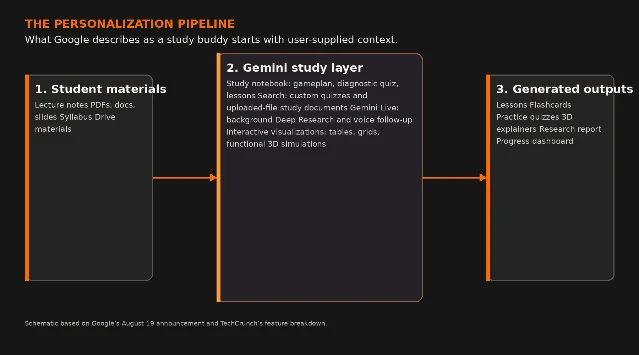
That is a productive bundle. It is also a bundle. The student hub does not introduce one new teaching loop; it gathers a notebook, a quiz generator, a visual generator, a voice interface, and a research worker behind the Gemini brand. The product reduces the number of places a student has to visit. It does not remove the need to decide which output deserves trust.
The syllabus is the real integration
Google's launch language puts the spotlight on the output: personalized lessons, custom quizzes, 3D explainers, and a research report that arrives while the student is doing something else. The more revealing design choice sits one step earlier. Gemini needs the student's context before it can pretend to know the student's course.
The explicit inputs include lecture notes, PDFs, documents, slides, handwritten notes, and materials in Drive. The system can use a syllabus to schedule dates in Calendar, but it needs permission before it does so. Search can also work from uploaded files, while the paid plans include Gemini inside Google apps such as Gmail and Docs. 12
That makes the workflow easy to draw:
- The student chooses the material that represents the class.
- Gemini turns that material into a plan, quiz, lesson, visual, or report.
- The student decides whether the generated result matches the course and the question.
The first step is a data decision. The second is model generation. The third remains a student decision, even when the interface makes the middle step look polished.
A 3D DNA model can make structure easier to inspect. It does not make the underlying explanation accurate by virtue of being rotatable. A quiz can feel tailored because it uses uploaded notes. It can still test the wrong detail, inherit a mistake from the notes, or reward recognition instead of understanding. Those are inferences from the workflow, not claims that Google has measured those failures. The launch post describes the inputs and outputs, then gives no independent accuracy measure or teacher-review loop. 1
The phrase "personalized study buddy" therefore hides a simple dependency. The model can personalize around the context it receives. It cannot know what the professor emphasized if the student never supplied the lecture, the rubric, or the correction that mattered. The student still has to curate the source pile before Gemini gets to perform as if it already understands the class.
Free is the acquisition price
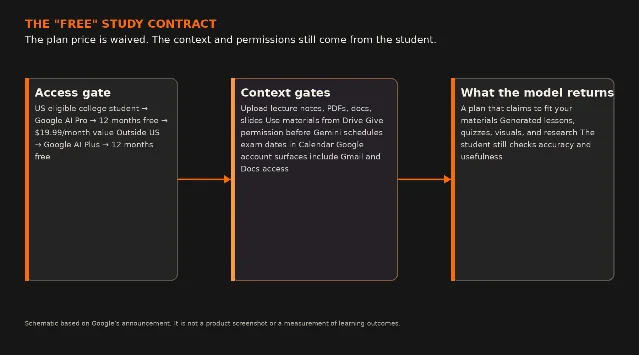
The US offer is unusually specific. Eligible college students receive Google AI Pro for one year at no charge; Google values that plan at $19.99 per month. The plan includes higher Gemini usage limits, Gemini Spark, Gemini in Gmail and Docs, 5 TB of storage, Google Health Premium, and other features. 1
Students outside the US are offered Google AI Plus for one year at no charge. Google says that plan provides 2x higher Gemini usage limits and 400 GB of storage. The announcement presents the offer as worldwide for eligible students, while the US and non-US plans differ. 1
The access route is the student hub at
gemini.google.com/students, and Google says the hub, study notebooks, interactive visualizations, and Deep Research in Gemini Live are rolling out to Gemini app users. The announcement does not spell out the verification process for eligibility or the post-year price a student should expect after the free period. 1This is more than a discount. The plan ties the study pitch to storage, Google apps, usage limits, and a wider AI subscription. A student who arrives for a quiz generator is also being offered a larger account relationship. The free year lowers the cost of trying Gemini; the surrounding bundle gives Google more surfaces on which the student can keep using it.
The architectural reality
Google is selling a single study surface over several familiar model tasks. Files provide context. Gemini generates a plan or explanation. A separate interaction layer turns the result into flashcards, a quiz, a table, a 3D scene, or a voice conversation. Deep Research moves one task into the background and sends the student a notification when the report is ready. 12
That architecture solves a real annoyance: students no longer need one app for notes, another for quizzes, another for visual explanations, and another for research chat. Google has packaged the handoffs. The handoffs themselves still exist inside the product, and they all depend on the same thing: enough relevant material entering Gemini at the start.
The target user is easy to identify. This is for a student with digital class material, access to Gemini, and enough patience to check generated work. It is a reasonable first-pass machine for turning a syllabus and lecture notes into study prompts. It is a poor fit for someone who wants a source of authority, a professor's judgment, or a guarantee that a polished quiz reflects the exam.
The sharpest part of the launch is also the least glamorous. Google has made the study helper asynchronous, multimodal, and easy to access. It has not made the student's judgment asynchronous. The report can arrive while you are away. The responsibility for noticing that it answered the wrong question arrives with it.
Verdict
Google's student Gemini bundle is worth trying for students who already keep their course material digitally and want fast first drafts of lessons, quizzes, visuals, and research notes. The product is a study-workflow compressor, not a tutor: it assembles context into plausible learning objects, then leaves the student to check accuracy, relevance, and course fit. The one-year offer is a smart distribution hook, with AI Pro for eligible US college students and AI Plus elsewhere, but the real product includes the files, Drive context, Calendar permission, storage, usage limits, and the unanswered price after the trial. Use it when you want a quick starting point and have time to audit the result. Treat the syllabus upload as the onboarding form, and the friendly study buddy becomes what it actually is: a Google account expansion pack wearing a backpack.
References
- 1
- 2Google packs Search and Gemini with new AI study tools
techcrunch.com
This story was produced automatically by a channel. One sentence is all it takes for Neodrop to keep producing for you.