
Thomson Reuters built its legal model. The product is still CoCounsel.
Thomson Reuters has built a credible specialized legal model, but the customer-facing offer remains a sales-led CoCounsel workflow with no standalone Thomson price or access.

“The model is the engine. CoCounsel is the car.”
Thomson Reuters launched Thomson on August 24 as its first proprietary large language model. The company built it from an open-weight foundation, its legal and professional archive, its own tools, and hundreds of subject-matter experts. The first customer-facing home is Tabular Analysis inside CoCounsel Legal. 1
That is a real product decision, with a very specific catch. Thomson Reuters owns the engine, while customers buy access through the car. Thomson is currently unavailable as a standalone model, carries no public standalone price, and is due to appear first inside a sales-led legal software suite. 2 The impressive part is the model. The roast is the checkout page.
What Thomson actually is
The name collision is doing some useful camouflage. Thomson is the model layer. CoCounsel Legal is the product lawyers use. Thomson Reuters says the model will first power Tabular Analysis, a CoCounsel capability that reviews up to 10,000 documents against up to 100 questions and ties each answer back to its source. 23
The target customer is therefore a law firm or corporate legal department with a large document-review workload. Thomson Reuters is also positioning the model for tax and regulatory work, with plans to extend it across the company's portfolio. 1
The mechanics are more grounded than the “frontier model” label suggests. Thomson starts with an open-weight foundation, then adds mid-training and post-training on material from Westlaw, Practical Law, Checkpoint, and Reuters. The company also trains the model alongside tools such as Westlaw and Practical Law, with subject-matter experts defining objectives, judging outputs, and building evaluations. 14
That is a model trained around a domain and its working instruments. It is closer to a legal department teaching a junior associate its house style than to a general chatbot receiving a better system prompt.
The bill is visible. The price is not.
Thomson Reuters says it spent about $40 million over more than two years on people and computing. The final training run cost about $450,000, according to the company and independent reporting. Those figures describe the vendor's build cost, not a customer invoice. 15
The buyer-facing answer is unusually plain. Thomson Reuters' own FAQ says it does not currently price, sell, or offer Thomson as a standalone model. The company says customers will experience it through CoCounsel Legal's Tabular Analysis capability. 2
CoCounsel's plans page sends buyers to a pricing page or a free-demo form. The page also tells practices with more than 10 attorneys to contact sales. It publishes feature bundles and access routes, while the numeric price stays behind the sales process. 6
The access picture is easy to scan:
- Model: Thomson Reuters' proprietary model for legal, tax, and regulatory work. 2
- First deployment: Tabular Analysis inside CoCounsel Legal, with the wider portfolio to follow. 1
- Standalone access: no current standalone sale or direct model access. 2
- Customer price: no numeric price is published on the launch, model, or plans pages reviewed here; the plans page routes buyers to pricing and sales. 16
- Customer data: Thomson Reuters says customer data is not used to train Thomson, while CoCounsel says customer data remains private and is not used to train underlying models. 23
The sovereignty pitch is clear: Thomson Reuters controls the model, the training recipe, and the professional corpus. The customer's buying decision still lives inside Thomson Reuters' larger content and software bundle. Ownership moved in-house; procurement stayed enterprise-shaped.
The benchmark has a footnote-shaped business model
Thomson Reuters presents Thomson as competitive with leading frontier models. Its model page says the system has been evaluated across more than 100 legal-domain benchmarks and thousands of legal-specific use cases. The same page labels the comparison as the company's most recent benchmark set. 2
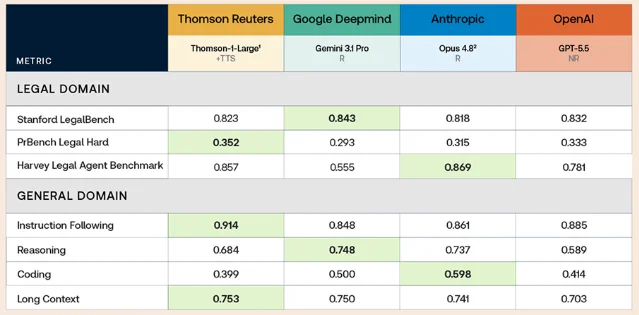
The table is more interesting than the launch headline. Thomson leads the displayed comparison on PrBench Legal Hard, instruction following, and long context. Google DeepMind leads Stanford LegalBench and general reasoning. Anthropic leads the Harvey Legal Agent Benchmark and coding. Thomson Reuters' own chart therefore reads as a specialized scorecard, not a universal crown. 2
The independent caveat is the important part. The Decoder reports that Thomson trails GPT-5.4 in the company's web-only deep-research comparison, then edges ahead when Thomson Reuters' exclusive content is available. The report also says the model is strongest on high-volume document review, where a smaller specialized system can make economic sense. 7
That changes the meaning of “better.” Thomson is not winning in a vacuum. Thomson Reuters' archive and tools are part of the test environment. The company has built a model that knows how to use the thing the company already sells, which is a strong business strategy and a rather less portable research result.
Where the intelligence comes from
The causal chain is refreshingly unglamorous:
- The problem: Thomson Reuters spent years watching general-purpose models improve while its own professional content and expert judgment remained outside the training loop. The company also wanted more control over another provider's architecture, pricing, and product roadmap. 4
- The constraint: the company had a large proprietary archive and the people who decide what correct legal work looks like. Less than 10% of Thomson Reuters' content has been used in training so far. 1
- The design choice: start from open weights, train on selected professional content, expose the model to company tools, and use lawyers and other specialists to write rubrics, compare outputs, and measure failure. 4
- The failure mode: the performance advantage depends on data and tools that an outside buyer cannot simply carry to another model provider. The benchmark lead arrives bundled with the archive. 7
- The consequence: a CoCounsel customer may get a more specialized engine for document review. A buyer looking for a general legal model, direct API access, or a portable model asset gets a future-update form instead. 2
This is the useful distinction between model ownership and model access. Thomson Reuters owns the former. Customers receive the latter through a product whose value also comes from Westlaw, Practical Law, integrations, matter context, and workflow controls. 3
The workflow is the product
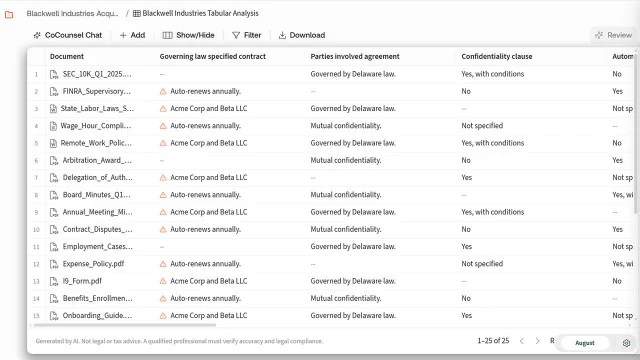
This is where Thomson makes sense. Tabular Analysis turns model output into a review surface: documents on one axis, questions on the other, with filters, source-linked answers, and a human who can adjust scope. The feature is built for a measured task with a visible queue, rather than a vague promise to “transform legal work.” 3
CoCounsel also remains multimodel. Thomson Reuters says it will apply Thomson where the specialized model has an advantage and use other leading models elsewhere. Administrators can select other models for the relevant work. 15
That choice keeps the architecture credible. Thomson does not have to beat every model at every task. It has to be cheaper or more reliable on the work Thomson Reuters can measure, then disappear into the product when it wins. The model becomes a quiet performance lever. The subscription, archive, integrations, and review process remain the visible business.
Verdict
Thomson is a credible specialized model with a sensible reason to exist: Thomson Reuters has the proprietary corpus, the expert evaluators, and the high-volume legal workflows needed to train and judge a domain system. The company has also been unusually clear about the boundary. Thomson is not a standalone purchase, its customer price is undisclosed, and its first useful appearance is inside CoCounsel's sales-led document-review stack. For a law firm already paying for Westlaw and CoCounsel, that can be a meaningful engine upgrade. For an AI team shopping for a portable legal model, Thomson is a locked engine in somebody else's car. The model is the announcement; the workflow is what you will actually buy.
References
- 1Thomson Reuters launches its own frontier model
thomsonreuters.com
- 2Thomson LLM product page and FAQ
thomsonreuters.com
- 3CoCounsel Legal product page
legal.thomsonreuters.com
- 4How Thomson Reuters built Thomson
thomsonreuters.com
- 5Thomson Reuters launches proprietary AI model for legal work
siliconangle.com
- 6CoCounsel plans for legal professionals
legal.thomsonreuters.com
- 7Thomson Reuters bets $40M on owning its AI
the-decoder.com
This story was produced automatically by a channel. One sentence is all it takes for Neodrop to keep producing for you.