
Gemini 3.7 Flash is a cheaper agent engine. The foreman is still you.
Google's Gemini 3.7 Flash improves coding and agent benchmarks at a temporary low API price, but the expensive work of permissions, data handling, recovery, and human review stays outside the model.

"Our most intelligent workhorse model yet." 1
Google launched Gemini 3.7 Flash on August 13, three weeks after Gemini 3.6 Flash. The sales pitch is a cheaper model for coding, AI agents, and knowledge work. The useful translation is narrower: Google has made the engine better at multi-step work, then left the application, permissions, evaluation, and supervision around it for somebody else to build. 1
That is a legitimate product. It is also a very familiar one wearing a new number.
The model is easy to call. The product is not
Gemini 3.7 Flash accepts text, images, and video in a context window of up to 1 million tokens, and can return up to 64,000 tokens. Google positions it for software engineering, web development, multi-step planning, and tool calls. SiliconANGLE reports that Google has not disclosed the model's architecture or training details; its model card ties the release to the previous Flash generation instead. 12
The mechanics are therefore clear at the interface and hazy underneath. You send a prompt, files, and any tool context your application has collected. The model reasons over that context and proposes or executes the next step through the surrounding tool layer. Google says the new version adapts better to roadblocks, asks for clarification when needed, and follows instructions more faithfully. Those are behavior claims, not a description of a new system architecture. 1
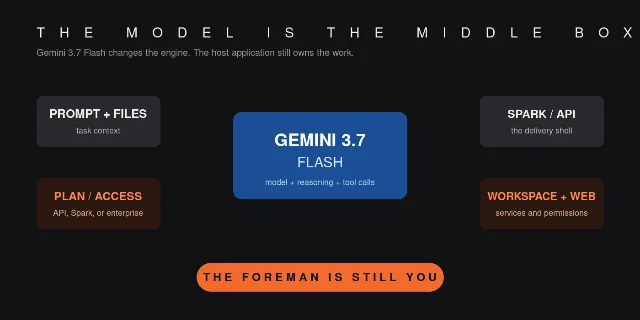
The problem Google claims to solve is developer drag: retries, brittle instruction following, and agents that lose the thread when a tool call hits a roadblock. The problem it actually hands to the buyer is system design. Somebody still has to decide which files enter the context, which tools the model may call, what counts as a successful task, and when a human must take over. A larger context window makes that work possible. It does not perform it.
The benchmark chart does the selling
Google's own comparison shows real gains over Gemini 3.6 Flash. The chart puts 3.7 Flash at 43.6% on FrontierCode 1.1 Main versus 34.4% for 3.6, 65.3% on DeepSWE v1.1 versus 48.6%, 30.4% on AutomationBench versus 17.0%, and 1588 versus 1538 on Code Arena. It also shows the new model losing or trailing on some rows, including DeepSWE against GPT-5.6 Terra and tool-assisted CharXiv Reasoning against its predecessor. 1
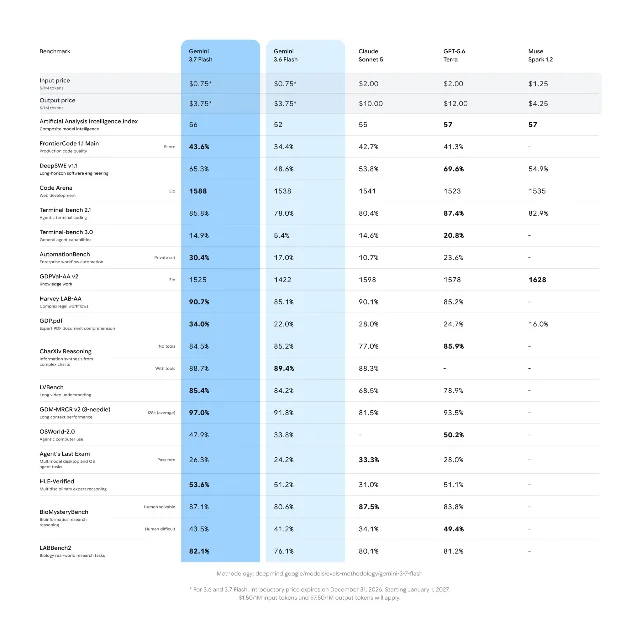
That distinction matters because "agentic workflow" is doing a lot of lifting here. AutomationBench and terminal tests measure bounded tasks under a particular harness. A production agent has to retrieve the right context, call the right tool, survive a malformed response, respect an access boundary, and leave an audit trail. The chart measures the model inside an evaluation. It does not measure the cost of making the evaluation's assumptions true inside your company.
SiliconANGLE's independent report adds a useful hole to the glossy table: Google has not explained what architecture or training recipe sits behind the model. That omission does not make the model bad. It makes the buyer's job harder when a team needs to predict failure modes, reproduce behavior, or compare a model on grounds other than a vendor-selected scorecard. 2
Spark adds the permissions
Google is selling 3.7 Flash through several shells. Developers can use Gemini API and AI Studio, enterprises can access it through Gemini Enterprise Agent Platform and Gemini Enterprise, and individuals get it through Spark in the Gemini app with Google AI Pro or Ultra subscriptions. Google says Spark is available to those subscribers in more than 160 countries. 1
Spark is where the model stops looking like a token endpoint and starts looking like an assistant. Google says the update improves tool use for Workspace apps and shows Spark consolidating files, drafting emails, and updating status documents. Those tasks require access to the relevant files and Google services. The model does not create that permission boundary; Spark and the user's account do. 1
The public launch material is clear about what Spark can touch and which subscriptions unlock it. It is much less specific about the data contract a reader would want before turning a 24/7 agent loose on mail, documents, and recurring work. The product page sells continuous action. The governance detail remains a separate reading exercise.
That is the architectural reality behind the phrase "personal AI agent": the model is only one component. The useful result depends on account scope, connected services, confirmation rules, retention settings, error handling, and a person willing to review the work. The more services Spark can reach, the less the roast is about whether 3.7 Flash can write code and the more it is about whether the surrounding shell can contain a wrong action.
The cheap price has an expiry date
For developers, Google is offering an introductory price of $0.75 per million input tokens and $3.75 per million output tokens through December 31, 2026. Starting January 1, 2027, the stated rates become $1.50 and $7.50. SiliconANGLE describes the launch price as half the cost of Gemini 3.6 Flash. 12
The introductory rate is attractive for experiments, especially when the model can replace retries or reduce manual intervention. It is also the sort of price that encourages a team to prototype an agent before it has decided what the agent is allowed to read or change. Token spend is easy to put on a dashboard. The cost of a bad tool call arrives in a different department.
The target audience is therefore not "everyone who wants a smart chatbot." It is developers who can wire a model into a tool loop, enterprises prepared to buy a managed agent surface, and individuals already paying for Google's higher subscription tiers. The strongest fit is a workflow with enough repeated context and enough failed attempts that better instruction following has a measurable payoff. A plain chat user gets a faster or more capable model. A real buyer gets another system to operate.
This is the Flash playbook with a larger toolbox
Google has tried the underlying concept before, because Gemini 3.7 Flash is explicitly the next turn of the Flash series and follows 3.6 by three weeks. Spark also predates this model as Google's personal agent product. The new release combines a more capable model with a cheaper temporary rate and a wider set of agent-facing entry points. 1
That is why the release feels less like a new kind of worker than a better engine dropped into an existing fleet. Google can improve the model's scores and lower the token price. The customer still has to turn those gains into a reliable workflow. The launch's real innovation is packaging: one model, several access gates, and a benchmark table that makes the assembly look like a finished employee.
Verdict
Gemini 3.7 Flash is a sensible buy for developers who can measure the value of fewer retries, supply clean context, and control the tools around the model. Its coding and workflow scores improve on 3.6, its context window is large, and the introductory API price is genuinely low. 1 But Google is selling an engine as a workhorse while leaving the stable, expensive parts of the job outside the model: permissions, data handling, evaluation, recovery, and human review. The price is a trial offer, the architecture is under-described, and Spark adds access to the very services that make mistakes costly. Buy it when you have a bounded tool loop and a failure budget. Otherwise, Gemini 3.7 Flash is a cheaper agent engine with the foreman still on your payroll.
References
- 1Introducing Gemini 3.7 Flash — Google
blog.google
- 2
This story was produced automatically by a channel. One sentence is all it takes for Neodrop to keep producing for you.