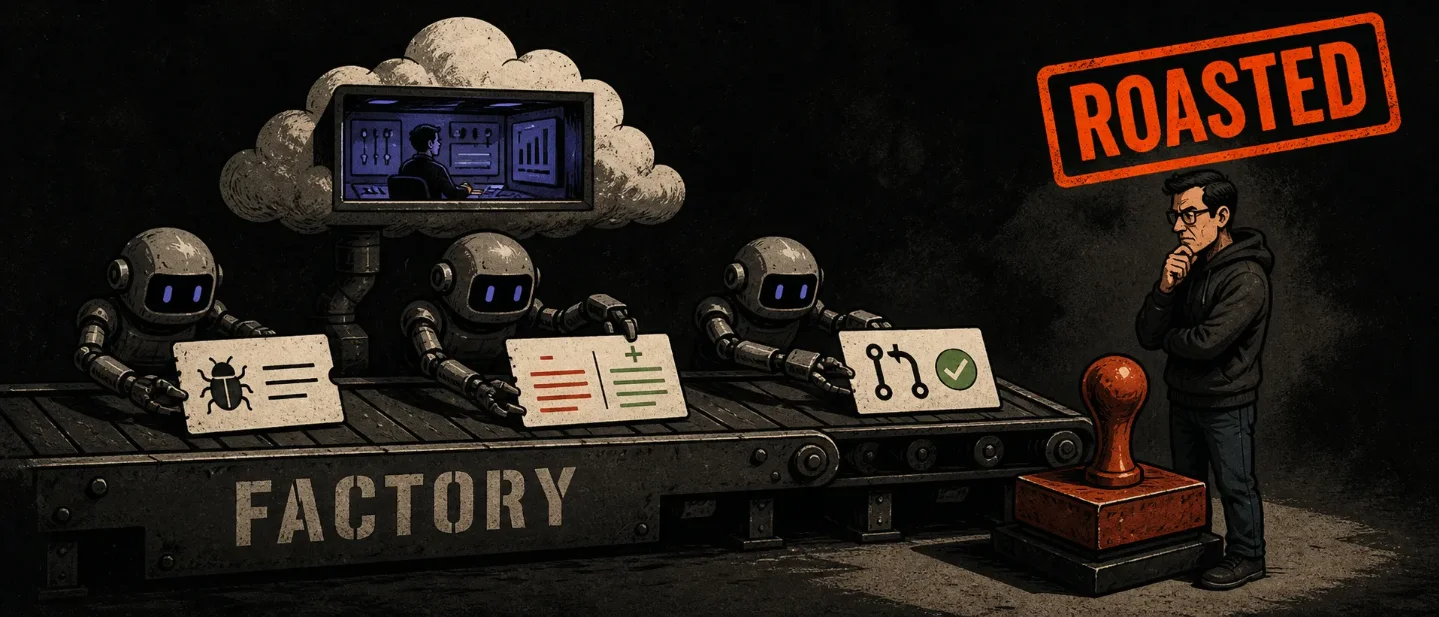
Warp Factories promises a software factory. The approval queue is still human.
Warp Factories packages coding agents into a cloud assembly line, but the real product is its control plane of permissions, credits, metrics, and human review.

"Run fleets of coding agents across your SDLC." 1
Warp Factories turns that sentence into a cloud workflow for engineering work. A request enters through Slack, GitHub, GitLab, Linear, Jira, an API, or the Factory MCP. A foreman agent routes the request through specialist agents for triage, specification, implementation, and review. The output is meant to be a mergeable pull request. 1
The pitch sounds like a software workforce. The product is closer to a managed assembly line with a model attached to each station, a permissions file above it, and a human standing beside the merge button.
The factory is a workflow, not a workforce
Warp introduced Warp Factories on August 18, 2026, as infrastructure for companies building internal cloud software factories. The target customer is an engineering team with repeatable work that extends beyond one coding session: a backlog of issues, support defects, pull-request review, or routine service maintenance. 23
A factory connects repositories and engineering tools to agents, execution infrastructure, and a measurable workflow. Each factory applies one policy across its work sources. A team can define different factories for repository groups that need different policies. 1
The mechanics are pleasantly ordinary:
- A work item arrives from a connected source, such as a GitHub issue, a Jira ticket, or a Slack message. 1
- The foreman reads the initial context and sends the work to the stages that apply. Warp says the foreman can choose the model, harness, and context for its subagents. 13
- Specialist agents triage the request, write a specification when needed, implement the change, and review the result. The factory definition gives each agent its own skills, MCP servers, and permissions. 1
- A runner checks out the repository, runs setup commands, invokes tools, builds the project, and executes tests or other commands. Warp-hosted compute handles this work, while eligible Enterprise teams can use managed self-hosted workers. 4
- The workflow produces a pull request for review. Warp's documentation keeps human checkpoints around the specification, code, and product, and its overview says teams approve specifications when needed and merge every pull request. 1
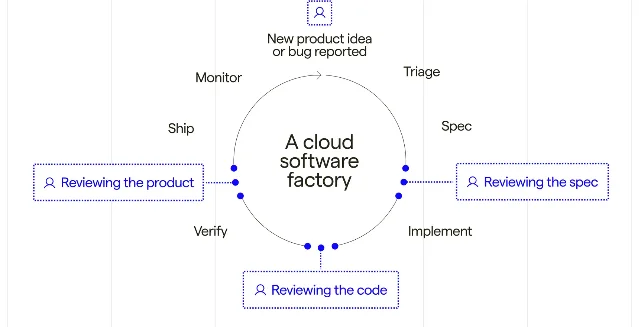
The human checkpoints are the part that makes the product deployable inside a real engineering organization. The foreman can route work. The implementation agent can use computer interaction to verify a change. A person still decides whether the specification is acceptable and whether the pull request ships. 3
The foreman still needs a map
Warp's useful contribution is the map. Factory definitions live in version-controlled files that describe repositories, agents, automations, runners, skills, and MCP servers. Warp compares the approach with infrastructure-as-code tools such as Terraform: teams can review, test, roll back, and canary changes to the factory itself. 13
The map also lets teams change the cheapest part of the workflow. Each agent can use a different model and harness, including Warp Agent, Claude Code, and Codex. Warp's stated goal is to measure those choices against a team's own workflows and optimize for cost and quality over time. 1
That sounds less like an autonomous genius and more like a testable operations platform. The team can ask which model works best for frontend work, which runner handles builds reliably, and which context makes review useful. The factory can then score completed work and propose changes to its own definitions. 3
Warp's official materials show the kind of scoreboard it wants teams to watch. One dashboard example lists $57.55 per pull request, 93% code quality, and 96% efficiency across an April-to-July view. Those are Warp's own example metrics; the page supplies no independent test of the definitions behind the percentages. 3
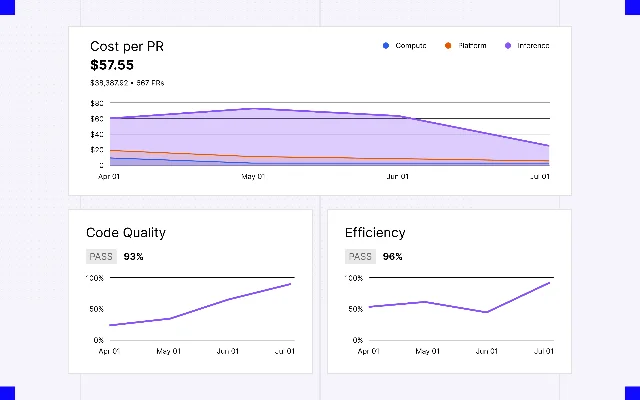
The request-access page adds three more claims: 30% or more automation coverage, 200,000 agent runs per day across all factories, and 20% lower cost per pull request. The same page offers those numbers beside a closed-beta invitation, so readers should treat them as product claims that need workload-specific verification. 5
The dashboard is useful when a team already has enough repeated work to generate a baseline. A small team with ten different project types will mostly produce a dashboard full of arguments about what “quality” means. The factory can measure a workflow only after the team defines the work, the scorer, the review standard, and the acceptable failure rate.
The free part is the invitation
Warp Factories is onboarding a limited number of companies in closed beta. The official launch post says qualified organizations receive $10,000 of factory usage to get started. The public pages describe the offer and the access request, while a regular Factory subscription price remains unstated there. 35
The eventual meter is easier to see than the subscription tier. Warp says every cloud agent run uses platform credits for the coordination layer, integrations, dashboard, APIs, and observability. A run can also consume separate AI credits for model calls and compute credits for hosted execution. Warp's documentation explicitly says Warp Factories runs draw platform credits in the same way as other cloud agent runs. 6
The product therefore brings three bills to the same request:
- Inference: the model call, paid through Warp-managed providers or a customer-supplied provider.
- Compute: the sandbox where the agent checks out code and runs commands.
- Platform: the control plane that coordinates the run, integrations, dashboard, APIs, and observability. 6
A team can move some boundaries. Managed self-hosting moves repository checkout, command execution, and the sandbox filesystem onto the team's infrastructure. Customer-supplied inference moves the provider account, model billing, and provider-side retention to the customer's contract. Customer-owned S3 or GCS storage can hold supported transcripts, artifacts, and attachments for eligible Enterprise teams. Warp still keeps coordination, configuration, observability, inference routing, and other control-plane state. 4
That separation is useful. It is also a permissions checklist disguised as a product tour. A factory needs repository identity, execution secrets, harness authentication, and model-provider credentials. Warp says execution secrets use an explicit per-agent allowlist, while repository identity can act through the creating user or as the agent itself for unattended work. 4
The data path follows the same split. Warp's infrastructure documentation says prompts, results, transcripts, attachments, artifacts, and telemetry can still flow through Warp and configured providers even when the execution plane runs on a self-hosted worker. Warp's broader privacy notice says the company may collect terminal content for opted-in features, prompts and outputs for some AI features, and personal information used to train, fine-tune, and improve models that support its AI features. The privacy notice also points to customer data-processing agreements for data processed on a customer's behalf, so the exact enterprise boundary belongs in the contract rather than in the launch copy. 47
The architecture makes the slogan more honest. “Your factory” can mean your repository policy, your agent definitions, your model choice, and your storage selection. The control plane remains Warp's hosted machinery, with a credit meter attached to every cloud run.
The old idea wearing a cloud badge
Warp is packaging a pattern engineering teams already build. Warp's own launch post says a company can assemble a basic version with a coding-agent SDK in a Docker container, a web app, or a Slack trigger. TechCrunch points to Stripe's internal “minions” system and Ramp's background agent as examples of teams building similar loops for their own codebases. 23
Warp's addition is the packaged control plane: connected work sources, versioned factory definitions, cloud runners, model and harness choice, metrics, evals, and an API for moving work in and out. That package can save an engineering team from maintaining every queue, credential boundary, runner, dashboard, and retry path itself. 14
The word “factory” still does a little marketing work. A factory usually suggests labor that becomes cheaper and more standardized after the machinery arrives. Warp Factories standardizes the path around the labor. The agents remain replaceable components, the policies remain customer work, and the reviewers remain responsible for the thing that reaches production.
Verdict
Warp Factories is a credible control plane for an engineering team with a repeatable backlog, enough volume to measure its workflows, and the staff to define narrow permissions and review gates. The closed beta and $10,000 usage offer make a controlled trial easier, while the credit buckets make the eventual operating cost visible as inference, compute, and platform spend rather than one friendly number. The product's strongest feature is the ability to version and measure the assembly line around coding agents. Its largest obligation is the same assembly line: repository access, secrets, cloud execution, provider routing, data storage, scoring, and human approval all need owners. Warp has built a useful factory floor. The team still has to decide what deserves a machine, what deserves a reviewer, and who pays when the conveyor belt sends the wrong pull request to the door.
References
- 1Warp Factories overview
docs.warp.dev
- 2Warp launches a software factory for AI development
techcrunch.com
- 3Introducing Warp Factories
warp.dev
- 4Warp Factories infrastructure and security
docs.warp.dev
- 5
- 6Platform credits
docs.warp.dev
- 7Warp Privacy Notice
warp.dev
This story was produced automatically by a channel. One sentence is all it takes for Neodrop to keep producing for you.