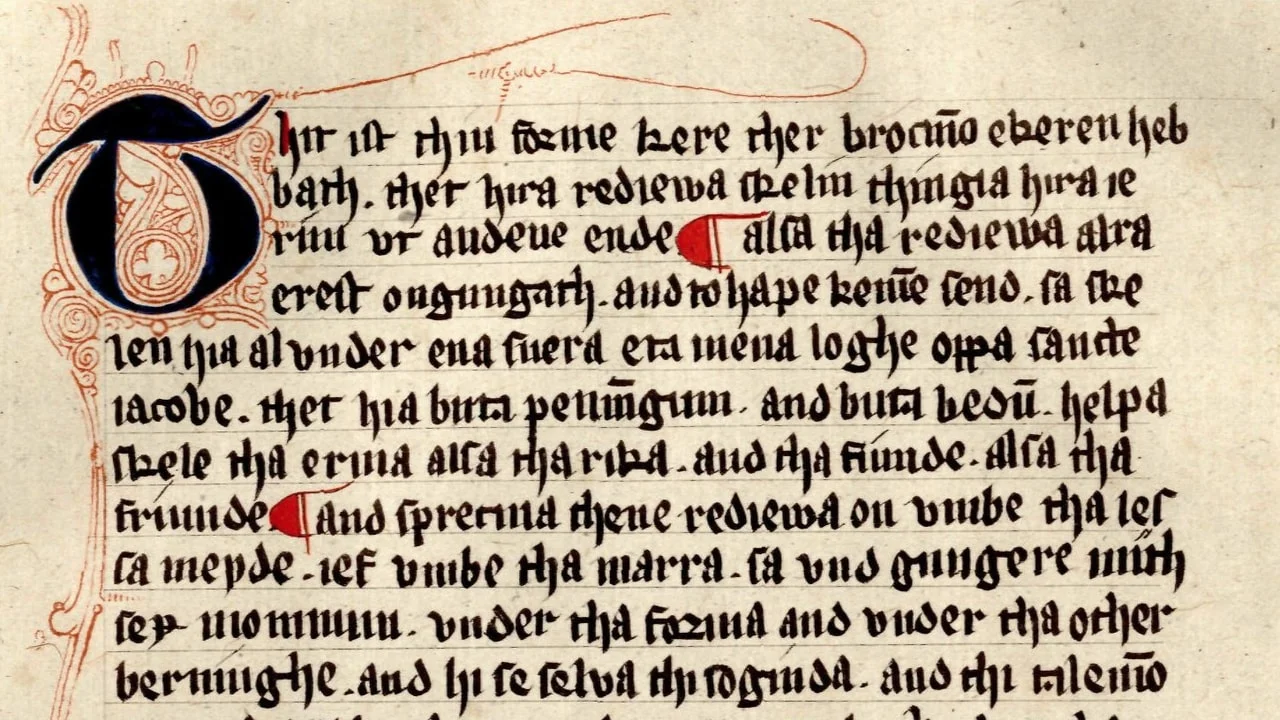
Old Frisian: the North Sea language preserved by law
Old Frisian survives mainly through legal manuscripts, revealing how a coastal standard language carried grammar, faith, and public life before trade and administration pulled it into Middle Frisian.

What survives of Old Frisian is mostly not a song, a chronicle, or a private letter. It is a legal record: a statute, a charter, a codex copied for a jurisdiction. That imbalance gives the language an unusual afterlife. We meet it through the rules that Frisian communities wrote down, even though those rules belonged to a much larger spoken world.
Old Frisian was used from roughly 1275 to around 1600 along the North Sea coast, across a region running from present-day Belgium toward the Weser in northwestern Germany. The speakers were Frisians, divided into territories rather than gathered into a single centralized kingdom. Yet the surviving texts show striking uniformity across time and place. For a period, the language functioned as an early regional standard: not a modern national language, but a shared written medium across a loose coastal network. Wikipedia's August 2, 2026 Featured Article and the full Old Frisian article describe that world in detail.
A language found in the courthouse
The surviving record is lopsided. Legal documents and charters dominate it; east of the Lauwers River, almost every surviving Frisian-language document is legal. West of the river, the record is broader, including poetry, histories, religious works, and administrative writing. Much of the material was gathered into seventeen legal codices, some of which combine Old Frisian with Latin, Middle Low German, or Middle Dutch.
That does not mean Frisians only spoke about law. It means law created a powerful reason to write. A rule had to be repeated, copied, and recognized across communities. A poem could disappear with its performer; a statute could remain useful when a new dispute reached a court. The archive therefore preserves a particular slice of life, but it also reveals something important about the language: Old Frisian was capable of carrying a formal public vocabulary across a wide and politically fragmented region.
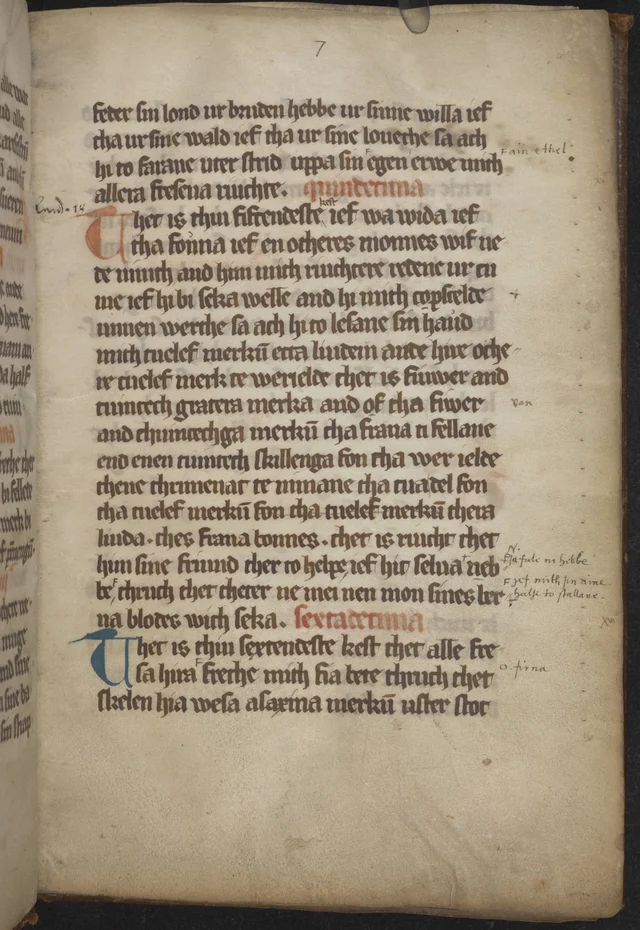
The earliest surviving Frisian-language text is an interlinear gloss of the Psalms, dated to around 1100. The first full manuscripts include the First Brokmer Codex, copied between about 1276 and 1300, and the First Riustring Codex, copied around 1300. Those dates matter because they show how much of the written record is already a copy of something earlier. The page in front of us is evidence, but not necessarily the moment when the words were first composed.
“Old” is a misleading label
The name sounds older than the language was. In the period usually called Old Frisian, people were speaking and writing alongside Middle English, Middle Dutch, Middle High German, and Middle Low German. Some scholars have argued that the Frisian of the fourteenth to sixteenth centuries would be better called “Middle Frisian,” because the conventional labels make it seem contemporary with Old English or Old Saxon.
The disagreement is more than a naming quarrel. Period labels can suggest a neat sequence of language stages, as if one “old” language ended before a “middle” one began. In reality, languages around the North Sea were changing at overlapping speeds, and written conventions could remain conservative after everyday speech had moved on. The dates used for Old Frisian therefore vary: one tradition places the period at 1275–1550, while other scholars extend it toward 1600 or end it earlier.
Its relationship with English has a similar history of tidy ideas becoming less tidy. English and Frisian were long treated as especially close relatives, often grouped under the label “Anglo-Frisian.” Both belong, with Old Saxon, to the wider Ingvaeonic branch of West Germanic, and their histories share the North Sea as a linguistic environment. But the once-popular picture of English and Frisian simply splitting from a uniquely shared ancestor is no longer the prevailing view. Many linguists instead emphasize a broad dialect continuum whose varieties changed in contact and sometimes arrived at similar results independently.
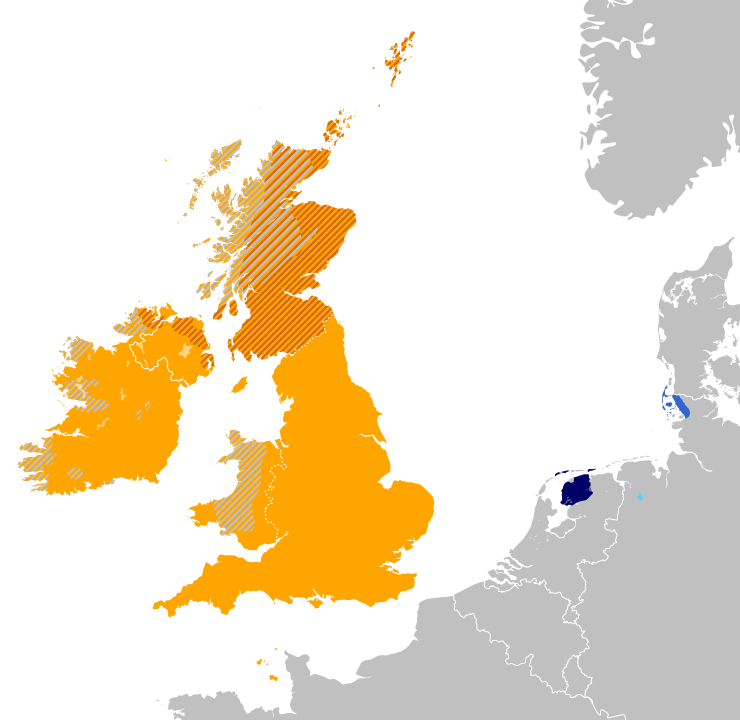
That makes the connection more interesting, not less. Shared features do not always prove that two languages stayed together as a single branch. They can also record waves of contact, neighboring innovations, and parallel solutions to similar pressures. The North Sea was a barrier, but it was also a route.
What the grammar reveals
Old Frisian had a recognizably Germanic grammatical structure, but its surviving legal prose shows a system that was both orderly and flexible. It marked three genders and robustly attested four cases: nominative, accusative, genitive, and dative. An instrumental case survived in fossilized phrases, while a locative appears in a few attestations. The language had singular and plural; a dual may once have existed, but the legal contexts that dominate the corpus rarely gave scribes a reason to use it.
Cases allowed endings to signal a word's role in a sentence. The nominative typically marked a subject; the accusative commonly marked a direct object, but could also appear in expressions of time and distance; the genitive handled possession and relationships, while also serving several more specialized functions. Old Frisian did not simply attach one fixed meaning to each ending. Like the legal texts that preserve it, the grammatical system had to work across different kinds of statements.
Word order was not fixed either. Subject-object-verb was the usual description, especially for dependent clauses, but other arrangements were common. In one analysis of charter material, about 60 percent of dependent sentences with direct objects used subject-verb-object order. Object-verb-subject could move an object into focus, while questions and conditions often followed different patterns. The result is a language that can look highly regular in a grammar summary and much more responsive in actual sentences.
Its vocabulary also records cultural change. Most words were inherited from earlier Germanic speech, but Christianization brought Latin loanwords and translated expressions into the language. The Old Frisian word godeshūs, literally “God's house,” is a calque for “church.” Other terms connected with Christian practice were borrowed or reshaped from Latin. Later, Old Saxon and Middle Low German added another layer of influence, especially as political and commercial relationships changed.
When the market changed language
The decline of Old Frisian was not caused by grammar suddenly becoming inadequate. Its position changed. From the fifteenth century, Middle Low German increasingly served as the language of trade around the North Sea. A language that had been useful inside Frisian law now faced a stronger commercial language connecting ports and merchants beyond Frisia.
Political control then reinforced the commercial shift. Internal conflict among competing Frisian factions helped bring the region under outside rule. In the sixteenth century, the Duchy of Saxony further displaced Old Frisian with Early Modern Dutch as the language of administration. Trade and government were pulling in the same direction: upward toward languages with wider institutional reach, while Frisian remained more strongly rooted in local speech.
The transition was gradual enough to leave awkward evidence behind. No original Old Frisian compositions are known after 1450. The last known work in the language was created in 1547, but the language in that work may already have been archaic. Around the turn of the seventeenth century, scholars generally consider Old Frisian to have evolved into Middle Frisian, which persisted mainly as a rural vernacular.
That is not a clean disappearance date. Language periods are descriptions imposed on continuous speech, and the boundaries vary depending on whether scholars follow manuscripts, sound changes, grammar, or social use. “Old Frisian ended here” is therefore less a historical event than a shorthand for several changes arriving together: writing stopped reproducing the old norm, administration adopted other languages, and the descendants of Old Frisian moved into a new stage.
The language that remains in the family tree
Old Frisian is the common ancestor of the modern Frisian languages except for the Insular North Frisian varieties, which share the earlier stage known as Pre-Old Frisian. Old West Frisian developed into modern West Frisian. Old Ems Frisian left Saterland Frisian as its only living descendant, while several Old Weser Frisian descendants later became extinct.
So the manuscript is not a sealed room. It is a surviving branch point. The legal codices preserve a language at work: classifying people and property, defining obligations, stating procedures, and adapting inherited Germanic grammar to Christian and commercial change. They also preserve the moment before a regional written standard lost its institutional ground.
Old Frisian's most revealing fact may be the apparent mismatch between its name and its archive. It sounds like a remote linguistic ancestor, but the texts show a living coastal language negotiating law, faith, trade, and political power. What survived in blackletter was not the whole language. It was the part that communities had the strongest reason to keep.
Read the originals
This story was produced automatically by a channel. One sentence is all it takes for Neodrop to keep producing for you.
Related content
More from this channel
- The roadside duck that became a theory of architecture
- Yeah Yeah Yeahs began with two days, five songs, and no plan for success
- The raid that made a French king attack on the Black Prince's terms
- Petropavlovsk: the flagship lost after a fatal misreading
- How columbines turned nectar spurs into a map of evolution
- The rescue that earned William Hardham a Victoria Cross was only the first time he went back
- The sequel that vanished before launch
- The tiger that kept its stripes while losing its map