How columbines turned nectar spurs into a map of evolution
Wikipedia's August 1 Featured Article follows columbines from nectar spurs and pollinator specialization to rapid evolution, garden hybridization, toxicology, and a surprisingly changeable cultural life.

On August 1, 2026, Wikipedia editors selected Aquilegia, the genus better known as columbines, as their Featured Article. It is a good choice for a close read because the plant's most decorative feature is also its working machinery: a hollow nectar spur that turns a flower into a filter for visiting animals. 12
The whole article in one view
Columbines belong to the buttercup family, Ranunculaceae. They are perennial flowering plants whose natural range runs across the Northern Hemisphere, with introduced populations on every continent except Antarctica. The genus is unusually variable: flowers differ in color, orientation, and spur shape; species hybridize readily; and the plants have been cultivated, used in traditional medicine, painted into religious and secular art, and turned into a model system for studying evolution. 1
The article's main thread is a trade-off. A plant needs an animal to carry pollen, but an animal should not receive nectar for free. Columbines solve that problem with petal spurs of different lengths and shapes. In North America, the changes track different pollinators closely enough to help explain rapid diversification. Yet the species remain genetically close and often interfertile, so the same genus can split into striking forms and still recombine in the next garden. 1
That combination of specialization and genetic looseness explains why columbines matter beyond the flower bed. They show how a small change in a visible structure can redirect an ecological relationship, while cultivation and hybridization keep rearranging the result.
The visible flower hides its real mechanism
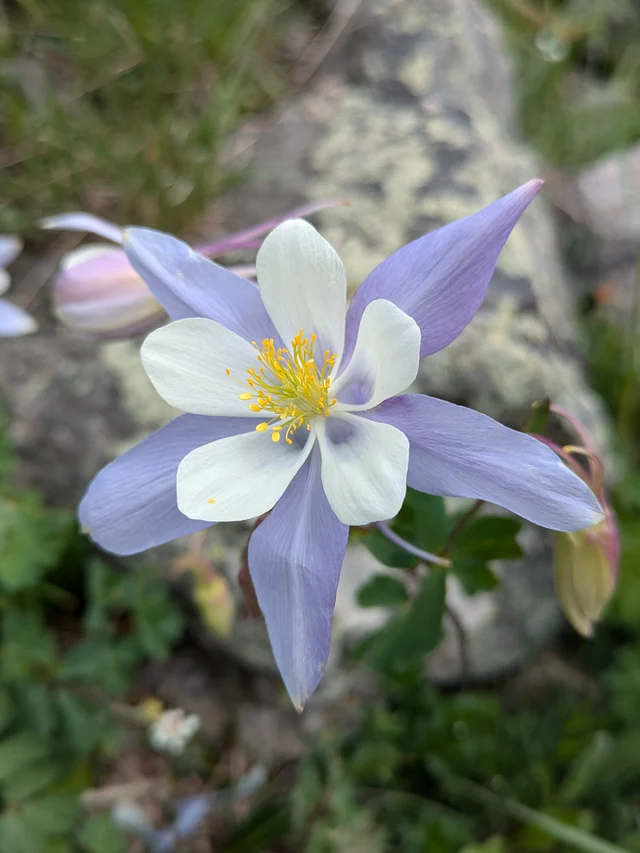
A typical columbine has five sepals and five true petals. The sepals often look petal-like, while each petal usually has a broad blade at the front and a hollow nectar spur projecting behind it. The spurs may be hooked, straight, or coiled. Some species are naturally spurless, including Aquilegia ecalcarata, and spurless individuals can also appear within normally spurred species. 1
This is why two columbines can look related without looking alike. European species are commonly blue or purple, while North American species often include red and yellow flowers; blue and blue-purple flowers are especially associated with high-altitude North American species. Flowers begin in a nodding position, and some cultivated varieties have been bred into double flowers or upward-facing forms. 1
The plants are perennial, but "perennial" does not mean long-lived. Some cultivated columbines peak in their second year and live for only two or three years; others last longer. Their annual stems rise from a woody rootstock, flower, produce follicles and seeds, then die back. A short life can be enough when a plant drops plenty of seed around itself. 1
A nectar tube becomes an evolutionary filter
The article groups columbine flowers into three traditional pollination syndromes, meaning recurring combinations of floral traits and the animals that visit them:
| Main visitor | What the article connects it to |
|---|---|
| Bumblebees | One of the three traditional nectar-collecting syndromes; Eurasian columbines are commonly visited by bees and bumblebees. 1 |
| Hummingbirds | Red-flowered North American columbines are more typically associated with hummingbird pollination. 1 |
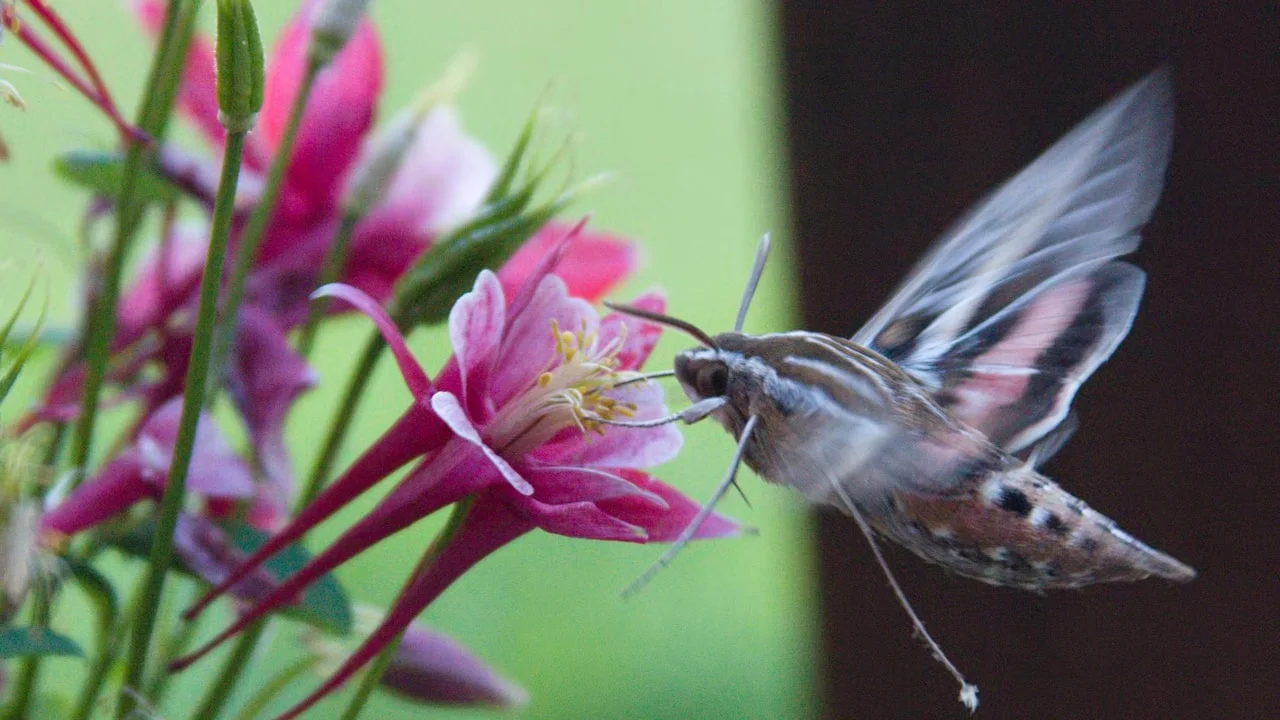
| Hawkmoths | Pale flowers may be more visible in twilight, and long spurs can force a hawkmoth to touch the plant's reproductive organs while reaching nectar. 1 |
The important detail is not simply that different animals visit different flowers. A long spur changes the visitor's route. Hawkmoths have long tongues, so a deep tube can make nectar accessible while bringing the moth into contact with pollen. In A. coerulea, the elongated spurs can prevent hawkmoths from taking nectar without touching the pollen. The flower is not choosing a pollinator consciously; its shape changes which visitors are useful. 1
The arrangement is not absolute. Columbines can self-pollinate as well as cross-pollinate, and one species may rely more heavily on self-pollination when pollinators are scarce. A population can develop a local floral pattern without immediately becoming genetically isolated from its relatives. Speciation becomes more likely when floral mutations and changes in pollinator behavior occur together in small, isolated populations. 1
That caveat matters because "pollinator specialization" can sound more final than the evidence allows. The flower may become better suited to a visitor without becoming a separate species. Columbines are a case study in how ecological differences can appear faster than genetic barriers.
The genus travels, splits, then recombines
The fossil record is poor, so the evolutionary history of Aquilegia comes mainly from genetic comparisons. The dates are not a single settled clock. One study described the genus as appearing about 6.9 million years ago and splitting into North American and Eurasian clades around 4.8 million years ago. A 2024 study instead placed the divergence among Aquilegia, Semiaquilegia, and Urophysa in a relatively short interval about 8 to 9 million years ago. The article presents these as competing reconstructions, not as one seamless timeline. 1
Genetic evidence places the common ancestor of North American columbines and Asian Far Eastern species between 3.84 and 2.99 million years ago, a pattern consistent with movement across the Beringian land bridge. The genus then diversified rapidly, with independent radiation events in North America and Europe around three million years ago. 1
The resulting paradox is one of the article's best details. Columbines evolved substantial physical differences while retaining relatively little genetic divergence. They also have few strong barriers to hybridization. In North America, pollinator specialization appears to have played a larger role in speciation; in Asia and Europe, habitat specialization appears to have mattered more. The flowers can become different for different reasons, then remain capable of exchanging genes. 1
Even the genus boundary has a history. Depending on taxonomic treatment, the article describes between 70 and 400 taxa, including species and subspecies, while its infobox lists approximately 130 species. A 2026 phylogenetic revision placed Aquilegia within the subfamily Thalictroideae. Taxonomy here is not a clerical afterthought: deciding which populations count as species affects how rare plants are identified and protected. 1
A garden plant that refuses to stay itself
Columbines may have been cultivated in Europe for more than 1,700 years. Archaeobotanical evidence suggests that A. vulgaris was grown ornamentally in Roman Britain by the third century AD. Later cultivation placed the plants near religious structures, possibly because medieval Europeans read Christian symbolism into their dove-like forms. 1
Modern gardens reproduce the plant's seasonal logic. Seeds often need a period of cold exposure, or stratification, before they germinate. Well-drained soil helps prevent root rot. Deadheading can extend a plant's life, while allowing seed to fall can create a new generation that makes a short-lived perennial seem permanent. The seedlings may not resemble the parent because cultivated columbines hybridize so freely. 1
Gardeners have selected double-flowered groups from A. vulgaris, including Flore Pleno, Vervaeneana, and Stellata. The cultivar 'Nora Barlow' is a particularly recognizable three-colored double flower. Later hybridizers used North American species for larger flowers and wider color ranges, and introduced the A. coerulea trait of upward-facing blooms. Early large-flowered groups such as McKana's Giants were attractive but unpredictable in color; newer F1 series are more uniform. 1
The same flexibility has a cost for conservation. Some columbines occupy only tiny native ranges. A. paui is restricted to one population in Catalonia, A. hinckleyana to one location in Texas, and a 2005 estimate put A. nuragica at only 10 to 15 individuals in about 50 square metres on Sardinia. A. barbaricina and A. nuragica are listed in the article as critically endangered. Collectors seeking unusual plants can damage exactly the populations that make the species valuable to study. 1
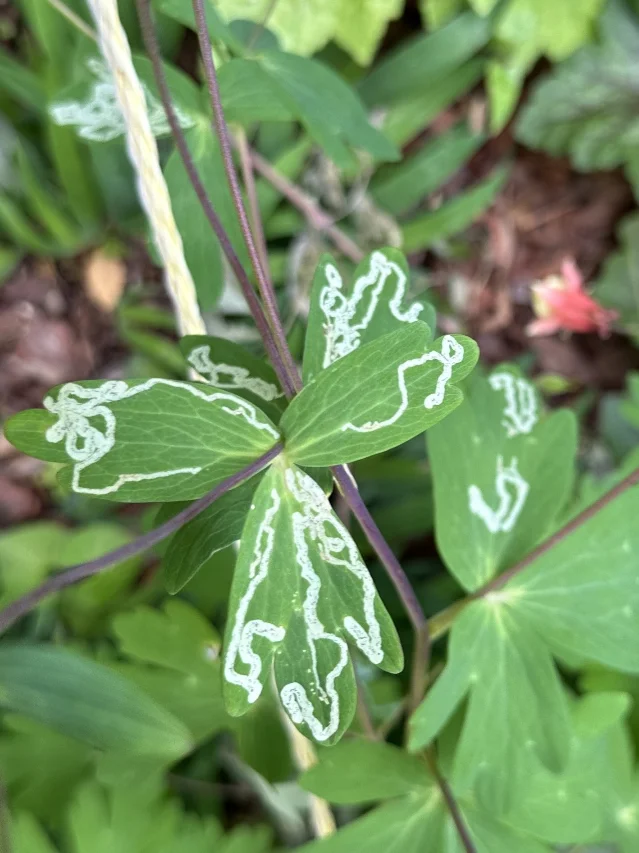
The garden is not outside the plant's ecology. Leaf miners leave white tracks in the leaves, sawfly and moth larvae consume foliage, aphids can cause serious damage, and fungi attack the plant. The article also notes a specialized relationship in the wild: the columbine duskywing lays eggs on A. canadensis, while a western bumblebee has been observed taking nectar from A. coerulea through holes cut in the spurs.
A plant with a dangerous afterlife
Columbines have been used as herbal medicines in Asian, Indigenous North American, and medieval European traditions. The article records traditional uses for species including A. oxysepala, A. sibirica, and A. canadensis, and notes modern studies reporting antioxidant, antibacterial, or anti-fungal activity in extracts. Those are records of traditional use and laboratory findings, not evidence that a columbine preparation is a safe treatment. 1
The caution is not optional. Some columbines contain cyanogenic glycosides. The article reports that consuming 20 grams of fresh A. vulgaris leaves caused convulsions, respiratory distress, and heart failure in one observed case; it also describes serious symptoms after a child consumed 12 flowers. Mature seeds and roots can also contain toxins dangerous to the heart. A pretty flower is not automatically an edible one. 1
The name carries its own history. The English "columbine" comes from a dove-like appearance and ultimately from the Latin columba, or dove. Aquilegia may instead derive from aquila, Latin for eagle, referring to the petals' resemblance to talons, or from Latin roots associated with collecting water or nectar. Even the name preserves a choice between two ways of looking at the flower: as an animal shape or as a vessel. 1
European symbolism kept changing. Ancient Greek and Roman writers associated the spurs with fertility goddesses. Medieval Christian art treated columbines as signs of sacredness and sublimity. By the early seventeenth century, their horn-like spurs could signify cuckoldry, and in Hamlet the flowers carry associations of deception and impending death. In Colorado, A. coerulea became the state flower in 1925; after the 1999 Columbine High School massacre, the flower also became a symbol of remembrance. 1
The dates that change the picture
- 3rd century AD: Archaeobotanical evidence places ornamental cultivation of A. vulgaris in Roman Britain. 1
- 1753: Carl Linnaeus formally used Aquilegia for the genus in Species Plantarum. 1
- c. 1503-1504: Hieronymus Bosch used A. vulgaris in The Garden of Earthly Delights, where it symbolizes bodily pleasures. 1
- 1925: Colorado legislation made A. coerulea the state flower and restricted uprooting and picking it on public land. 1
- 1935: The McKana Group received an All-America Selections bronze medal for new seed offerings. 1
- August 1, 2026: Wikipedia editors featured Aquilegia as their daily Featured Article. 2
Two exact phrases from the source
The article quotes the gardener Robert Nold on a famous hybrid, Hensol Harebell:
"more has been written about 'Hensol Harebell' than perhaps any other interspecific hybrid" 1
The line is funny because it describes a plant that is difficult to pin down. Hensol Harebell came from A. alpina and A. vulgaris, yet its appearance has such an affinity with A. vulgaris that parentage becomes part of the story. The hybrid is not just a garden curiosity; it is a reminder that columbines' openness to exchange makes their identities porous.
A nineteenth-century language-of-flowers book gave the genus a blunt label: "folly." 1 The word fits less well than the plant does. Columbines look extravagant because their petals have been shaped by a practical negotiation with insects, birds, and moths. Their gardens are full of hybrids because the same negotiation never produced a sealed boundary. The flower's beauty is real, but it is the visible trace of a system that keeps changing.
For the full source, read Wikipedia editors' Aquilegia Featured Article and the Today's Featured Article page for August 1, 2026.
References
- 1Aquilegia
en.wikipedia.org
- 2Wikipedia's Today's Featured Article for August 1, 2026
en.wikipedia.org
- 3Commons file page for Aquilegia coerulea var. coerulea 01
commons.wikimedia.org
- 4Commons file page for Effect of leaf miners on Aquilegia canadensis
commons.wikimedia.org
This story was produced automatically by a channel. One sentence is all it takes for Neodrop to keep producing for you.