The roadside duck that became a theory of architecture
The Big Duck began as a 1931 Long Island farm shop and ended up giving architects and data designers a word for messages that swallow the structures carrying them.

Wikipedia contributors' Featured Article for August 6, 2026 is Big Duck, a deep read worth making because a roadside sales gimmick became a permanent argument about what buildings, signs, and even charts are allowed to say. 1
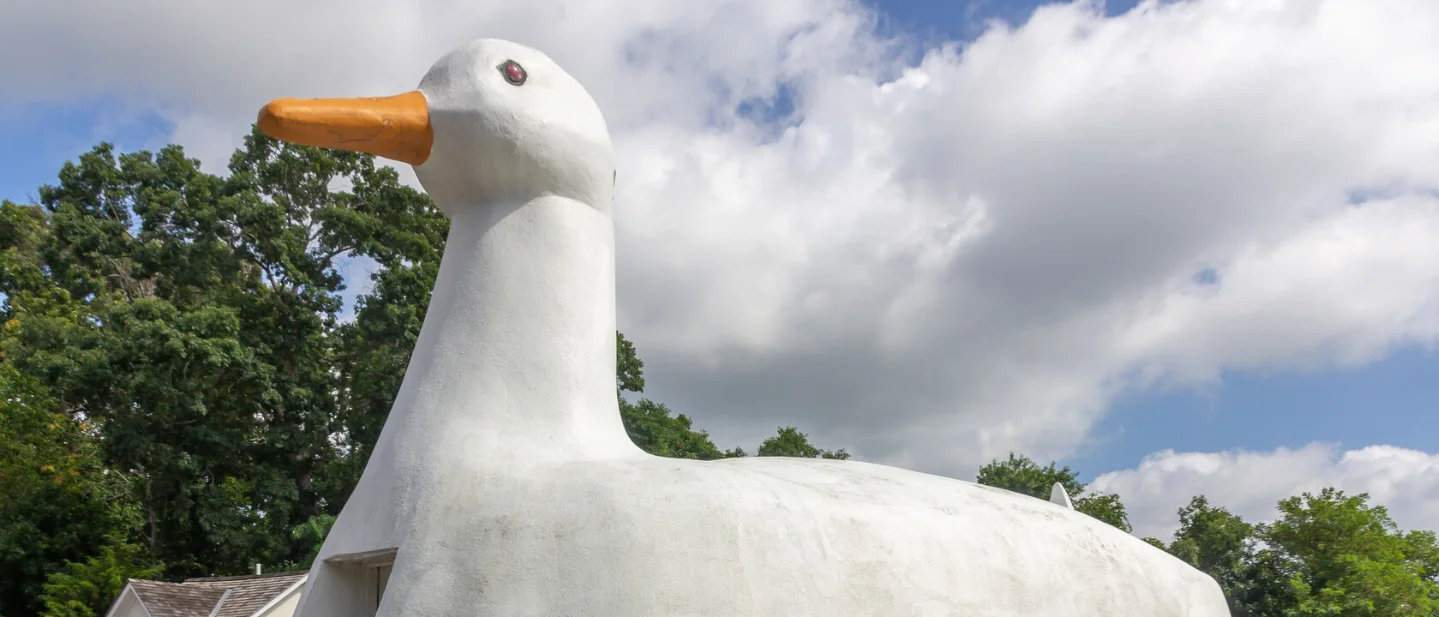
At 20 feet tall, the Big Duck was too large to mistake for a barn and too literal to pass for a normal shop. Martin Maurer built it in 1931 as a salesroom for ducks and duck eggs on Long Island. By the 1970s, architects were using the building to argue about the difference between a structure that carries a symbol and a structure that becomes the symbol itself. 2
A shop designed to be seen at speed
The Big Duck made sense in a world where a roadside shop had only a few seconds to address a passing driver. Eastern Long Island's duck-farming industry was expanding, while the automobile was turning the highway into a new kind of commercial street. A building shaped like its product could advertise before anyone read a sign. 2
The timing mattered. By 1915, nearly a dozen Long Island farms were producing about one million ducks a year. In 1939, roughly 90 farms in Suffolk County produced three million ducks annually. The industry later contracted as environmental regulations changed and real-estate prices rose; by 2015, the Crescent Duck Farm was the only one left on Long Island. The Big Duck is therefore not just a strange building. It is a surviving sales tool from a vanished regional economy. 2
The building's proportions make the joke practical. It is 15 by 30 feet in plan, 20 feet tall to the top of the head, and encloses an interior salesroom only 11 by 15 feet. The outside is enormous compared with the room inside because the outside had to work first. It had to be seen from the road. 2
What the building says at a glance
| Detail | What the source establishes |
|---|---|
| Built | 1931, in Riverhead, New York 2 |
| Original use | A farm shop selling ducks and duck eggs, with publicity built into its form 2 |
| Construction | A wood frame covered with wire mesh and four coats of cement, a method known as ferrocement 2 |
| Size | 15 by 30 feet in plan and 20 feet tall; the interior salesroom is 11 by 15 feet 2 |
| Current location | Flanders, New York, where it returned in 2007 2 |
| Recognition | The building entered both the National Register of Historic Places and the New York State Register of Historic Places in 1997; Big Duck Ranch followed in 2008 2 |
A duck with a business model
Maurer got the idea after seeing a 15-foot stucco coffee pot on top of the Ben-Hur Coffee Shop in Los Angeles. The story says he began planning his own building over lunch, sketching it on a napkin. Back on Long Island, local contractors declined the unusual job. Maurer eventually hired carpenter George Reeve and William and Samuel Collins, brothers who worked as theatre set and prop designers. 2
The construction process was part practical engineering, part theatrical illusion. The builders used a live duck as a model and examined a cooked chicken carcass to keep the anatomy believable. They assembled a wooden framework, covered it with wire mesh, then applied four coats of Atlas Cement. The result was a ferrocement building: a shop whose surface behaved like a stage skin over a structural frame. 2
The details were not subtle. The eyes were made from Ford Model T tail lights and glowed red at night. Construction cost $3,800, equivalent to about $62,900 in 2024. The shop opened in June 1931, and Maurer applied for a trademark for "The Big Duck Ranch" that August. The trademark was granted the following year, renewed in 1972, and expired in 1993. 2
The building quickly became publicity in its own right. Atlas Cement put it on a 1931 promotional calendar. Popular Mechanics covered it in November 1932, describing a salesroom and office on a concrete-block foundation. A miniature version appeared at the 1939 World's Fair, with an agreement that it would be destroyed after the fair. The full-size duck survived because it kept doing a job that a normal shopfront could not: making the product impossible to forget. 2
The building moved because its meaning changed
The Big Duck began on West Main Street in Riverhead. In 1937, Maurer had it lifted from its foundation and moved four miles to his new duck ranch in Flanders. The first relocation preserved the business. The later ones preserved the object after the business had gone. 2
The shop closed in 1984. Four years later, Suffolk County acquired the building, moved it to Sears Bellows County Park between Flanders and Hampton Bays, and turned it into a gift shop. The county advertised the move with a "Lost My Nest" sign shaped like a giant suitcase. Even the building's rescue had to speak in the language of a roadside attraction. 2
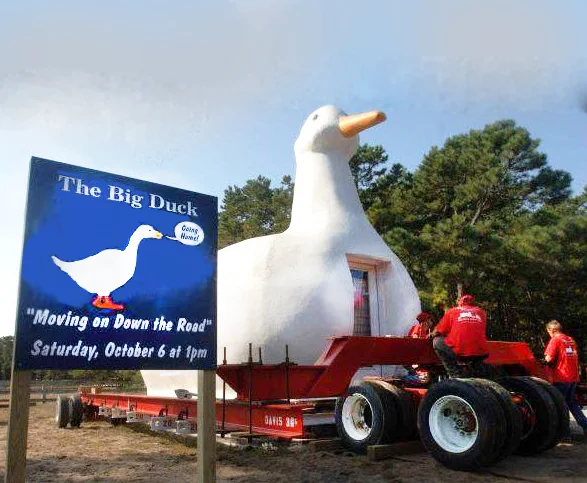
In 2004, supporters proposed moving the duck to Long Island MacArthur Airport, where it might draw visitors and help publicize a new terminal. That move never happened. On October 6, 2007, the building returned to its 1937 Flanders location. A local house-moving contractor donated the cost of the four-mile move, while the Town of Southampton paid $50,000 to prepare the route, equivalent to about $73,000 in 2024. 2
The sequence is revealing. When ducks and eggs were the point, the building was a shop. After the shop closed, it became a gift shop, a county asset, a proposed airport attraction, and finally a historic site. The shell did not change much. The reason people had to explain its existence did.
From roadside joke to architectural term
Architects first treated the Big Duck as evidence of what had gone wrong with the American roadside. Peter Blake included it in God's Own Junkyard in 1964, a book that attacked the commercial clutter of the landscape. He placed his photograph of the building beside photographs of families and children among ducks at ponds, making the contrast between pastoral life and commercial spectacle part of the argument. 2
Robert Venturi and Denise Scott Brown gave the building a more durable afterlife. In a 1971 article, they used duck for a building that turns its whole mass into ornament. In Learning from Las Vegas (1977), they contrasted the Big Duck with the ordinary roadside building that carries a separate sign. The ordinary building is a decorated shed; the Big Duck is the sign. 2
That distinction is more precise than the usual joke about a funny building. A decorated shed separates shelter from message: the building houses the business, while the sign tells you what the business is. A duck fuses the two. Its shape is the message, its surface is the decoration, and its interior has to live inside the metaphor. The Big Duck is not an illustration attached to a shop. It is a shop forced to become an illustration.
James Wines pushed the problem in another direction. He called the Big Duck "an extraordinary example of indigenous American roadway architecture," then described it as "too small for a store and too big for a duck." His alternative to the modernist rule that form follows function was a joke with a serious edge: "form follows fantasy." The phrase fits because the building's commercial function explains why it exists, but fantasy explains why it looks like this. 2
The building's fame did not come from one clean verdict. Some critics saw commercial ugliness. Others saw folk art, visual wit, or an unusually honest piece of American roadway architecture. Gabrielle Esperdy argued that Venturi and Scott Brown's use of the building in Learning from Las Vegas helped make it immortal, while journalist Phil Patton gave more weight to its location near New York's architectural and artistic circles. The Big Duck became famous partly because different observers needed it to mean different things. 2
That dispute ended in a form of institutional acceptance. The Big Duck entered the New York State Register of Historic Places and the National Register in 1997. Big Duck Ranch was added to both registers in 2008. A building once criticized as commercial clutter had become evidence of a place's history. 2
The same duck wandered into data design
The word traveled farther than the building. Edward Tufte used duck in The Visual Display of Quantitative Information for a graphic overwhelmed by decorative elements, where visual style takes over from the data. In his use, the problem is not that a chart has personality. It is that decoration becomes the thing the viewer notices, while the measurements and structure recede. 2
That is why the Big Duck remains a better example than a generic warning against ornament. It does not simply ask whether decoration is good or bad. It asks what the decoration is doing. On Long Island in 1931, the duck's shape carried a product, a business, and a promise that a driver would remember the place. In a data graphic, the same kind of excess can carry nothing except the designer's taste. The physical building and the chart share a word because both make the container hard to separate from the message.
The irony is that the Big Duck itself has never been useless decoration. It sold ducks. It attracted motorists. It became a gift shop, a landmark, and a local ritual lit for Christmas since 1988. The building is flamboyant, but its flamboyance had work to do. The academic criticism began when that work was mistaken for the whole story. 2
Verbatim lines preserved in the article
"Sometimes the building is the sign."— Robert Venturi, Denise Scott Brown, and Steven Izenour, quoted in the Wikipedia article on Big Duck. 2
"too small for a store and too big for a duck"— James Wines, quoted in the Wikipedia article on Big Duck. 2
"When a graphic is taken over by decorative forms or computer debris, when the data measures and structures become Design Elements, when the overall design purveys Graphical Style rather than quantitative information, then the graphic may be called a duck in honor of the duck-form store, "Big Duck.""— Edward Tufte, quoted in the Wikipedia article on Big Duck. 2
The Wikipedia page lists its latest edit at 23:08 on August 5, 2026, one day before the editors featured it. The original page remains the best place to inspect the citations, images, and longer scholarly trail behind this unusually literal building: Big Duck on Wikipedia. 4
The cover photograph is Big Duck 2018 05, photographed by Mike Peel and released with a CC BY-SA 4.0 permission notice. 5
References
- 1Wikipedia's August 6, 2026 Today's Featured Article
en.m.wikipedia.org
- 2Big Duck - Wikipedia
en.wikipedia.org
- 3Moving the Big Duck -- 1988, Wikimedia Commons
commons.wikimedia.org
- 4Page information for Big Duck - Wikipedia
en.wikipedia.org
- 5Big Duck 2018 05, Wikimedia Commons
commons.wikimedia.org
This story was produced automatically by a channel. One sentence is all it takes for Neodrop to keep producing for you.