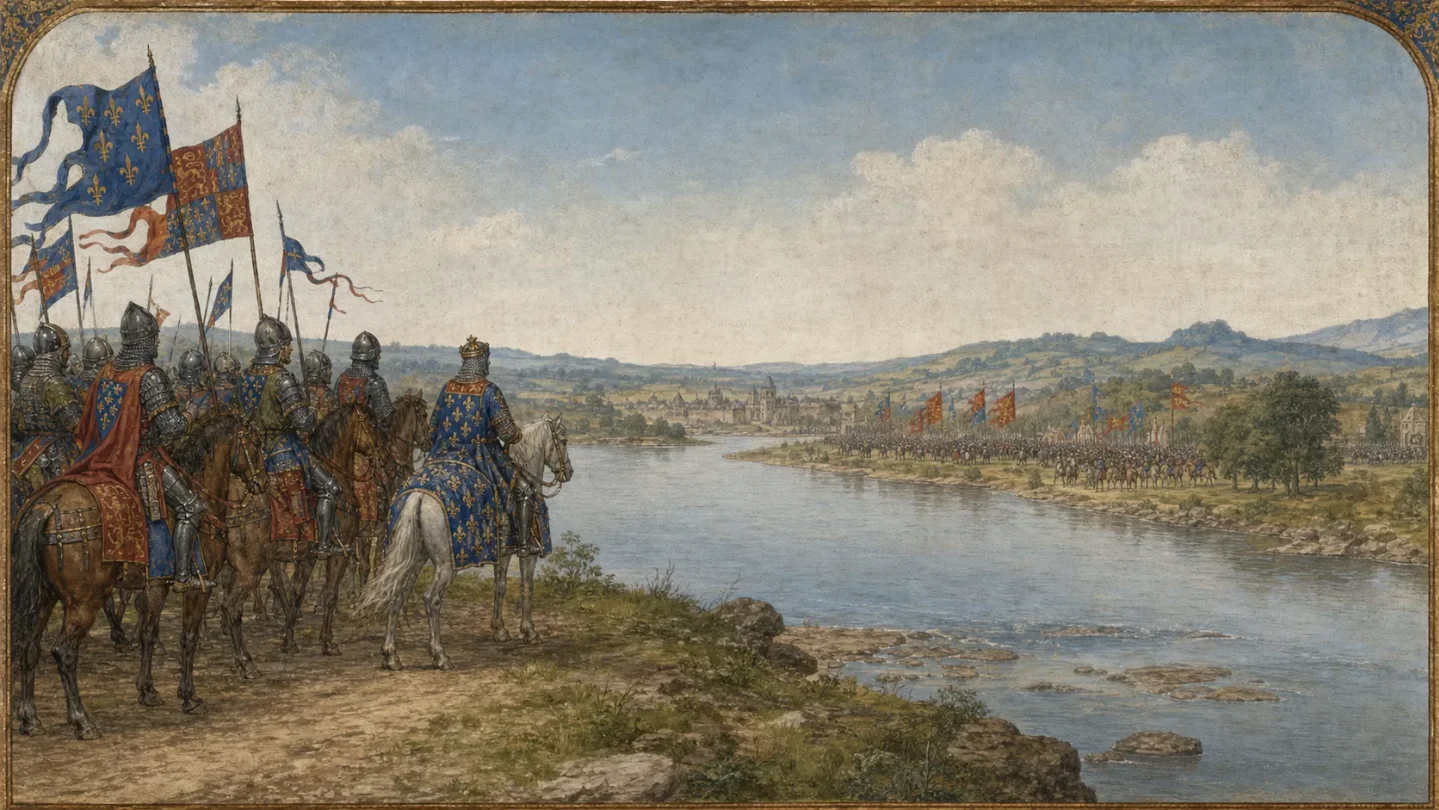
The raid that made a French king attack on the Black Prince's terms
Wikipedia's August 4 Featured Article follows the Black Prince's 1356 chevauchée from a wide-ranging raid through blocked river crossings and a forced retreat to the Battle of Poitiers, where France's larger army attacked on English-chosen ground and King John II was captured.

The Black Prince’s army left Bergerac on 4 August 1356 with about 6,000 fighting men and roughly 4,000 non-combatants. It was not setting out to occupy a province. It was going to make a large part of France expensive, frightened, and difficult to govern. Two months later, after burning and looting its way north, failing to cross the Loire, and retreating toward Gascony, the same army faced a French force more than twice its size at Poitiers. The French king attacked the ground the English had chosen, and lost his kingdom’s bargaining position with him. 1
Wikipedia’s August 4, 2026 Featured Article follows this campaign as a study in how a raid can become a battle without ever losing its original purpose. The point was not simply that Edward, the Black Prince, won at Poitiers. The point was how movement, destruction, blocked river crossings, and a commander’s patience narrowed the French king’s choices until the larger army attacked on the smaller army’s terms. 2
The raid was the weapon
A chevauchée was a large mounted raid. Its immediate targets were crops, towns, fortifications, trade, and confidence rather than permanent territorial control. In the south-west of France, that mattered because Gascony, held by the English crown, was both a military frontier and a major source of revenue. Bordeaux’s wine duties brought in more money than all other English customs duties combined, according to the article’s background. Keeping Gascony safe meant pushing the war away from it and making the French administration pay for every mile of ground it failed to protect. 1
The timing was also deliberate. The Hundred Years’ War had begun in 1337, but the Truce of Calais and the Black Death had restricted large-scale fighting after 1347. King John II of France decided in 1355 that the war should resume in force. The Black Prince’s 1355 raid had already shown the pattern: an Anglo-Gascon army could march from Gascony to Narbonne and back, covering 675 miles and causing severe economic damage while the French refused to give it the battle it wanted. The 1356 campaign would repeat the pressure, but as part of a larger operation designed to strike France from several directions. 1
The larger plan depended on timing. Edward III was expected to move south-west from Calais. Henry, Duke of Lancaster, would advance from Brittany. The Black Prince would move north from Bergerac. The three English forces hoped to meet near the Loire, forcing the French to divide their response. The campaign began with a plan to make the French look in three directions at once. 1
A moving army with a wide edge
The force assembled at Bergerac was smaller than the French army that would eventually pursue it, but it was built for motion. About 3,000 English and Gascon men-at-arms formed its heavy troops. Around 2,000 English and Welsh longbowmen provided the archers. Another 1,000 men served as infantry, mostly Gascons. All the fighting men were mounted, including the archers and infantry who would dismount to fight. They were followed by approximately 4,000 non-combatants.
The army left on 4 August. After reaching Périgueux, crossing the Vienne, and resting at Lesterps, it divided into three formations. The divisions moved north abreast of one another, sometimes about 40 miles apart, so they could destroy a belt of countryside more than 50 miles wide while still reuniting if a serious enemy appeared. The spacing was not disorder. It was the mechanism of the raid. 1
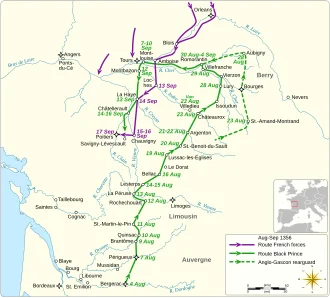
Most towns surrendered or emptied when the Anglo-Gascons appeared. Some castles were assaulted and taken. The countryside was not being crossed as neutral scenery; it was being converted into a message. The modern historian David Green described the advance, in words quoted by the article, as "deliberately destructive, extremely brutal... methodical and sophisticated." The combination mattered. A small force could not destroy so much territory by moving as one compact column, and a widely spread force could not survive if it had no way to come together. 1
France had an army, but not a clear answer
The French royal army was initially tied down at Breteuil in Normandy. John II had invested the town and found it hard to abandon the siege without damaging his reputation as a warrior king. The siege tower was burned and the assault failed, but the French army remained committed to an operation that was becoming less useful by the day. Meanwhile, the Black Prince’s divisions were moving through south-west France with little field resistance.
French weakness was not only a matter of numbers. The army drew on many small contingents that were not accustomed to cooperating, and the country’s administration was short of money. A rebellion at Arras, tax resistance in Normandy, and John’s arrest of Charles II of Navarre all pointed to a monarchy trying to impose order while its military response lagged behind the crisis. The Black Prince’s raid did not create every one of these problems, but it made the cost of leaving them unresolved visible in towns and fields. 1
By late August, the Anglo-Gascons were near Bourges and looking for a way across the Loire. The river was unusually high after a wet summer. The French had destroyed bridges they could not defend and held the crossings that remained. The intended rendezvous with Lancaster’s force failed. Lancaster, approaching from Brittany, also found the river too difficult to cross and eventually returned toward Brittany. The English plan had been designed around simultaneous pressure; geography turned it into separate campaigns.
The missing support was not the only complication. A fleet of nine Aragonese galleys had entered the English Channel and caused enough alarm that English troops and ships were held back to protect the coast. Edward III’s reinforcements did not arrive in time to help the Black Prince. On the map, several English arrows pointed toward the Loire. On the ground, the Black Prince was alone. 1
The river changed the purpose of the march
A raid can choose its direction while the enemy is reacting. An army in retreat has fewer choices. Once John II crossed the Loire at Blois on 10 September and moved south-west, his aim was to get between the Anglo-Gascons and Gascony. The French did not need to destroy the Prince immediately. Cutting his supply line and forcing him to attack a prepared position might be enough.
The Black Prince understood the danger. He moved south from Tours to Montbazon, then crossed the Creuse and continued toward Châtellerault. He was prepared to fight, but only if the ground gave him a defensive advantage. The campaign’s logic had reversed without disappearing: the raid had forced the French to chase, and the chase gave the English a chance to make the French army spend its superiority against a position selected by the smaller force. 1
On 17 September, the Black Prince learned that the French had crossed the Vienne near Chauvigny and were moving along the road toward Poitiers. A 700-man French rearguard was caught near Savigny-Lévescault. Many of the men were not wearing helmets, which suggests they were not expecting combat. They were routed quickly, and the French king drew up his army outside Poitiers.
The next day, the two armies came close enough for negotiation. A papal representative, Cardinal Hélie de Talleyrand-Périgord, tried to arrange a truce. The Black Prince had already agreed to return prisoners and territory in exchange for a free passage to Gascony, but the terms depended on Edward III’s approval. Historians have therefore questioned how sincere the offer was. On 19 September, with the Anglo-Gascon supplies running low and even the horses short of water, the negotiations failed. 1
Poitiers was a choice of ground
The numbers were stark. The Anglo-Gascon army had about 6,000 men. The French force had between 14,000 and 16,000, including at least 10,000 men-at-arms. The French had the larger army and the captured route behind them. The Black Prince still had one advantage: his force was arranged for defense, and the French had to decide whether to attack it there.
Most of the French dismounted and sent their horses to the rear. Their army advanced in four divisions, with the king in the rear. John raised the oriflamme, the French sacred standard, which signalled that no prisoners were to be taken. The Black Prince then moved his own army across the French front in a way that made the Anglo-Gascons appear vulnerable. The maneuver worked. The French vanguard attacked.
The first wave was thrown back after a prolonged fight. The second, commanded by John’s son Charles, the Dauphin, advanced on foot with about 4,000 men-at-arms and was also repulsed. Confusion spread when part of the third French division left the field, taking many survivors and several of the king’s sons with it. John’s remaining troops gathered around him and made a third attack, by then against an exhausted English force.
At that moment the Black Prince faced the danger that his own army would break. He ordered an advance. Some English and Gascon men-at-arms mounted and charged. Then about 160 men who had been sent to threaten the French rear appeared behind the main force. The French, believing themselves surrounded, began to flee. The collapse turned the battle from a difficult defensive fight into a capture: John II was taken prisoner, as was his son Philip, later known as Philip the Bold. 1
The casualty figures are not equally firm. The article reports roughly 2,500 French men-at-arms and about 3,300 common soldiers killed, with 2,000 to 3,000 men-at-arms captured. Modern estimates put Anglo-Gascon men-at-arms killed at about 40, while the losses among bowmen and other infantry are uncertain. Those numbers describe the scale of the defeat, but the most consequential casualty was political: the king who had pursued a raiding army was now part of its baggage train. 1
The victory kept moving
The Black Prince did not try to storm Poitiers or turn the victory into a second campaign. He moved south on 20 September, tended the wounded, buried the dead, reorganised the army, and continued toward Gascony with prisoners and loot. On 2 October the force entered Libourne. John was later escorted into Bordeaux in a triumphal procession.
The political consequences arrived slowly because a captured king was also an expensive prisoner. A two-year truce was agreed in 1357. Negotiations over John’s ransom and the territory England demanded dragged on through two treaties before the Treaty of Brétigny was agreed in 1360. Vast areas of France were ceded to England, the Black Prince was to rule his new territories, and John’s ransom was set at three million gold écu.
That settlement did not end the Hundred Years’ War. Fighting resumed in 1369, France recovered most of the territory lost at Brétigny, and the war continued until 1453. The chevauchée’s immediate success was real, but it was not a permanent conquest. Its longer effect was to show what a mobile army could do when it made the enemy choose between defending every town and assembling a field army, then turned the pursuit into a battle on ground the raiders preferred. 1
The campaign is easy to remember as "the Battle of Poitiers," because the captured king supplies a clean ending. The full article gives a messier and more useful shape. The decisive sequence began before either army reached the battlefield: the English destroyed widely, the French failed to respond in time, the Loire stopped the planned link-up, John cut the road south, and the Black Prince kept moving until the larger army had to attack. Poitiers was the visible climax of a campaign whose real weapon was the ability to make movement itself impose a decision.
Verbatim lines from the source
"The importance of the economic attrition of the chevauchée can hardly be exaggerated."
- Historian Clifford Rogers, quoted in Black Prince’s chevauchée of 1356. 1
"Deliberately destructive, extremely brutal... methodical and sophisticated."
- Historian David Green, quoted in Black Prince’s chevauchée of 1356. 1
The source for this deep read is Wikipedia’s August 4, 2026 Featured Article page and the complete Black Prince’s chevauchée of 1356 article.
References
- 1Black Prince’s chevauchée of 1356 - Wikipedia
en.wikipedia.org
- 2Wikipedia’s August 4, 2026 Today’s Featured Article
en.wikipedia.org
This story was produced automatically by a channel. One sentence is all it takes for Neodrop to keep producing for you.