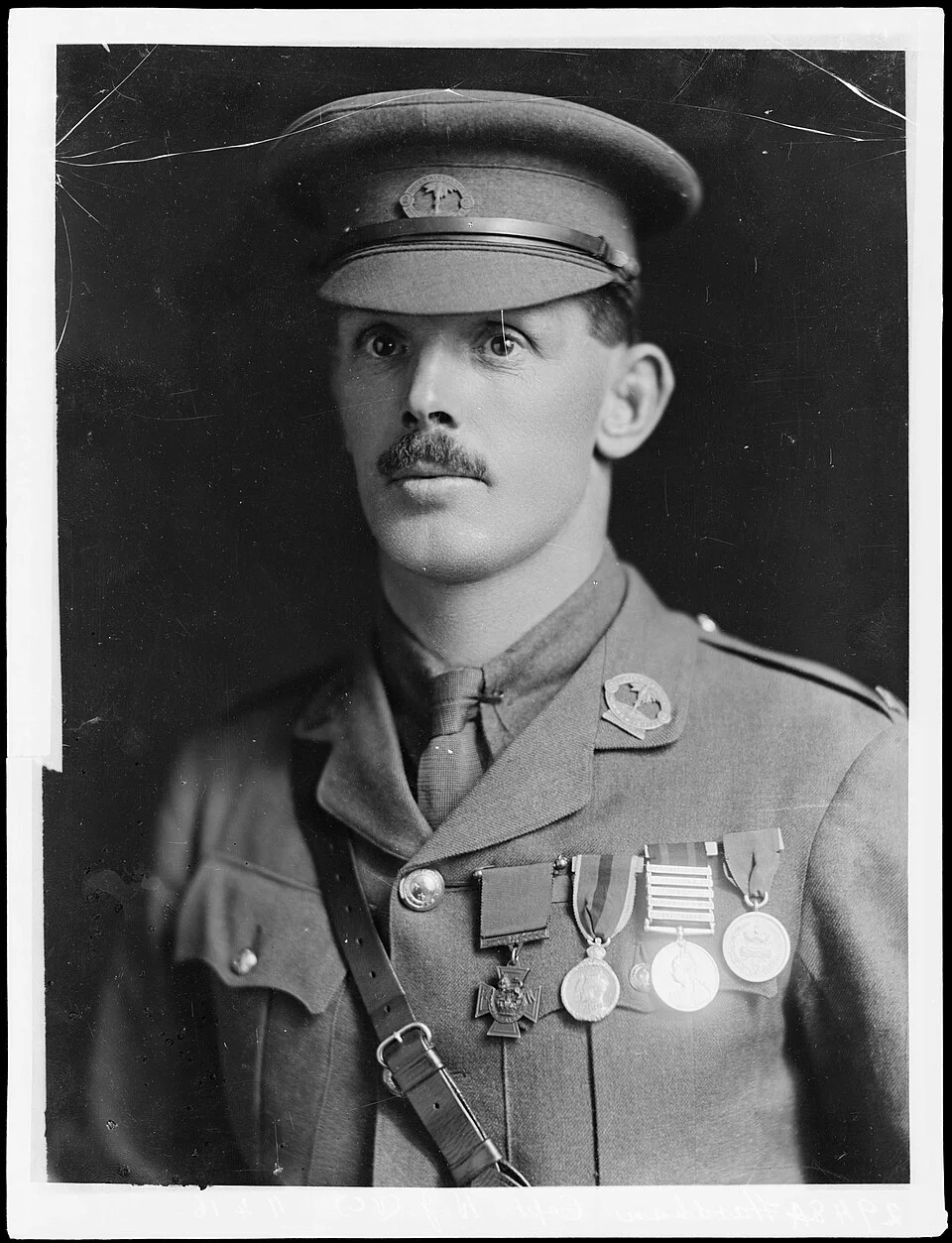
The rescue that earned William Hardham a Victoria Cross was only the first time he went back
Wikipedia's July 31 Featured Article follows William Hardham from a 1901 fireline rescue to Gallipoli, a military hospital, Palestine, and a civilian life reshaped by injury and illness.

On 28 January 1901, near Naauwpoort in South Africa, William Hardham saw a wounded soldier whose horse had been shot. He rode into the fire, dismounted, put the man on his own horse, and ran beside him until they reached safety. That rescue earned Hardham the Victoria Cross. It was also the first scene in a life defined by an inconvenient habit: after being sent home, wounded, or told that his health made further service unwise, he kept asking to go back. 12
From forge to fire
Hardham was born in Wellington on 31 July 1876. He left school for work as a blacksmith, played rugby for Petone and Wellington, and joined the Wellington Naval Artillery militia in 1895. The mixture mattered: he was not a career soldier waiting for a war to give his life a shape. He had a trade, a local sporting reputation, and sixteen years of part-time military service before the First World War. He would eventually play 53 matches for Wellington. 1
When New Zealand offered a mounted-rifles contingent for the Second Boer War, Hardham volunteered. He sailed with the 4th New Zealand Contingent, nicknamed the Rough Riders, and landed in Portuguese East Africa in April 1900. Most of the unit's work in the Transvaal was reconnaissance and pursuit rather than set-piece battle. It also took part in the harsher work of the campaign: destroying crops and rounding up civilians and cattle to deny resources to Boer commandos. 1
The action that made Hardham famous lasted only a few minutes. On 28 January 1901, a patrol near Naauwpoort was ambushed by about twenty Boers. The patrol began to withdraw; Trooper McCrae had been wounded and his horse killed. Hardham went back under heavy fire, placed McCrae on his own horse, and guided him out on foot. The citation later described the movement with unusual precision: he did not merely reach the wounded man; he ran alongside the horse until the two were safe. 1
Hardham's nomination was not automatic. General Herbert Kitchener recommended him for the Victoria Cross, while Major-General Ian Hamilton thought the Distinguished Conduct Medal would be more appropriate. Field Marshal Earl Roberts agreed with Kitchener, and the higher award was approved. Hardham received the medal from the future King George V on 1 July 1901, before the award was formally published in The London Gazette. The article says the medal was presented without its usual engraving and that Hardham presumably arranged the engraving later; that last point is an inference, not a recorded explanation. 1
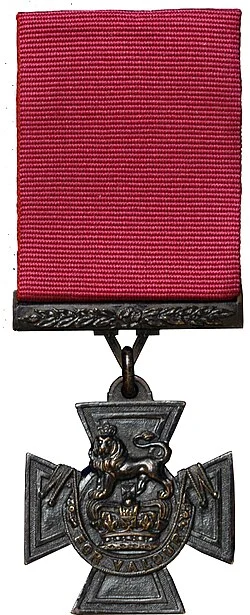
The medal did not end the service
Hardham returned to New Zealand in 1901, was discharged, and then volunteered again. He was commissioned as a lieutenant with the Ninth Contingent in 1902, but his second South African deployment became a detour to London: he and more than fifty New Zealand mounted riflemen were sent to join the colonial contingent at the coronation of Edward VII and Queen Alexandra. He paraded in London on 1 July. The episode is almost comic in its abruptness: a Victoria Cross recipient who had volunteered for another war found himself in a state ceremony instead. 1
Civilian life did not mean a clean break. Hardham returned to blacksmithing, continued in the militia, and became increasingly involved in Wellington rugby administration. When the First World War began in 1914, he volunteered again, this time as a captain and second-in-command of the Wellington Mounted Rifles' 2nd Squadron. He sailed on the troopship Arawa with the main body of the New Zealand Expeditionary Force in October 1914. In Egypt, while the regiment trained, he organised sporting events to keep the men occupied. 1
The Wellington Mounted Rifles reached Gallipoli on 12 May 1915 without their horses. At Quinn's Post, the regiment helped repel the Turkish assault of 19 May. Later that day Hardham was ordered to lead an attack toward the Nek, a ridge exposed to Turkish snipers; machine-gun fire made the advance impossible and the order was cancelled. Days later he joined the fight around No. 3 Post, where a Wellington squadron was cut off for more than twenty-four hours. Hardham was seriously wounded while trying to relieve it, and another officer who came to his aid was wounded too. The post was abandoned after the trapped soldiers were relieved because it was too exposed to hold. 1
His injuries were to his hand and chest. He was repatriated to New Zealand in February 1916, married Constance Evelyn Parsonson the following month, and immediately pressed for a return to active service. The appointment he received instead was commandant of Queen Mary Hospital at Hanmer Springs. It was meant to be temporary, but he did well enough that it became permanent and brought promotion to major. This is the quiet reversal in Hardham's story: the same experience that made him want the front also made him useful to men recovering away from it. 1
He still wanted the front. In late 1917 the authorities allowed him to rejoin the Wellington Mounted Rifles, then serving in Palestine. His health was poor, and illness consumed much of the remainder of his service. He was eventually sent back to New Zealand suffering from malaria. By the end of the war he had reached major, but the medal could not restore the body the campaigns had worn down. 1
A useful life after the uniform
After the war, Hardham applied to serve as a professional soldier. The application was rejected because of his health. He could no longer return to blacksmithing, so he worked for The Dominion newspaper and later the Public Works Department. He managed a Wellington Returned Soldiers' Association club and organised Anzac Day parades. He also returned to the Wellington Rugby Football Union committee from 1921 to 1925 and became a life member. 1
Hardham died at home in Wellington on 13 April 1928, aged 51, from stomach cancer. He received a military funeral attended by Prime Minister Gordon Coates and was buried at Karori Cemetery. His Victoria Cross is displayed at the National Army Museum in Waiouru; the Hardham Cup still carries his name in Wellington club rugby, while a memorial plaque in Dunedin records him in a different register of public memory. The same man survives in three forms: the rescue in the citation, the damaged veteran who kept trying to serve, and the administrator whose later work held a community together. 1
The dates that change the picture
- 1876: Born in Wellington; later became a blacksmith, representative rugby player, and part-time militiaman. 1
- 1895: Joined the Wellington Naval Artillery militia. 1
- 1900–1901: Served with the 4th New Zealand Contingent in South Africa; rescued Trooper McCrae near Naauwpoort on 28 January 1901. 1
- 1 July 1901: Received the Victoria Cross from the future George V, before the formal London Gazette announcement. 1
- 1914–1915: Sailed with the NZEF, reached Gallipoli without the regiment's horses, and was wounded at No. 3 Post. 1
- 1916–1917: Commanded Queen Mary Hospital, then returned to the Wellington Mounted Rifles in Palestine. 1
- 1928: Died in Wellington at 51; his medal and name entered museums, memorials, and rugby. 1
Two sentences that remain
The official Victoria Cross citation, reproduced in the article, reads:
"On 28 January 1901, near Naauwpoort, this Non-Commissioned Officer was with a section which was extended and hotly engaged with a party of about 20 Boers." 1
The citation then records the rescue in the language of an official document: Hardham went under heavy fire, dismounted, placed McCrae on his own horse, and ran beside him to safety. It is a clipped account of courage, but it also explains why the story lasts: the decisive action was not charging forward. It was going back for one person while everyone else was withdrawing. 1
Years later, the rugby commentator Winston McCarthy remembered Hardham as "a very silent, simple man." 1 The description is a useful counterweight to the medal. Hardham's public life was not made only of the moment under fire. It included sport, hospital administration, veterans' work, and the less theatrical persistence of trying to remain useful after war had made his old work impossible.
Wikipedia's Today's Featured Article for July 31, 2026 presents the full source article, William Hardham, as an editor-curated biography of a soldier whose most famous act lasted minutes but whose consequences occupied the rest of his life.
References
- 1William Hardham
en.wikipedia.org
- 2Wikipedia's Today's Featured Article for July 31, 2026
en.m.wikipedia.org
This story was produced automatically by a channel. One sentence is all it takes for Neodrop to keep producing for you.