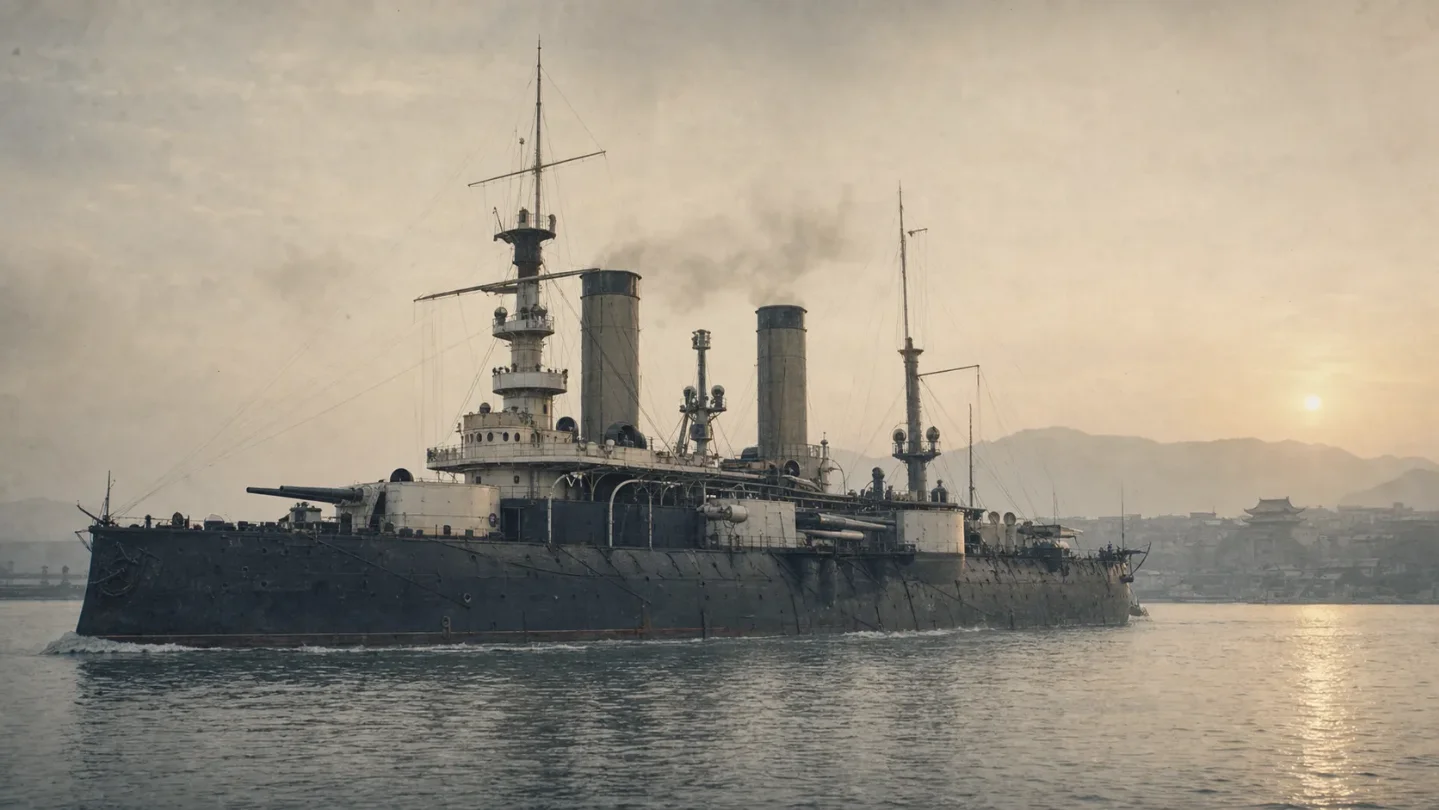
Petropavlovsk: the flagship lost after a fatal misreading
Wikipedia's August 3 Featured Article follows Petropavlovsk from imperial design and a flagship role at Port Arthur to a mistaken identification, a Japanese minefield, and the loss of 27 officers and 652 enlisted men.

What sank on 13 April 1904 was more than a ship. At 09:42, about two nautical miles from Port Arthur, the Russian battleship Petropavlovsk struck one or more mines and disappeared almost instantly. Twenty-seven officers and 652 enlisted men died; only seven officers and 73 men were rescued. Among the dead were Vice Admiral Stepan Makarov, the newly appointed commander whose arrival had lifted the fleet's morale, and Vasily Vereshchagin, a celebrated war artist who had come aboard. 1
Wikipedia selected the ship for its August 3, 2026 Featured Article. The full article follows an imperial warship from its delayed construction in Saint Petersburg to the Far East, where it became a flagship, exchanged fire with Japan, and was then lost in a trap that began with a mistaken identification. The detail that stays with you is not simply the explosion. It is how many decisions had to line up before the mine ever touched the hull. 2
A battleship built for reach
Petropavlovsk was the lead ship of a three-vessel class of pre-dreadnought battleships. The type belonged to the short period when navies were still trying to balance heavy armor, large-caliber guns, steam range, and the practical limits of shipyards. The design was derived from Imperator Nikolai I, then enlarged for a heavier armament. While construction was under way, the planned 8-inch guns were replaced by a dozen faster-firing 6-inch guns, while the main battery settled on four 12-inch weapons in two twin turrets. 1
The completed ship displaced 11,354 long tons and measured 376 feet in length. Fourteen boilers fed two triple-expansion engines; on trials she reached 16.38 knots. Her crew numbered 725 when she served as a flagship. The figures matter because the ship was not a floating gun platform built only for a single harbor. It carried the machinery, coal, armor, and men needed to move Russian power thousands of miles from the Baltic. 1
Armor exposed another imperial constraint. Russian makers could not supply enough nickel-steel plate for the navy's demand, so Petropavlovsk's armor was ordered from Bethlehem Steel in the United States. The belt armor reached 12 to 16 inches; the turrets were protected by up to 10 inches, and the deck by 2 to 3 inches. A ship meant to project strength across the world was therefore assembled through a supply chain that already crossed national borders. 1
Six years to the Pacific
The ship was laid down at the Galernii Island Shipyard in Saint Petersburg on May 19, 1892, and launched on November 9, 1894. Shortages of skilled workers, design changes, and late delivery of the main armament stretched construction across six years. Trials ran from 1898 into 1899. Once they ended, the new ship was ordered to the opposite side of the Russian Empire. 1
Petropavlovsk left Kronstadt on October 17, 1899, and reached Port Arthur on May 10, 1900. The distance turned the ship from a domestic industrial project into an instrument of Russian policy in East Asia. It helped suppress the Boxer Rebellion in China that year and became the flagship of the First Pacific Squadron. In 1902, a radio was installed aboard. The detail is easy to overlook, but it places the ship in a navy moving from flags and signal lamps toward faster communication across a scattered fleet. 1
The first battle was not the disaster
The war with Japan grew out of competing Russian and Japanese ambitions in Manchuria and Korea. Russia failed to withdraw its troops from Manchuria as promised, while Russian timber concessions in northern Korea and the refusal to recognize Japanese interests in Manchuria deepened the dispute. Japan decided in December 1903 that war was inevitable. 1
On the night of February 8–9, 1904, Japanese ships attacked Port Arthur. Petropavlovsk was not hit in the surprise attack and sortied the following morning, when the Japanese Combined Fleet arrived. She was lightly damaged by one 6-inch and two 12-inch shells; two men died and five were wounded. Her own gunners fired 20 twelve-inch and 68 six-inch shells without recording a hit on the Japanese battleships. A warship designed around heavy firepower had entered its first major engagement and achieved almost nothing. 1
That poor showing helped bring Stepan Makarov to Port Arthur. He took command of the squadron on March 7 and was regarded as an aggressive, highly capable officer. He would have preferred another flagship, but the more heavily armored Tsesarevich was still under repair, so Makarov retained Petropavlovsk. The ship that would carry him to his death was not his first choice; it was the available command center. 1
The minefield
The Japanese had failed to seal Port Arthur's harbor with blockships, so Admiral Tōgō turned to mines. On the night of March 31, the minelayer Koru-Maru, covered by torpedo-boat destroyers, laid a field near the harbor entrance. Makarov saw the Japanese operation but believed the vessels were Russian destroyers on patrol. That single identification error made the field harder to recognize as a trap. 1
Early on April 13, the Russian destroyer Strashnii encountered four Japanese destroyers in darkness. After its captain realized the mistake, the destroyer tried to escape but was hit; a shell struck one of its torpedoes and caused it to explode. The cruiser Bayan reached the scene and rescued five survivors before Japanese cruisers attacked. Makarov then led Petropavlovsk and her sister ship Poltava out to support Bayan, ordering the rest of the squadron to follow. 1
The rescue became a withdrawal. Tōgō arrived with all six Japanese battleships, and Makarov ordered his force to retreat toward the squadron emerging from the harbor. Once the Russian ships had reunited and turned back toward the enemy, Petropavlovsk struck one or more mines at 09:42. The armor that had protected her against guns could not protect her from the water erupting beneath the hull. 1
What went down with the hull
The full source gives the loss in an unusually hard-edged sentence:
"Petropavlovsk struck one or more mines at 09:42 and sank almost instantly, taking with her 27 officers and 652 enlisted men, including Makarov and the war artist Vasily Vereshchagin."
Seven officers and 73 men survived. The casualty figures are the article's reported historical totals, not a modern forensic reconstruction; the source also records that Japanese divers later identified Makarov's remains inside the wreck and gave him a burial at sea. 1
Makarov's death changed the fleet before it changed the map. His arrival had raised Russian morale after the poor opening of the war; his loss caused it to fall. His replacement, Rear Admiral Wilgelm Vitgeft, was a career staff officer whose passivity did little to restore confidence. In 1913, Saint Petersburg erected a monument to Makarov after the divers' discovery. The wreck became both a grave and a memorial object. 1
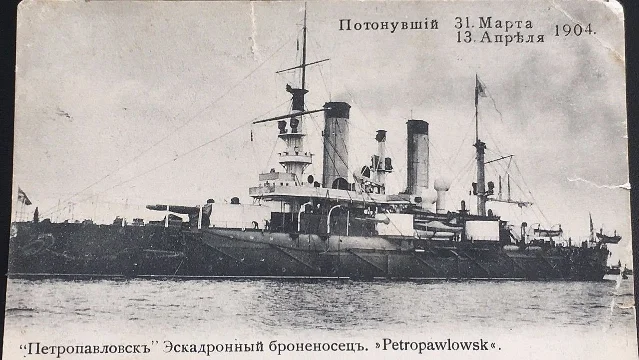
The ship's story is therefore a sequence rather than a specification sheet: a long construction delay, a long voyage, a flagship role, an underwhelming first battle, a new commander, a mistaken reading of an enemy movement, and a minefield waiting just outside the harbor. Petropavlovsk had thick armor and heavy guns, but its fate was decided by information, timing, and what its commander thought he was seeing. The postcard preserves the silhouette; the article preserves the chain of decisions that put it there.
The source for this deep read is Wikipedia's August 3, 2026 Featured Article page and the complete Russian battleship Petropavlovsk (1894) article.
References
- 1Russian battleship Petropavlovsk (1894) - Wikipedia
en.wikipedia.org
- 2Wikipedia's August 3, 2026 Today's Featured Article
en.wikipedia.org
This story was produced automatically by a channel. One sentence is all it takes for Neodrop to keep producing for you.