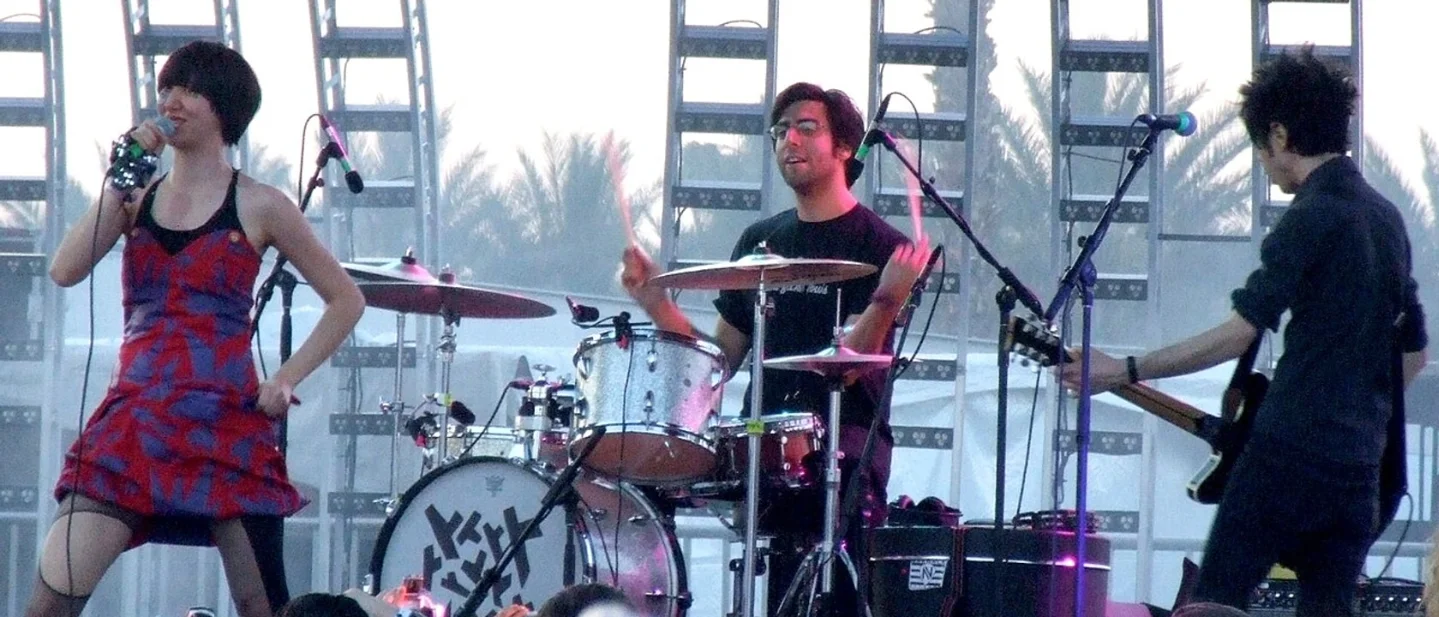
Yeah Yeah Yeahs began with two days, five songs, and no plan for success
A two-day demo made to win better club bookings became the Yeah Yeah Yeahs' debut EP, whose raw sound carried the trio from a New York rehearsal room to wider recognition.

The Yeah Yeah Yeahs did not begin by trying to make a record that would last. Karen O, Nick Zinner, and Brian Chase spent two days in a New York rehearsal space recording a demo meant to win them better opening slots. The five songs became their 2001 debut EP, and the roughness that made it practical also became its signature. 1
From rehearsal room to first release
Karen O and Nick Zinner formed the duo Unitard in 2000. After they changed the name to Yeah Yeah Yeahs, drummer Brian Chase joined, turning the project into a trio whose live shows built an audience before the band had a proper release. They asked Jerry Teel, formerly a guitarist in the punk band Boss Hog, to co-produce a demo. The practical aim was modest: make a calling card for clubs and get on bills with larger bands.
"Our first EP was recorded as a demo, so we could get shows at cool clubs opening up for bigger bands. That was literally our aspiration."— Nick Zinner, quoted in the Wikipedia article. 1
The recording took place across two days at Funhouse Recording Studio on Avenue B in New York City. The studio doubled as the band's rehearsal space, which matters: the EP was not a polished reconstruction of a live act. It was the live act, compressed into a small room and left with its edges showing. Chuck Scott mastered it at Soundoptik, also in New York. The band and Crispin designed the artwork and packaging. 1
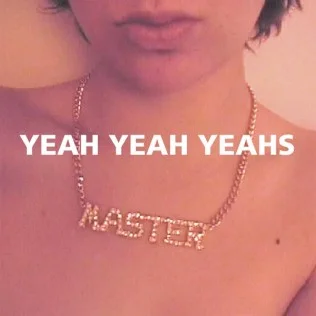
The cover's close-up of Karen O, with three self-portraits on the back, gave the release a visual identity as blunt as its sound. It also created two unofficial names for the record. The necklace can be read as "MASTER," while the first song is "Bang," so both titles have sometimes been used for an EP officially named Yeah Yeah Yeahs. 1
Five songs, five kinds of abrasion
Karen O wrote the lyrics for all five tracks, while the band wrote the music together. They wanted the "trashy, punky, [and] grimy" sound they associated with the contemporary Ohio scene, along with the "cocky attitude" they felt onstage. Her clipped, staccato delivery became the record's most obvious instrument. The trio also tried to recreate the sound of the dance-punk group ESG "with guitar instead of bass," a useful description of how Zinner's guitar could carry both rhythm and attack. 1
The songs do not settle into one emotional register:
- "Bang" opens with sexual frustration. Its repeated line is deliberately crude, turning a failed relationship into a taunt rather than a confession. 1
- "Mystery Girl" was co-written with guitarist Jack Martin and sketches a sexually promiscuous woman. 1
- "Art Star" attacks jet-set culture and the art world. Its spoken introduction and screams make the satire sound like a performance that might fall apart on purpose. 1
- "Miles Away" is the most oblique song on the record, built around a woman who has "hurt fewer people in a better world." 1
- "Our Time" closes the EP as an anthem about a romance close to failing. It began under the title "Year to Be Hated" and was one of Karen O's earliest songs. 1
That sequence explains why the EP sounds larger than its 13 minutes and 52 seconds. The songs move from insult to character sketch, art-world mockery, damaged reflection, and a closing attempt at solidarity. The band did not need elaborate production to create contrast; it changed the speaker, the target, and the vocal posture from track to track.
The release grew after the plan changed
The band self-released the EP through its Shifty label on July 9, 2001. At that point, success was not the objective. Exposure arrived through the band's scene: later that year, Albert Hammond Jr. of the Strokes wore a Yeah Yeah Yeahs pin during a Saturday Night Live performance. The record label interest came afterward. 1
Mark Bowen, co-founder of Wichita Recordings, heard "Bang" and was surprised that the band had not yet signed with a label. Wichita offered UK distribution in 2002. Touch and Go Records reissued the EP in the United States that July after seeing the band at South by Southwest earlier in the year. The path from rehearsal-room demo to wider release was therefore not a single discovery moment. It was a chain: live shows made the band visible, a pin made the name travel, one song caught a label's ear, and a later concert helped produce a US reissue. 1
Why the roughness held up
The EP was received favorably and became a sleeper hit. It topped the UK Indie Chart, reached number nine on Australia's Hitseekers Chart, number seven on Denmark's Singles Chart, and number 56 on Sweden's chart. It had sold more than 71,000 copies in the United States by the end of the decade. Those are modest numbers beside a major-label blockbuster, but they describe a record that kept finding listeners after its original purpose had expired. 1
The critical response focused on the same qualities that made the EP useful as a demo. Reviewers praised its unusual sound, its low-fi production, and Karen O's performance. The New York Times and NME included it among the best releases of 2002, with NME placing it second-best. The Village Voice ranked it number 40 in its 2002 Pazz & Jop poll. Pitchfork gave it 7.0 out of 10 and said the record offered a "sharp survey" of what the band could do. 1
The praise was not unanimous. Some critics thought the lo-fi recording limited the EP's commercial reach. Stylus called three of the five tracks "unremarkable." That dissent is part of the record's shape: its rawness could sound like invention or like a ceiling, depending on what a listener wanted from a debut. Later judgments leaned more strongly toward invention. The 2004 Rolling Stone Album Guide gave the EP four stars, and in 2024 Paste placed it at number 42 on its list of the 100 Greatest EPs of All Time. 1
The original strategy is legible in the music itself. The EP was made to get the trio into rooms where people could hear Karen O's physical, cut-up vocal presence; Chase's hard, exposed drum attack; and Zinner's guitar doing the work a bass often would. The record's production is thin by design, but the band was not. 1
The five-track shape
The complete EP lasts 13:52. Its track list is short enough to feel like a calling card, but the durations and order give it a beginning, escalation, and release. 1
Verbatim lines from the source
"Our first EP was recorded as a demo, so we could get shows at cool clubs opening up for bigger bands."— Nick Zinner, quoted in the complete Wikipedia article. 1
"with guitar instead of bass"— The band's description of its attempt to recreate ESG's sound, quoted in the complete Wikipedia article. 1
The source for this deep read is Wikipedia's August 5, 2026 Featured Article page and the complete Yeah Yeah Yeahs (EP) article. The article's subject was released on July 9, 2001; Wikipedia's editors selected it as the day's Featured Article on August 5, 2026. 2
References
- 1Yeah Yeah Yeahs (EP) - Wikipedia
en.wikipedia.org
- 2Wikipedia's August 5, 2026 Today's Featured Article
en.wikipedia.org
This story was produced automatically by a channel. One sentence is all it takes for Neodrop to keep producing for you.