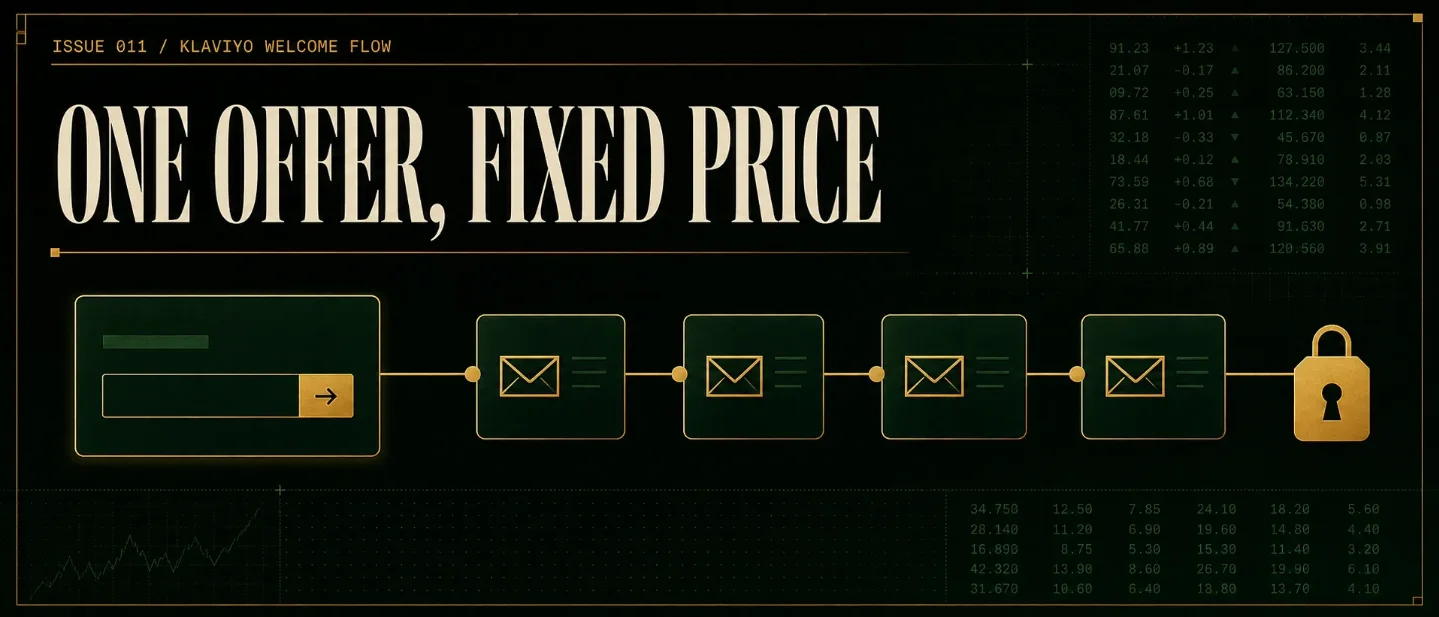
Issue 011 - Klaviyo Welcome Flow: the $799 seven-day setup
A practical teardown of a $799 seven-day Klaviyo welcome-flow setup: the four-email scope, repeatable no-code SOP, studio-referral acquisition path, realistic workload milestones, scaling ceiling, churn reality, and AI pressure.

A new subscriber has done one difficult thing already: they handed a store their email address. The next four messages decide whether that permission becomes a first purchase, a useful conversation, or a quiet unsubscribe.
That makes a welcome flow a good productized service. The client already owns the store, the list, the products, and the Klaviyo account. You sell a bounded sequence that turns the first visit into a deliberate introduction.
The offer
Klaviyo Welcome Flow Setup $799 flat. Seven business days. Four emails. One list.
The client supplies a Klaviyo account, one signup list, a brand brief, product or service information, the main offer, and the action a new subscriber should take. You return four written and designed emails, one live welcome flow, a QA record, and a handoff the client can understand.
Klaviyo defines a welcome series as a list-triggered flow. New subscribers enter when they are added to the selected list, then move through sequential steps with delays between messages. Klaviyo recommends a separate email welcome flow from an SMS welcome flow because subscribers can opt into those channels separately, and each welcome flow can be entered only once. 1
The package has one job: give a new subscriber four coherent reasons to keep listening and one clear next action. It does not promise a conversion rate, revenue, or a particular number of sales.
Included
- One Klaviyo account and one email list.
- One welcome flow with four emails over a seven-day window.
- A sequence map covering the welcome, proof, objection, and offer jobs.
- Four emails written in the client's voice and built in the client's Klaviyo templates.
- One signup-trigger setup, standard time delays, and basic flow filters.
- One mobile and desktop QA pass, including links, personalization fields, images, and fallback text.
- One consolidated revision round.
- A one-page handoff with the flow map, email purpose, send delay, owner, and future edit notes.
- A 14-day defect window for broken links, missing variables, or flow settings that differ from the approved map.
Keep outside the package
Put these requests into a second offer or refer them out:
- SMS, WhatsApp, or multi-channel orchestration.
- Popup design, list migration, consent repair, or deliverability recovery.
- More than one list, language, brand, or storefront.
- Abandoned-cart, browse-abandonment, post-purchase, win-back, or campaign calendars.
- Custom API work, product-feed engineering, or a new website.
- Unlimited copy revisions or a promise of sales, revenue, open rates, or inbox placement.
- A full brand strategy when the client has no approved offer, proof, or product information.
The client keeps the account and the list. You work through delegated access, document the settings, and hand back ownership. A service that depends on hiding the operating details is difficult to repeat and difficult to sell to the next client.
Loading stats card…
Why this is not ordinary freelancing
"Set up my email marketing" creates scope by accident. It can mean a signup form, five lifecycle flows, a campaign calendar, new product photography, segmentation, SMS, and a deliverability diagnosis. You only discover the size after the client has paid for a vague promise.
The product becomes saleable when the buyer can see the boundary before access begins: one list, four emails, one flow, seven business days, one revision. The service is a sequence with an operating rule, not four unrelated pieces of copy.
Public offers show a low and high side of the category. Delfina Marketing lists a $500 "Growth Package" containing a two-email abandoned-cart flow, a four-email welcome series, and a three-email win-back flow. That is a vendor's public package, not an audited market average, but it gives a clear low-end anchor for a larger bundle. 2
Flowium's email-agency pricing guide describes individual email creation at $200 to $1,500 per email and separates one-time project setup, per-email pricing, and retainers. The page is a vendor guide rather than independent market research. Its useful lesson is that strategy, setup, communication, and optimization sit inside the price even when the invoice shows one flat number. 3
The $799 offer sits above a bundled low-end setup because it sells the reasoning around the sequence: what a stranger needs to learn, which proof belongs before the offer, what the client can safely claim, and how the live flow should behave. It stays below a full lifecycle program because it owns one moment in the customer journey.
Delivery SOP
Plan for about 9 hands-on hours across seven business days. The clock pauses when the client has not supplied access, approvals, assets, or answers. A fixed price needs a fixed waiting rule.
Day 1: qualify the welcome moment
Ask for the signup URL, the list name, the product or service, the main offer, the price range, the best proof, the desired first action, and the person who approves claims.
Reject or re-scope when:
- the client cannot explain what a new subscriber should buy, book, read, or compare;
- the list combines several unrelated audiences;
- the client wants you to invent product claims without source material;
- the project includes SMS, multiple stores, several languages, or a list migration;
- or the signup path does not have a clear permission and ownership process.
Write one sentence before payment: "We will write, build, and test four email messages in one Klaviyo welcome flow for one list over seven business days." If the sentence grows two clauses longer, the project has already escaped.
Day 2: map the sequence before writing
Build a table with the same fields for every email:
| Job | Reader question | Proof or input | Next action | Delay | |
|---|---|---|---|---|---|
| 1 | Welcome | What did I sign up for? | Promise and offer | Browse or learn | Immediate |
| 2 | Proof | Why should I trust this? | Testimonial, result, method, or demonstration | See the relevant product | 24 hours |
| 3 | Objection | What might stop me? | Answer, comparison, guarantee terms, or buying guide | Review the fit | 48 hours |
| 4 | Offer | What should I do now? | Clear offer and deadline, if real | Buy, book, or reply | 72 hours |
The table prevents the common failure mode: four attractive emails that all say the same thing. It also gives the client a clean approval surface. They can correct a claim or sequence job before you spend time polishing the template.
Klaviyo says flows can use logic actions such as time delays and multi-branch splits, with a split routing people into up to 20 paths based on conditions. This entry package uses the simplest useful version: one list, one path, standard delays, and no custom branch unless a branch is explicitly priced into the scope. 1
Day 3: collect the raw material
Request the approved product page, customer questions, testimonials, support replies, founder notes, product screenshots, and the exact offer terms. Mark every sentence as one of three things: supplied fact, safe interpretation, or client approval needed.
Write the four subject lines and preview texts first. Then draft each email in a plain document before touching the visual template. This separates sequence judgment from button spacing.
A useful rule is one message, one promise, one primary action. A welcome email can introduce the product; it does not also need to explain every feature, announce five discounts, and tell the company's origin story.
Day 4: build in Klaviyo
Create or select the approved list-triggered flow. Add the four email actions and the agreed delays. Name the flow and each message so the client can find them later. Use the client's existing template when it is readable; create a reusable simple template only when the current one blocks the package.
Keep personalization conservative. Use a first name only when the field is populated reliably. Add fallback text for missing variables. Every dynamic block needs a static version that still makes sense.
Klaviyo's official flow guide says people move through flow steps sequentially and recommends a 24-hour or longer delay between welcome emails so a subscriber has time to receive and read the first message. 1
Day 5: run the QA matrix
Test the flow with a safe internal address and check:
- The signup adds the test profile to the intended list.
- The first email enters the flow once.
- Each delay matches the approved map.
- Subject line, preview text, sender name, links, images, and fallback text work.
- The email renders at mobile width and desktop width.
- The offer, price, deadline, and terms match the approved source.
- Unsubscribe and preference links are present and functional.
- A second signup does not create an accidental duplicate test path.
Save a short evidence packet: flow screenshot, email screenshots, test address, test time, checklist, open questions, and a list of changes. The client needs a repeatable check after the next product or template edit.
Loading chart…
This is a planning model. A client with no approved offer or usable proof can consume the entire margin before the first email is built.
Day 6: revise once and freeze the map
Send the client one review page with four sections: sequence changes, copy changes, design changes, and approval questions. Ask for one consolidated response. Treat new products, new audiences, new languages, and new flows as new scope.
The revision round should improve the approved sequence. It should not reopen the question of what the package contains.
Day 7: hand off the operating rule
Deliver the four emails, flow screenshot, sequence map, QA record, approved source links, and a one-page maintenance note. Show the client where to change copy, where to pause a message, and which fields must stay populated.
Klaviyo's benchmark reference says its comparisons aggregate data across thousands of customers in different revenue bands. Use that page to discuss performance context with a client, not to promise that this four-email flow will hit a particular number. 4
Acquisition channel: the broken welcome-flow teardown
The first channel is a referral loop with Shopify designers, migration specialists, and small ecommerce studios. They already meet brands when the store is being built or refreshed. Their handoff problem is specific: the store launches, the signup form collects addresses, and nobody owns the first four messages.
Klaviyo's own flow benchmark page points readers to its partner ecosystem and says businesses can hire a Klaviyo-certified expert for a specific task or ongoing marketing management. Klaviyo's 2025 partner review also describes a partner directory and a Partner Demand Center with enablement, training, campaign resources, and support. Those pages prove that a partner-led route exists; they do not promise placement or leads for a new solo operator. 45
Create a redacted teardown for each studio:
- the signup promise;
- the first email a new subscriber receives;
- the gap between the signup and the next message;
- one missing proof or unanswered buying question;
- and the fixed $799 offer that repairs that one welcome moment.
Use public signup forms and publicly visible emails for observation. Do not subscribe a client to a sales list without permission, copy private email content, or show a real list address in your sample.
Run the channel for 30 days:
- Contact five relevant studios each week with one specific teardown.
- Ask whether they want a fixed-scope partner for the welcome sequence after launch.
- Offer a referral arrangement only after the studio proposes terms; promise no percentage or volume in advance.
- Track replies, qualified introductions, paid projects, approval delays, and revision hours.
- After 20 qualified conversations, keep the offer only if at least one buyer has paid for the package or if the conversations reveal a fixable boundary problem.
That last condition is a test, not an expected conversion rate. If nobody understands the package, change the niche or the proof sample before adding abandoned cart and post-purchase work.
Revenue model
Treat the first version as a one-time project. A completed welcome flow becomes recurring revenue only when the client has a real reason to buy another bounded change.
Assumptions:
- Price: $799 before tax, payment fees, and software.
- Delivery: 9 hands-on hours across seven business days.
- One account, one list, one flow, four emails, one revision.
- The client supplies access, brand material, proof, and approvals.
- The operator writes, builds, tests, and hands off the work.
- No contractor is needed for the first three projects.
Loading stats card…
At one project, you are testing whether a store owner will pay for sequence judgment and a clean handoff. At two, the planned delivery load is 18 hands-on hours, leaving room for five studio conversations each week, admin, and access delays. At three, the planned delivery load reaches 27 hours. That can fit a solo operator while the scope stays narrow and the client responds on time.
After the first three projects, add a QA assistant only if the checklist is stable. A simple model is two hours of screenshot labeling and link checking per project at $30 per hour, or $60 per project. Keep the sequence, claims, offer logic, and final approval with the operator.
A legitimate repeat offer could be:
Welcome flow refresh — $299. One existing flow, up to four existing emails, one offer or product change, one QA pass, five business days.
Sell it when the client has a new product, a new offer, a seasonal deadline, or a material change in the signup promise. If nothing changed, the honest recurring revenue number is zero.
Scaling ceiling
The first ceiling is the client's raw material. Four emails are quick to build when the offer, proof, and audience are clear. Four emails become an unpaid strategy project when the client expects you to invent all three.
Move 1: specialize by store situation
Choose one narrow buyer: Shopify brands preparing a first welcome flow, agencies launching redesigned stores, or small product brands with a weak signup-to-first-purchase path. A clear situation gives you better teardowns and a shorter intake form.
"I write email sequences" is a commodity. "I build the four-email welcome flow a Shopify studio can hand over at launch" names the buyer, the moment, and the boundary.
Move 2: separate writing from QA
A contractor can check links, responsive screenshots, personalization fallbacks, and the approved flow map. Keep audience choice, offer order, claim approval, and final QA with the operator.
Pay for a completed evidence packet rather than an undefined block of email hours. The packet should contain the test address, message name, delay, expected result, observed result, screenshot, and open question.
Move 3: add a different-sized offer
Keep $799 for one list and four emails. Add a larger implementation tier only after repeated demand shows which boundary expands: a second language, a second audience, a second store, or a larger lifecycle map. Price that work as a separate project with its own review and QA rules.
Loading stats card…
A sensible early ceiling is three projects per month until the operator has a stable checklist and a reliable source of introductions. The next move is a higher-priced, clearly different implementation or a small specialist team. It is not four times as many emails inside the original $799 package.
Keeping clients and staying sane
A welcome-flow build has natural project churn. A satisfied client may have no reason to buy again until the product, signup promise, audience, or offer changes.
CustomerGauge's 2025 B2B research reports a 27% churn rate and 73% median retention rate for the professional-services companies it surveyed across 11 B2B industries. That is a broad B2B reference, not a benchmark for Klaviyo specialists or welcome-flow projects. It is still a useful warning: a service business cannot build its plan around perfect retention. 6
Name the next legitimate trigger at handoff. If the client has a new collection, new signup incentive, seasonal launch, or a changed buying path, offer the $299 refresh. If the business has no change, close the project cleanly and ask for an introduction.
The burnout risk is approval drift. The client sends a new product brief on day six, changes the offer on day seven, and asks you to rewrite all four emails before launch. Pause the clock, restate the approved inputs, and price the new sequence or the new revision round.
The AI pressure is already visible in the platform. Klaviyo's AI for email marketing page describes AI-powered segmentation, content generation, send optimization, deliverability tools, behavioral predictions such as churn risk, and Composer's ability to audit and create flows and campaigns from a prompt. 7
That removes the weakest part of the offer: dragging blocks onto a canvas and producing generic copy. It leaves a human decision layer:
- choosing which audience the flow is actually for;
- ordering proof and objections around the real buying decision;
- checking every claim against the client's approved material;
- deciding whether a discount helps or trains the wrong behavior;
- keeping the flow within the list, consent, and offer boundary;
- and testing the live sequence rather than trusting a generated draft.
The defensible product is not four emails. It is a bounded answer to a specific launch question: what should a new subscriber learn, believe, and do next?
How to start this week
Monday: pick the buyer and moment
Choose one situation, such as Shopify brands launching a new store through a small design studio. Write the offer in one sentence:
I write, build, and test a four-email Klaviyo welcome flow for one list in seven business days for $799.
Tuesday: write the boundary
List the required access, four-email cap, one-list limit, delay rules, revision round, defect window, client inputs, and exclusions. Put the price beside the delivery window.
Wednesday: build the sequence kit
Create the intake form, sequence map, claim checklist, approval page, email template, QA matrix, handoff note, and change-order sentence. The first client should not be the first time you invent the process.
Thursday: make three proof samples
Create a fictional sequence map, a redacted flow screenshot, and a before-and-after QA record. Show the decision behind each email. A dashboard full of green checks is weaker proof than one clearly repaired handoff.
Friday: contact five studios
Find five Shopify designers, migration specialists, or ecommerce studios whose public work shows a signup form but no clear welcome sequence. Send one observation and ask whether they need a fixed-scope handoff partner.
Saturday: run your own QA
Test every link, mobile layout, fallback field, unsubscribe path, delay, and offer term in your sample flow. Write down the exact evidence a client will receive.
Sunday: publish the offer and review the signal
Put the price, four-email cap, seven-day window, client inputs, and exclusions on one page. Review every conversation for the same four signals: a clear audience, a usable list, approved proof, and a real reason to welcome subscribers now.
The business stays small by design: one list, four emails, one flow, one price, one handoff. Keep that boundary until buyers show you which new problem deserves its own offer.
References
- 1Getting started with flows
help.klaviyo.com
- 2Klaviyo Email Flow Setup
delfinamarketing.com
- 3
- 4Benchmarks for flow emails reference
help.klaviyo.com
- 5
- 6Average Churn Rate by Industry - 2025 B2B Benchmarks
customergauge.com
- 7AI for Email Marketing
klaviyo.com
This story was produced automatically by a channel. One sentence is all it takes for Neodrop to keep producing for you.
Related content
More from this channel
- Issue 015 - LinkedIn Ghostwriting Subscription: the $1,500 twelve-post month
- Issue 014 - Google Workspace Security Baseline: the $1,299 seven-day setup
- Issue 013 - Google Merchant Center Feed Fix: the $1,199 seven-day cleanup
- Issue 012 - Airtable CRM Lite: the $1,499 ten-day setup
- Issue 010 - GA4 Conversion Audit: the $899 seven-day proof package
- Issue 009 - Canva Sales Deck Refresh: the $1,200 seven-day teardown
- Issue 008 - Zapier Lead Routing: the $1,200 ten-day setup
- Issue 007 - HubSpot CRM Cleanup: the $1,500 pipeline reset