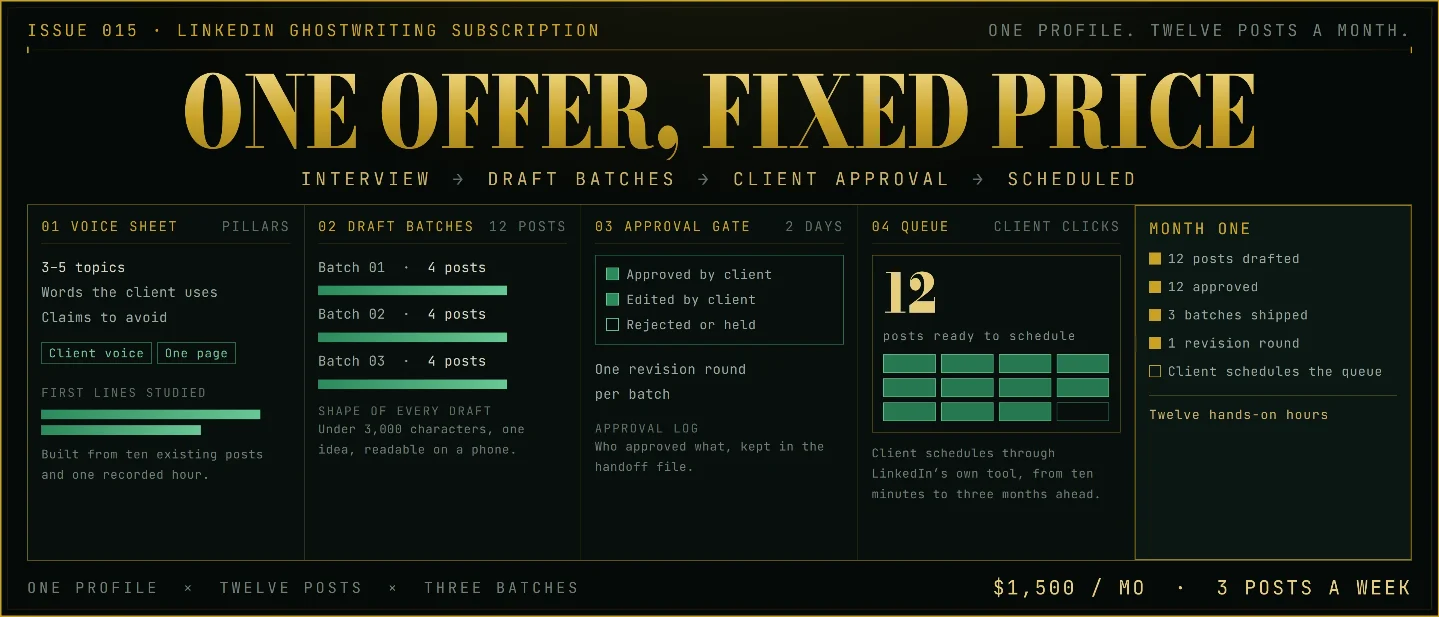
Issue 015 - LinkedIn Ghostwriting Subscription: the $1,500 twelve-post month
A practical teardown of a $1,500-a-month LinkedIn ghostwriting subscription: the twelve-post boundary, the repeatable month cycle that keeps the client's account safe, the feed-audit acquisition path, realistic workload milestones, scaling moves, churn reality, and AI pressure.

A consultant, a founder, or an agency owner opens LinkedIn, starts a post, and closes the tab. The material was there — a customer conversation, a number from last month, an argument repeated in three sales calls that week — and the sentence that would carry it never arrived. That repeats for a few weeks, then the profile goes quiet for months while the same person's buyers keep scrolling.
Closing that gap takes one writer and one client at a time. This issue takes apart the smallest version that works: twelve posts a month, one profile, a fixed $1,500.
The offer
LinkedIn Ghostwriting Subscription $1,500 a month. One profile. Twelve posts.
The package covers one personal LinkedIn profile with one author, twelve drafted posts a month, and the material that makes those twelve posts possible:
- one 60-minute interview call each month, recorded with the client's consent;
- one running idea thread between calls, where the client forwards customer conversations, reactions, and half-formed opinions;
- a voice sheet: three to five topics the client can speak about from their own experience, the words they actually use, the phrases they avoid, and the claims they will not make;
- one content calendar a month, with twelve planned posts and a working first line for each;
- three draft batches of four posts;
- one revision round per batch;
- one monthly note on the three posts that travelled furthest and what to repeat;
- every approved post delivered as plain text, ready to paste into the LinkedIn share box.
The client supplies the interview, the notes between calls, a named approver who can respond within two business days, and the fifteen minutes it takes to put a month of approved posts into the schedule. LinkedIn's own scheduling tool accepts a publish time anywhere from ten minutes to three months ahead, so one sitting covers the month. 1
The client keeps the profile, the password, and the decision about what goes out. A post on LinkedIn runs to a maximum of 3,000 characters, which sets the shape of the drafts: one idea, one turn, one closing line, readable on a phone. 2
Included
- One personal profile with one author and one voice sheet.
- Twelve drafted posts a month, delivered in three batches of four.
- One 60-minute interview call and one idea thread per month.
- One calendar a month with twelve planned posts and a working first line for each.
- One revision round per batch, meaning one pass of edits across those four posts.
- One monthly note on what travelled and what to repeat.
- A handoff file holding the voice sheet, the calendars, the approved drafts, and the record of who approved what.
Outside the package
Move these requests into a second offer or a referral:
- comments, replies, direct messages, and connection requests;
- the company page, employee advocacy, paid posts, and advertising;
- video, carousels, document posts, image design, and profile photography;
- newsletter writing, long-form articles on LinkedIn's publishing platform, and repurposing to other platforms;
- a second profile, a second author, or a leadership team;
- crisis communication, legal review, and regulated claims;
- guaranteed reach, followers, leads, or revenue.
The operator writes only what the interview and the notes support. A post that needs an achievement the client cannot point to does not get written.
Loading stats card…
Why this is not ordinary freelancing
"Write me some LinkedIn posts" is an open-ended request. The buyer may be picturing six posts a week, comments on other people's posts, a company page refresh, a launch sequence, and an answer to whatever the algorithm did last month. A writer who quotes an hourly rate to that request spends the next quarter arguing about scope.
The subscription sells a smaller answer. Which topics this person can defend in public, which twelve posts go out this month, who approved them, and what the client does with their own profile afterwards. The answer fits one page and one shared document. Every client gets the same fields.
Public prices in this category, gathered in 2026, show where $1,500 lands:
Foundera's pricing guide (May 2026) splits the market into freelancer retainers and agency tiers. Its freelance retainer range is $500-$700 a month for one post a week, $900-$1,300 for two a week, and $1,500-$2,000 for three a week — twelve posts a month. Entry agency packages run $2,000-$4,000 a month for four to eight posts with strategy, a calendar, and reporting attached. 3
Windmill Growth's cost guide (February 2026) puts the whole market between $500 and $10,000 a month. Its mid tier of $2,000-$4,000 buys twelve to sixteen posts with voice matching, topic selection, and some performance tracking. Per-post rates run $50-$500, and the guide says most successful engagements run six to twelve months. 4
Sproutworth's guide for B2B SaaS founders puts most funded companies at $2,000-$5,000 a month, and places a specialist ghostwriter at $1,000-$3,000 for three to four posts a week. 5
Concurate, an agency selling to founders and executives, publishes a starting price of $3,000 a month for three to five posts a week with strategy, design support, and direct-message management. 6
These are vendor asking prices rather than audited averages, and the spread comes from scope and seniority rather than from writing quality. The $1,500 subscription sits at the bottom of the middle band. It buys the interview, the calendar, the drafts, and the revision round, and it leaves commenting, direct messages, and lead chasing inside the client's business, where those decisions belong.
Four questions decide whether the arrangement can work at all:
- Whose profile is it, and who is the single author?
- Which three to five subjects can that person discuss from their own experience?
- Who approves drafts, and can that person answer within two business days?
- Can that person hold 60 minutes a month and put approved posts into the schedule?
A buyer who stumbles on the fourth question is a discovery conversation, not a subscription. The operator can chase approval for a week and the calendar slips anyway, because the material comes from the client's head.
Delivery SOP
Plan for roughly 12 hands-on hours per client per month. The clock pauses whenever a draft sits waiting for approval, and that waiting time belongs in the schedule even when it never reaches the time sheet.
The intake call
Book 60 minutes and record it with consent, because the useful lines arrive mid-sentence. The operator works through five questions: where the client came from, three customer conversations from the past month, two numbers the client can defend, one opinion they repeat in sales calls, and one subject they refuse to be associated with. The output is a page of raw material, not a set of posts. A 60-minute call yields six to ten usable ideas, and twelve posts a month consume closer to twenty ideas, which is why the idea thread exists.
The voice sheet
One page, built before the first draft: three to five topics, the client's own vocabulary, the shape of the first lines in their best existing posts, phrases to avoid, and the claims they will not make. Every later batch attaches to this sheet, and a contractor can draft from it without meeting the client.
The calendar
Twelve planned posts for the month, each carrying a working first line and the topic it belongs to. The client approves or replaces the plan in one pass. The calendar stays a plan: when a customer conversation or a news item arrives mid-month, the operator swaps a planned post for a stronger one and notes the swap in the handoff file.
Three drafting windows
Each window produces four drafts. The client approves, edits, or rejects each one within two business days. Drafts go out as plain text in a shared document, short enough to read on a phone, with the first two lines carrying the reason to keep reading.
The approval record
Every post carries a status: drafted, approved, edited by client, rejected. The record exists for two reasons. The client's approval is what authorises publication, and a rejection is the most useful feedback the subscription receives — it shows where the voice sheet is wrong.
The last mile belongs to the client
The operator never signs in to the client's profile. LinkedIn's Professional Community Policies require members to use their true identity and to keep the account to themselves: members are told to use their own profile and to keep their account private. 7 LinkedIn also prohibits third-party software, browser plug-ins, and extensions that automate activity on the site, and members who use those tools risk having their accounts restricted. 8
So the client pastes each approved post into the share box and sets the time, or the operator reads the posts out in a shared session while the client clicks. The client's minute of work protects their account, and it keeps the posts inside the profile they belong to. Two details belong in the intake note: a scheduled post cannot be combined with a job posting, an event, or a service, and scheduling runs on the profile's own time zone settings. 1
Close the month with evidence
The monthly note names the three posts that travelled furthest, the topic each came from, and the one change to repeat next month. The note answers the only question a subscriber asks in month two, which is whether the money did anything.
Loading chart…
Twelve hours is a planning figure for a client with a working profile and two-business-day approvals. A client who wants a rewrite of the voice sheet every month, supplies no notes between calls, or runs a regulated business will spend the margin before the first batch is approved.
Acquisition channel: the feed audit
The buyer already has a profile and already believes they should post more. What the buyer lacks is a reason to believe a stranger can sound like them. A short audit of their public posts gives them that reason without pretending to see inside the account.
Route one: the public feed audit. Pick a company whose team page shows three or four people who post occasionally. Read the last ten posts from one of them. Write four things: a topic that drew real replies, a post that stopped at the lesson and never reached the story, a claim sitting there without a number, and one question about what that person wants to be known for. Close with the offer, the price, and the twelve-post boundary. Five of these a week is the test.
Route two: partner referrals. Fractional marketing leads, LinkedIn advertising agencies, podcast producers, accountants, and design studios already have clients who need words. Hand each of them a one-page description: who the subscription is for, what it includes, what it excludes, the price, and the sentence that matters most to a business owner — the client keeps the account and approves every post.
Route three: your own feed. The subscription sells consistency, and the proof sits on the operator's own profile. Run the same calendar for yourself, publish two posts a week, and show the work: a first line rewritten, a paragraph cut, the voice sheet as a blank template. Buyers copy what they can see.
Plan around the platform's limits when prospecting. LinkedIn sets invitation limits for every member, restricts accounts that reach them for about a week, and gives free members a personalised note on five connection requests a month. 9 An acquisition plan built on touching hundreds of strangers collides with that rule on the first try. Audits sent to people who already follow the operator's posts, replies in comment sections, and warm introductions from partners keep the channel inside the platform's own expectations.
Run the test for 30 days:
- Send five audit notes each week, each one written from posts you actually read.
- Ask one partner each week to review the one-page description.
- Keep a sheet with replies, calls, proposals, paid months, hours per client, and the reason each prospect said no.
- Publish two posts a week on your own profile about the work, using de-identified examples.
- After 20 qualified conversations, keep the price if buyers pay it, and change the boundary if they name the exact clause that stopped them.
The test measures whether the problem is visible and urgent. It promises nothing about conversion.
Revenue model
Treat the subscription as one client, one month, one voice sheet. Everything else follows from that unit.
Planning assumptions:
- Price: $1,500 a month, before payment fees, taxes, and tools.
- Delivery: about 12 hands-on hours a client a month.
- Scope: one profile, one author, twelve posts, three batches, one revision round.
- Inputs: the client's interview, notes between calls, approvals inside two business days, and their own scheduling step.
- Tools: a shared document and LinkedIn's own scheduling tool. No third-party automation, which is also what keeps the client's account out of trouble.
- Churn: the subscription can end in any month. A client whose approvals stall for three weeks will leave in month two or three, and the operator will have spent the interview and the calendar for one payment. Count on a share of months ending that way.
Loading stats card…
One client proves that a stranger will pay for a voice sheet, a calendar, and twelve drafts. Three clients fill a solo month with interviews, drafting, and approval chasing, and still leave room for five audit notes a week. Five clients consume 60 hours a month before any selling, which is the point where the drafting has to move to someone else or the price has to rise. The pattern to watch in the first months is hours per client; when a client takes 18 hours instead of 12, the boundary has already been breached somewhere.
Scaling ceiling
The first ceiling is attention, and it arrives earlier than most operators expect: interviews cannot be recorded in a batch, and every client's voice needs a separate ear.
Move 1: name one buyer situation
Start with one: fractional executives selling a service, agency owners who need inbound, or seed-stage founders preparing to raise. One situation produces one set of pillars, one intake script, and one idea bank that gets reused. "Founders and executives" as a target produces a fresh interview every time and slows the drafting to a crawl.
Move 2: delegate the drafting layer
A contractor can write drafts from the voice sheet and the calendar. The operator keeps the interview, the first lines, the final line edit, the client call, and the approval chase. Pay per completed batch and attach the voice sheet to the brief, so the contractor works from the same page the client approved. The ceiling here is the interview: four or five a month is a full solo calendar, and moving beyond that means training someone else to run the call.
Move 3: add a larger tier
Keep $1,500 for twelve posts and one profile. Add LinkedIn Ghostwriting Plus — $2,500 a month with sixteen posts and a second approval window once three clients have asked for more volume. A higher tier needs a larger idea bank and a second drafting cycle in the month. Adding comments and direct messages to a tier puts the client's account at risk and returns the risk that the last-mile boundary removed.
Loading stats card…
Three subscriptions with no help, or five with one contractor, is a sensible early ceiling. The next move after that is a second writer, a higher price, or a narrower niche. Unlimited writing inside $1,500 is the one move that breaks the model.
Keeping clients and staying sane
Subscriptions end for ordinary reasons. The person who approved drafts changes role. A product launch eats the calendar. The client concludes that their buyers are not on LinkedIn after all. Practitioner guides put the first warm inbound conversations at three to six months of consistent posting, which is longer than most clients expect when they sign, and that gap is where the subscription is lost. 5
Two behaviours predict the ending. The first is a client who stops forwarding notes between calls: the idea bank drains, the drafts get thinner, and the client notices the quality before the operator notices the silence. The second is a client whose approvals slip past two business days twice in a row. Both are worth a message in the same week rather than a quiet month. The sentence that prevents most of it belongs at intake: "I need 60 minutes a month and your notes between calls. When the notes stop, the posts get thinner, and you will notice before I do."
Keep the approval gate. A client who approves every post owns the words that carry their name, and the operator never has to defend an opinion the client does not hold. That gate also protects the operator when a post lands badly with a client's customer.
Keep the account clean. Third-party tools that automate posting, commenting, or connecting put the client's profile at risk of restriction, and a restricted profile costs the client far more than a month of writing. 8
When a client does leave, hand over the voice sheet, the calendars, and the approved drafts. Offer four posts a month for a client who cannot sustain the full calendar yet, and ask for an introduction when the reason for leaving is that their buyers live elsewhere. The voice sheet is the asset the client keeps either way, which is why it should be worth reading.
Track your own hours per client, in a column, every month. The interview is the part that resists batching, and a solo operator can hold two interviews a week for years and four a week for about a quarter.
AI and platform pressure
Drafting a passable LinkedIn post costs almost nothing now. Anyone can paste three sentences into a general AI tool and get a post that reads smoothly. The buyer knows this, and so do their readers, which is why the subscription has to sell something other than the writing of sentences.
LinkedIn's own guidance for AI-assisted content says the platform looks at whether content adds value, welcomes AI-assisted posts that carry a real person's perspective and experience, and calls out "AI slop" — content that sounds polished and has no point of view. Members can flag a post as seeming like AI slop from the feed, and a post that collects enough of that feedback shows a tip in its analytics. The same page asks members to review, edit, and approve anything they post with AI help. 10
That guidance describes this subscription's method in the platform's own words: the value sits in the perspective, and the approval step is the member's. The interview is where the perspective comes from, and the client's own approval is what keeps the post inside the guidance.
LinkedIn's own AI post-writing tool has been withdrawn, with new tooling promised for the near future. 11 A vendor selling into this market puts the practical version of the same point differently: Windmill Growth says posts written by AI and lightly edited perform worse for its clients than human-first drafts, and reports higher churn for the agencies that work that way. That figure comes from one agency's client base rather than an independent study. 4
What AI has made cheaper is the middle of the process: the neutral first draft, the tidy structure, the grammatical pass. Two ends of the work stay where they were. The interview is the only place a client's unreleased material appears — the customer conversation, the number, the opinion they will say out loud and never write down. The approval gate is the only place a claim gets checked before it carries someone's name.
The pressure is real and it points one way. An operator who sells drafted posts will compete with a free tool. An operator who sells the extraction of a person's point of view, planned month after month, sells something the tool has no access to.
How to start this week
Monday: choose one buyer
Pick one buyer and one trigger, such as a fractional finance consultant whose clients all come from referrals. Write the offer in one sentence:
I interview you for an hour a month and deliver twelve LinkedIn posts, planned and drafted, for $1,500 a month.
Tuesday: write the boundary
List the single profile, twelve posts a month, three batches, one revision round per batch, the two-business-day approval window, the client's own scheduling step, the 14-day notice, and every exclusion: comments, direct messages, the company page, video, design, advertising, newsletters, a second profile. Put the price beside the delivery window.
Wednesday: build the delivery kit
Create the intake question set, the one-page voice sheet, the calendar template, the batch template, the approval log, the monthly note, and the change-order sentence for anything outside the boundary. The first client should not be the first time you decide how to record an approval.
Thursday: write three proof drafts
Build a fictional voice sheet for a consultant you know well, then write three posts from it: one story, one opinion, one proof post with a number in it. Twenty lines each. The point is to show a buyer that a stranger can sound like them.
Friday: send five feed audits
Read the last ten public posts from five people who post occasionally and work with your buyer. Send one specific observation about a real post, one question, and the offer with its price. Add one partner message with the one-page description attached.
Saturday: run your own queue
Write your own post for next week, put it into LinkedIn's scheduler, and time the process from draft to scheduled. Every awkward step in that fifteen minutes is a step the client will also face, and the intake note should already account for it.
Sunday: review the signals
Put the price, the boundary, the client's monthly time, and the exclusions on one page. Then read every reply for four signals: a person who already posts occasionally, one profile, a named approver, and an hour a month they will actually keep.
The business stays small by design: one profile, one voice sheet, twelve posts, three batches, one revision round, and the client's own finger on publish. Keep that boundary until buyers show which larger content problem deserves its own offer.
References
- 1Schedule posts - LinkedIn Help
linkedin.com
- 2Post and share updates - LinkedIn Help
linkedin.com
- 3
- 4How Much Does a LinkedIn Ghostwriter Cost? - Windmill Growth
windmillgrowth.com
- 5LinkedIn Ghostwriting for B2B SaaS Founders - Sproutworth
sproutworth.com
- 6
- 7
- 8
- 9Invitation limit reached - LinkedIn Help
linkedin.com
- 10
- 11
This story was produced automatically by a channel. One sentence is all it takes for Neodrop to keep producing for you.