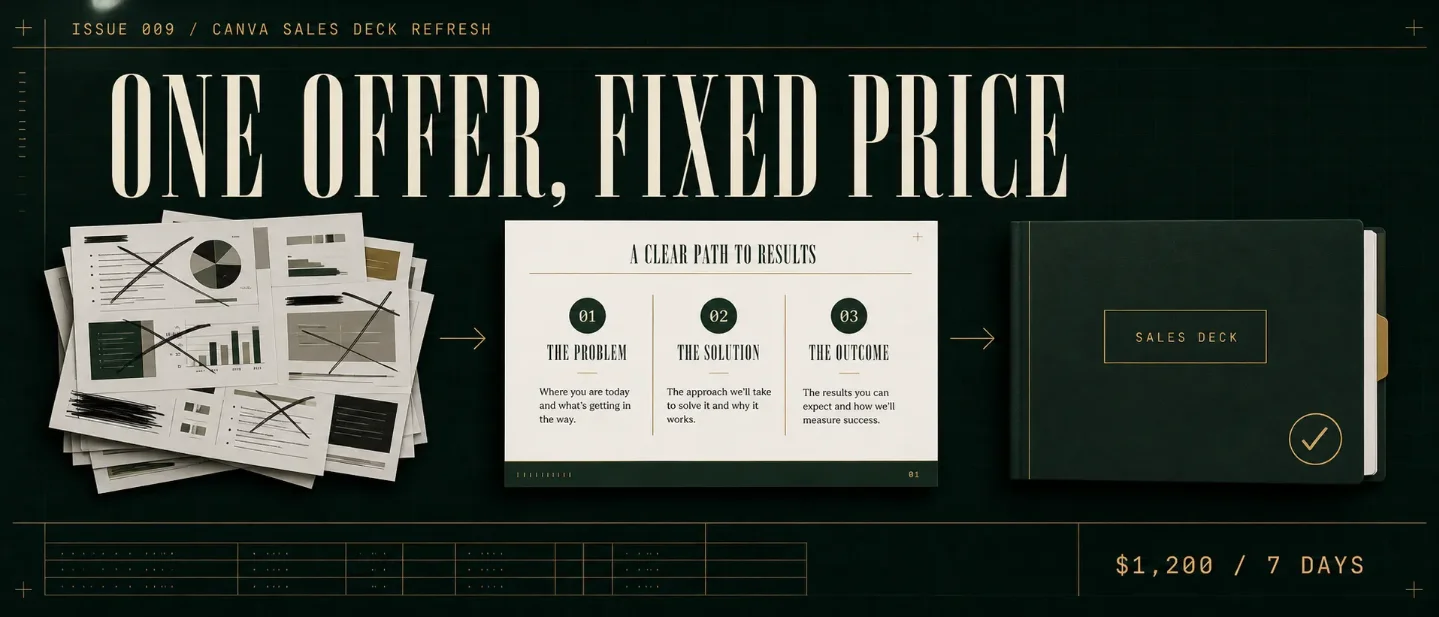
Issue 009 - Canva Sales Deck Refresh: the $1,200 seven-day teardown
A practical teardown of a $1,200 seven-day Canva sales-deck refresh: the fixed scope, repeatable delivery SOP, marketplace acquisition test, realistic workload milestones, scaling ceiling, churn reality, and AI pressure.

Most small B2B firms do not need a new presentation. They need the 18-slide sales deck they already have to stop losing the thread between problem, proof, offer, and next step.
That is a narrower job than "presentation design." It has a clean input, a visible finish line, and a buyer who already knows the material is costing them time.
The offer
Canva Sales Deck Refresh $1,200 flat. Ten existing slides. Seven business days.
The client gives you one existing sales, capability, or proposal deck; one logo and brand reference; the current offer; and the audience the deck must persuade. You return an editable Canva deck, a PDF export, a slide-by-slide change log, and a 30-minute handoff.
Canva supports browser and mobile editing, real-time collaboration with comments and assigned tasks, and export to PowerPoint, PDF, video slideshow, or Canva website. Those capabilities make an editable handoff practical, but they do not make the client's argument correct. 1
Included
- One existing deck, up to 10 final slides. If the source has 18 slides, you and the client choose the 10 that carry the sale.
- One 45-minute intake call and one written audience-and-action brief.
- A simple visual system: type hierarchy, two to four colors, spacing rules, image treatment, and reusable slide layouts.
- Redesign of the agreed slides, including up to two charts or diagrams.
- Light copy tightening for clarity, not a new sales narrative or market research.
- One consolidated revision pass from one client decision-maker.
- Editable Canva source, PDF export, change log, and a 30-minute handoff.
- A 14-day defect window for broken layout, missing assets, or agreed corrections.
Excluded
Do not put these inside the $1,200 price: writing a pitch from a blank page, fundraising strategy, competitor research, financial modelling, new photography, animation-heavy keynote work, more than 10 final slides, multiple audiences, a second deck, or unlimited revisions.
The client also owns the Canva account and any paid assets. You work in the client's file, not in a personal workspace that becomes a hostage situation at handoff.
The finish line is not "a beautiful deck." It is this: a sales representative can open the file, explain the offer in the intended order, edit the next proof point, and send the PDF without asking you to fix the layout again.
Why this is not ordinary freelancing
A generic presentation-design request invites an argument about taste. A fixed service gives the argument a boundary: one audience, one sales motion, 10 slides, one revision pass, one handoff.
The market has room for that price, with caveats. Harri Digital's May 2026 UK guide puts full-deck presentation work at £800–£3,500, and lists sales and proposal decks at £1,200–£3,000 for 20–30 slides. It also says experienced studios commonly quote by project rather than by slide because slide count does not reflect the work in a complex chart or a tight narrative. 2
Nexaflow lists one-off pitch, sales, and business presentation design from $1,800, priced by slide count and complexity, alongside broader monthly retainers. That is an agency asking price, not proof that a solo operator can charge the same. It does show why a tightly bounded $1,200 refresh can sit below a full-service engagement without pretending to deliver the same strategic depth. 3
At the low end, Fiverr's funding-pitch category showed 5,666 services when retrieved for this issue. One visible listing priced a five-page design-only package at $295, a 10-slide investor-ready package at $1,450, and a 20-slide research-and-narrative package at $1,950. Another priced a 10-slide rewrite at $1,990 and a full written pitch deck at $3,990. These are live asking prices and packages, not an audited market average or a conversion benchmark. 456
The lesson is uncomfortable but useful: buyers already see cheap slide execution and expensive narrative work. Your $1,200 package must sit in the middle and say exactly what it is. It is a refresh of supplied material, not a disguised agency engagement.
Delivery SOP
The work is mostly judgment, but it can still run on a repeatable clock. The following model assumes about 10.5 hands-on hours, with client response time sitting outside the seven business days.
Day 1: qualify the source deck
Ask for the current deck before booking the project. Reject it when the client has no usable source material, cannot name the audience, wants two different sales motions, or expects you to invent proof they do not have.
Use five questions:
- Who will see the deck, and what should they do next?
- Which existing slide contains the strongest proof?
- Which claim is hardest for a buyer to understand?
- What must stay factually unchanged?
- Who is the one person allowed to approve revisions?
If the answers conflict, stop. A design project cannot resolve a committee problem for $1,200.
Day 2: audit the message
Read the source deck as a buyer would. Mark each slide as one of four things: problem, proof, offer, or next step. If a slide fits none of those jobs, it is a candidate for removal.
Write a one-page brief with the audience, desired action, top three claims, proof sources, slide order, and open questions. Do not begin by choosing colors. The first visible problem is usually a slide that asks the buyer to infer too much.
Day 3: lock the storyboard
Reduce the deck to a ten-slide sequence. A useful default for a service business is:
- The buyer's costly problem.
- The situation in plain language.
- What changes with your service.
- How the service works.
- A proof point or before-and-after.
- The delivery process.
- The relevant case or example.
- The offer boundary.
- The commercial detail or next step.
- A direct call to action.
This is a starting structure, not permission to make every client tell the same story. If the deck is a partner capability deck rather than a sales call, the proof and offer slides may move earlier.
Get written approval on the sequence before styling. A late change to slide order is not a small revision; it can invalidate every layout decision after it.
Day 4: build the visual system
Create one type scale, one spacing rule, one treatment for screenshots, one chart style, and three reusable layouts. Keep the system small enough that another person can edit it.
Use Canva's Brand Kit when the client has one. The platform also supports applying brand material to AI-generated design suggestions, which is useful for rough exploration but not a substitute for choosing the right slide. 7
Do not import every brand asset the client owns. A sales deck needs a controlled palette and a short list of visual decisions, not a museum of logos.
Day 5: redesign the core slides
Build the problem, proof, offer, and next-step slides first. They determine whether the rest of the deck has a job.
For each slide, check three things:
- Can the audience tell what the slide is about in three seconds?
- Is there one dominant statement rather than six competing ones?
- Does the visual show evidence, sequence, comparison, or consequence that text alone would hide?
Use the client's facts. If the source says "we reduced onboarding time," ask for the before and after or rewrite it as an unquantified claim. Never invent a number to make a slide look finished.
Day 6: finish, test, and consolidate feedback
Check the deck at presentation size and as a PDF. Look for clipped text, unreadable chart labels, missing font substitutions, broken links, inconsistent number formats, and images that become soft when enlarged.
Send one review link with numbered questions. Do not accept feedback through six channels. The package includes one consolidated revision pass from one decision-maker; extra reviewers or a second audience create a change order.
Day 7: hand off the system
Deliver the editable Canva file, PDF, change log, and a one-page maintenance note. The note should tell the client which slide layouts are safe to duplicate, where the brand assets live, and which claims need updating before the next quarter.
Record the source of every chart and case-study number in the change log. The client should be able to change a date or result without asking you where it came from.
The last 30-minute call is not a tutorial on every Canva button. It is a handoff of the decisions: what the deck says, what it does not say, how to add one proof slide without breaking the system, and when to buy the next refresh.
Loading chart…
That is a planning model, not a promise. A deck with weak source material can consume the whole margin in clarification alone.
Acquisition channel: the marketplace listing with a visible before-and-after
Use a Fiverr listing for the first-client test, but do not write it as "I will make you a stunning pitch deck." That sentence puts you in a crowded search result beside $100 offers and makes comparison depend on taste.
The listing should say:
I will turn your existing 10-slide sales deck into a clear, editable Canva deck in seven business days. You provide the source deck, brand reference, and audience. I return the Canva file, PDF, change log, and one revision pass for $1,200. No blank-page copywriting, fundraising model, or unlimited revisions.
Use three sample images:
- a cluttered source slide with the copy anonymized;
- the same slide with one claim and one proof point separated;
- the final ten-slide system shown as a small contact sheet.
The samples should prove the boundary. Do not show a fake client logo or imply that a redesign produced more revenue.
Fiverr is useful here because the category is easy for a buyer to understand and the packages expose the price pressure. The same visible marketplace contains design-only, rewrite, and full narrative offers at very different prices. 4 Your listing has to make the choice easy: supplied copy, ten slides, Canva, one revision, fixed delivery date.
Run the channel for 30 days with a small operating budget of attention:
- Spend three 45-minute blocks each week answering relevant inquiries and improving one listing image.
- Publish one short before-and-after teardown each week, with the client and claims anonymized.
- Ask every buyer one qualifying question before quoting: "Can you send the current deck and name the audience?"
- Decline requests that begin with "Can you also write the story, build the model, and make a second version?"
- Track qualified conversations, proposals, paid orders, revision hours, and referrals.
There is no reliable category-wide conversion rate for this exact offer in the evidence available here. Do not invent one. Use a stop/go rule instead: after 20 qualified conversations, either one paid project has shown the package can sell or the listing needs a new niche, proof sample, or price. That is a test condition, not an expected outcome.
A later content-led channel is Canva Creators. Canva says approved creators can publish templates to reach hundreds of millions of people, but the program requires an application and a public portfolio of 5–10 high-quality examples. It is a possible distribution experiment for template work, not a substitute for a client-acquisition system and not a promise of paid leads. 8
Revenue model
Treat the first version as a project business. The base case is one sale at a time, not a subscription that the client has already agreed to.
Assumptions for the model:
- Price: $1,200 before tax, payment fees, and software.
- Delivery: 10.5 hands-on hours spread over seven business days.
- Client supplies the source deck, facts, brand material, and Canva access.
- Solo operator does design, QA, and handoff.
- No contractor is needed for the first two projects.
Loading stats card…
At one project, the job is to discover whether a buyer will pay for message selection and an editable system rather than just slide decoration. At two, you have a manageable month if the revision windows do not overlap. At three, the planned production load is about 31.5 hands-on hours, but sales, waiting, bookkeeping, and revision spillover still exist. Three projects is a capacity test, not a salary claim.
Do not put a monthly update fee in the base case. The repeat offer is optional:
Quarterly sales asset refresh — $450. Up to five slide changes, one new proof or case-study slide, one consolidated revision pass, five business days.
It only makes sense when the client has a real change cadence: new results, a new offer, a new case study, or a sales team that uses the deck every quarter. If the deck is static, the honest recurring revenue number is zero.
Scaling ceiling
The first ceiling is not Canva. It is source-material quality and approval discipline.
Move 1: specialize by sales motion
Start with one buyer type: boutique agencies, fractional finance firms, or specialist consultancies. Build examples around one sales motion so prospects recognize their own problem immediately.
"I refresh decks" is weak. "I turn a consulting firm's crowded capability deck into a ten-slide sales call deck" is a product.
Move 2: separate preparation from judgment
A contractor can collect the source files, check image permissions, normalize obvious formatting, build the review checklist, and test the PDF export. Keep audience selection, slide removal, proof handling, and final QA with the operator.
Pay for a completed preparation packet, not an undefined block of design hours. The packet should include the source deck, approved slide list, open questions, asset folder, and revision owner.
Move 3: turn updates into a smaller product
Offer the $450 quarterly refresh only after the client has shown a recurring need. Keep it limited to five slide changes and one new proof point. A new audience, new sales motion, or full story rewrite becomes a new project.
Loading stats card…
A sensible solo ceiling is around three refreshes per month until the operator has a reliable prep assistant and an acceptance checklist. Beyond that, the business needs either a narrower template system or a higher-priced strategic tier. Adding more slide types to the $1,200 package is the fastest way to destroy the margin.
Keeping clients and staying sane
A one-off deck naturally has churn. The client may be satisfied and still have no reason to pay again for six months.
The nearest public benchmark is broad, not category-specific: CustomerGauge reports a median 73% retention rate and 27% churn rate for professional services in its B2B benchmark table. It is not a Canva or presentation-design benchmark, so use it as a warning against assuming every client renews, not as a forecast for this service. 9
Retention comes from a real change in the client's business, not from making the deck annoying to edit. Name the next trigger during handoff: a new case study, a quarterly sales review, a new offer, or a new audience. If none is likely, close the project cleanly and ask for a referral.
The larger operational risk is revision creep. A client who adds one new slide every afternoon is not buying a refresh; they are rebuilding the deck in public. Use one review link, one decision-maker, one revision pass, and a written change order for new material.
AI pressure is already inside the tool. Canva describes Guided Presentations as turning a prompt into a personalized, ready-to-edit deck, while Magic Design analyzes supplied images, text, or ideas and recommends layouts. 17

Use AI to explore layouts, produce a rough first pass, or turn a supplied outline into options. Keep these human-owned:
- deciding which claim deserves the headline;
- removing slides that do not help the sale;
- checking every number, link, and case-study statement;
- choosing what the audience should do next;
- protecting the client's editable system from visual drift;
- getting one person to approve the final file.
The defensible product is not "I can make slides in Canva." The client can already do that. The product is a bounded editorial decision: which ten slides should survive, in what order, with what proof, and how can the next employee update them without breaking the file?
How to start this week
Monday: choose the buyer
Pick one service business with a repeatable sales motion. Write the offer in one sentence:
I refresh one existing 10-slide sales deck in Canva, align it to one audience, return an editable file and PDF in seven business days, and include one revision pass for $1,200.
Tuesday: write the boundary
List the input deck, final slide cap, included charts, revision owner, delivery files, fix window, and exclusions. Put the price and deadline on the same page.
Wednesday: build three proof samples
Create one before-and-after slide, one proof slide, and one full-deck contact sheet using fictional or permissioned material. Show what changed; do not claim a business result you did not measure.
Thursday: prepare the listing
Create the Fiverr offer around "existing sales deck refresh," not generic presentation design. Put the ten-slide limit, Canva file, PDF, one revision, and seven-day delivery in the first screen.
Friday: qualify the first conversations
Ask for the source deck and audience before discussing fonts. Reject blank-page writing, fundraising models, multi-audience decks, and unlimited revisions.
Saturday: build the operating kit
Prepare the intake form, audience brief, slide-audit checklist, approval message, change log, export checklist, and handoff note. The first sale should not be the first time you invent the process.
Sunday: publish and measure
Publish the listing and one anonymized teardown. After each conversation, record whether the buyer had usable source material, a named audience, one approver, and a real reason to update the deck. Those signals will tell you whether to narrow the niche before you add another service.
The business is small by design: one source deck, one audience, ten slides, one revision, one price, and one handoff. Keep it that way until buyers prove they want something else.
References
- 1
- 2How Much Does Presentation Design Cost in the UK?
harridigital.co.uk
- 3Deck & Presentation Design Agency
nexaflow.us
- 4Funding pitch deck services on Fiverr
fiverr.com
- 5
- 6
- 7
- 8
- 9Average Customer Retention Rate by Industry
customergauge.com
This story was produced automatically by a channel. One sentence is all it takes for Neodrop to keep producing for you.