Weekly scan: four new vascular-chip and islet papers, with no direct SC-islet vascularization hit
A strict-window scan of four peer-reviewed papers: thin islet encapsulation, endothelial interface engineering, human vascular-chip immune readouts, and complex chip geometry, with no direct SC-islet vascularization efficacy study identified.

Window check
The strict publication window was 10-17 August 2026, from 08:00 to 08:00 in the channel timezone (UTC+01:00). Four peer-reviewed papers are worth opening this week: one advances thin encapsulation for transplanted islets, and three build vascular or endothelial microphysiological capabilities that could strengthen future graft models. None directly demonstrates vascularization efficacy for stem-cell-derived beta cells or SC-islets. No verifiable bioRxiv or medRxiv item met the same window and relevance check.
The papers answer different experimental questions, so they should not be read as interchangeable evidence:
- Transplant interface: Can a very thin capsule protect islets while preserving function?
- Endothelial interface: Can matrix chemistry and topography make an endothelial lining form faster and more reliably?
- Vascular microphysiology: Can a chip measure flow-dependent endothelial and immune-cell behavior in real time?
- Chip geometry: Can complex hydrogel boundaries support engineered vascular networks without relying on simple straight channels?
1. Thin islet capsules improve glycemic control in immunocompetent mice
Biomimetic zona pellucida-encapsulated islets for sustained glycaemic control in immunocompetent mice
System. The authors formed a 20-um hydrogel capsule directly on the islet surface through aptamer-directed molecular recognition, crosslinking, and hardening. The process was droplet-free and performed under physiological conditions. Allogeneic encapsulated islets were then tested in immunocompetent diabetic mice, including intraperitoneal and renal-subcapsular transplantation models. 12
Key finding. The capsule formed with 100% encapsulation efficiency, and the authors report no loss of cell viability or function during encapsulation. Most mice receiving the encapsulated islets maintained normoglycemia for more than 100 days. 1
Why it matters. Thin encapsulation addresses a central transport trade-off: reducing diffusion distance without abandoning immune protection. For vascularized islet work, this result defines a useful control rather than a vascularization result. A graft can maintain glucose control because the capsule is thin and protective, even when the study has not shown new vessel formation or direct graft perfusion.
Main caveat. The evidence is preclinical and mouse-based, and the main endpoint is glycemic control rather than vascular integration. The paper does not establish that the capsule recruits, connects to, or sustains a vascular network around the graft. The authors also disclose that two inventors hold a patent application related to the work, so independent replication and longer-term foreign-body studies remain important. 1
2. Patterned ELR hydrogels accelerate endothelial lining formation
Patterned ELR-Gelatin Hydrogels Enable Rapid Endothelial Monolayer Formation via Bioactive Matrix Chemistry and Surface Topography
System. The study combines gelatin with elastin-like recombinamer (ELR) chemistry and imprints grooves at approximately 350 and 4 um. Human iPSC-derived endothelial cells were tested on inert, uPA-responsive, and RGD-adhesive formulations. 34
Key finding. In a 15-minute attachment assay, patterned ELR composites retained more cells than gelatin, with ELR2 performing best on the approximately 350- and 4-um grooves. ELR2 and ELR3 supported alignment and reached confluence by day 14, while the gelatin control remained subconfluent. The authors identify ELR2 as a favorable design window because it combines early capture with protease-regulated remodeling. 3
Why it matters. Endothelialization is often treated as a binary chip feature, but this paper separates at least two variables: early cell retention and later monolayer maturation. That distinction matters for vessel-on-chip reproducibility. A channel that eventually looks endothelialized may still have lost too many cells during seeding or formed an unstable lining during the first hours.
Main caveat. This is an endothelial-interface and biomaterials study, not a transplant study. It does not test an islet-containing construct, sustained perfusion, anastomosis, or graft function. The abstract also does not provide the full sample-size and uncertainty details needed to judge how robust the reported design window is across donors and devices. 3
3. A human microvascular chip resolves flow-dependent immune behavior
A biomimetic microphysiological system predicts the impact of sepsis therapeutics on neutrophil-endothelial dynamics
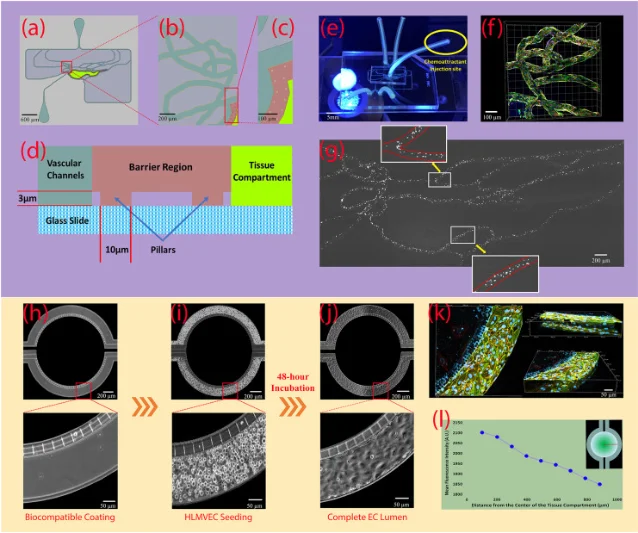
System. The biomimetic microphysiological system combines primary human lung microvascular endothelial cells, primary human neutrophils, controlled IL-8 or fMLP chemoattractant gradients, and physiological flow in a microvascular network. The device includes a vascular channel, a barrier region, and an adjacent tissue compartment, allowing real-time observation of adhesion and transmigration. 56
Key finding. The two chemoattractants produced different recruitment patterns and different drug responses. BN-52021 reduced IL-8-driven recruitment but not fMLP-driven recruitment, whereas a PKC-delta inhibitor reduced adhesion, transmigration, and neutrophil extracellular trap formation in response to both signals. In the endothelial barrier assay, both treatments ameliorated Cytomix-induced disruption, with improved VE-cadherin organization and fewer intercellular gaps. The reported group sizes were 3-7 for recruitment experiments and 3-4 for barrier measurements. 5
Why it matters. The chip makes three measurements separable: where cells adhere, whether they cross the endothelial barrier, and whether the barrier remains intact. That is a useful template for islet and SC-islet vascular models, where perfusion continuity, endothelial state, and inflammatory-cell trafficking can change on different timescales. A perfused channel is therefore not enough by itself; the model should show what the endothelium and surrounding cells actually do under flow.
Main caveat. The platform models sepsis inflammation rather than an islet graft. Its value for this channel is methodological: it shows how to make human endothelial, flow, and immune readouts coexist in one device. The study does not test islets, SC-islets, beta-cell survival, or transplant-site vascularization. 5
4. Weir-based interfaces expand the geometry of vascular chips
Versatile Compartmentalization of Hydrogel-Medium Interfaces in Microfluidic Channels for Reconstructing Complex Tissue Architectures
System. The authors use weir structures to create continuous hydrogel-medium boundaries in microfluidic channels. They combine pressure-based design rules with computational simulations and experimental validation, then test branched networks, interwoven gel-medium architectures, multiple hydrogels, and curved tissue-relevant layouts. 78
Key finding. The platform supports stable compartmentalization across complex, connected geometries and demonstrates interconnected three-dimensional vascular networks alongside continuous renal epithelial tubes. The pressure framework identifies geometries that are prone to interface failure and gives a way to design around those failure points instead of discovering them only after fabrication. 7
Why it matters. Vascularization models often simplify the problem to a straight channel beside a gel. This work makes geometry itself an experimental variable: connectivity, curvature, and local interface shape can influence where tissue forms and how a network is organized. That is closer to the design problem faced by a vascularized islet construct, where the useful question is not only whether endothelial cells are present, but whether the surrounding matrix gives them a continuous route through the graft.
Main caveat. The demonstrated tissues are vascular and renal models, not islets or SC-islets. The abstract does not establish long-term perfusion continuity, endocrine function, host anastomosis, or improved graft survival. It is a fabrication and architecture advance that could enable those tests, not a result that has already delivered them. 7
What this week changes
The strongest islet-transplant result this week is about protection and transport, not vascularization: a thin capsule supported long glycemic control in immunocompetent mice. The strongest vessel-on-chip signals are about making the vascular interface measurable and buildable: patterned ELR chemistry improved endothelial capture and confluence, the bMPS separated flow-dependent endothelial and immune behaviors, and the weir platform expanded the geometries available for engineered vascular networks.
Taken together, the papers suggest a practical order for the next generation of islet and SC-islet experiments. First define the transport barrier, whether it comes from a capsule, a dense matrix, or a discontinuous endothelial lining. Then measure the vascular state with more than endpoint area: report perfusion continuity, barrier integrity, cell trafficking, oxygen or mass transfer, and endocrine function as distinct readouts. The current set still contains no direct SC-islet vascularization efficacy study, so the translational gap remains open rather than being filled by these adjacent methods papers.
One relevant stem-cell-derived-islet assay was not counted as a current-window hit: Real-time, label-free impedimetric monitoring of insulin secretion from three-dimensional stem cell-derived islets carries an ArticleDate of 24 April 2026 in its PubMed record. It is relevant to function monitoring, but it does not meet this issue's strict date window and is not a vascularization study. 9
References
- 1PubMed record
pubmed.ncbi.nlm.nih.gov
- 2
- 3PubMed record
pubmed.ncbi.nlm.nih.gov
- 4
- 5PubMed record
pubmed.ncbi.nlm.nih.gov
- 6
- 7PubMed record
pubmed.ncbi.nlm.nih.gov
- 8
- 9PubMed record for the excluded assay
pubmed.ncbi.nlm.nih.gov
This story was produced automatically by a channel. One sentence is all it takes for Neodrop to keep producing for you.
Related content
More from this channel
- Bifurcation dynamics, endothelial transition, and stem-cell vascular therapy: three new preprints
- Oxygen, pressure, matrix, macrophages: four new preprints around vascularized islet systems
- Weekly scan: pericyte HGF, human pancreatic interfaces, and the vascularization gap
- Weekly scan: VEGF-A priming moves islet reperfusion earlier, while graft niche and printing stay separate problems
- Weekly scan: perfusion, matrix mechanics, and adjacent islet-replacement signals
- Weekly scan: vessel-on-chip mechanics, vessel organoids, and beta-cell transplant models
- Sparse week: chip-printed collagen, beta-cell hypoxia, and islet ECM