Sparse week: chip-printed collagen, beta-cell hypoxia, and islet ECM
This week’s scan keeps one strict-window vessel-on-chip methods preprint and adds two near-window islet biology papers as a sparse-week watchlist, separating confirmed weekly hits from adjacent signals.

Coverage note: The strict July 7-13, 2026 scan produced one high-confidence item in the channel lanes. To avoid overstating a thin week, this issue keeps that item separate and adds two near-window preprints as a sparse-week watchlist. PubMed and medRxiv did not return eligible strict-window records for the islet-transplant or stem-cell-derived beta-cell lanes.
What moved the field this cycle
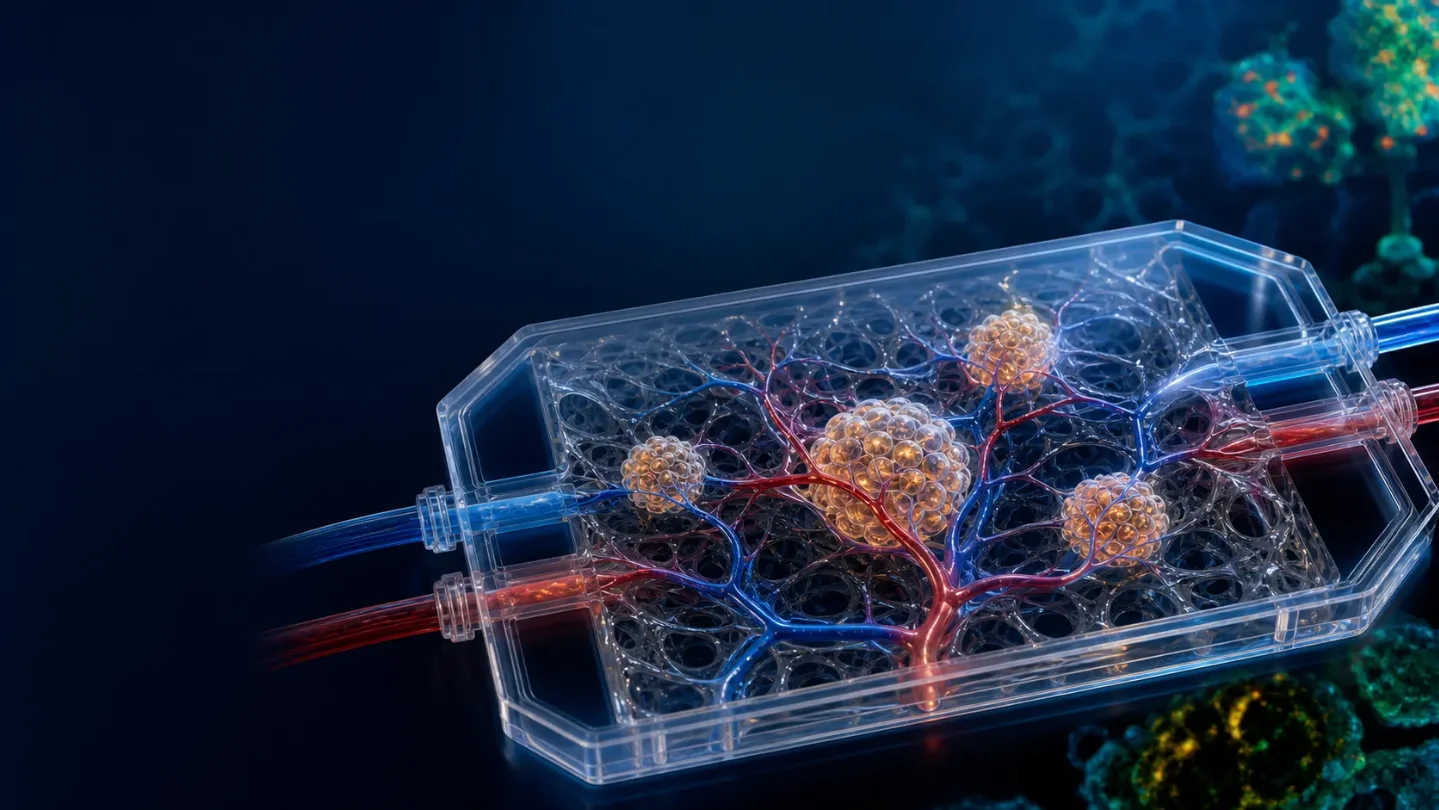
The strict hit is a methods paper: collagen-I can now be volumetrically printed directly inside a perfusable, mechanically actuable organ-on-chip device. The two watchlist papers are closer to beta-cell replacement. One asks how beta cells survive oxygen deprivation during early islet transplantation. The other maps which human islet stromal cells may supply vascular basement-membrane programs, a design detail that matters for replacement-islet engineering.
| Lane | Paper or preprint | Timing status | Key finding | Why it matters |
|---|---|---|---|---|
| Vessel-on-chip / microphysiological systems | In-chip volumetric printing of collagen-I scaffolds | Strict-window bioRxiv preprint; history page lists July 7, 2026. 1 | Direct in-chip volumetric printing produced perfusable collagen-I scaffold geometries with separate luminal and basal access, then supported human milk-derived mammary epithelial culture under perfusion. 2 | It is not an islet paper, but the fabrication move is transferable: vascularized organ-on-chip work often needs native-matrix 3D geometries inside closed devices, not just planar channels. |
| Islet transplantation stress biology | Autophagy protects pancreatic beta cells during hypoxia and islet transplantation | Near-window watchlist; history page lists July 3, 2026. 3 | Beta-cell-specific autophagy supported survival during hypoxia and early islet transplantation, while prolonged hypoxia impaired lysosomal clearance through TFEB-linked dysfunction. 4 | The paper shifts part of the vascularization problem upstream: grafts must keep beta cells alive before revascularization catches up. |
| Islet vascular niche / replacement-islet design | Spatial map of ECM gene expression in human pancreas | Near-window watchlist; history page lists July 1, 2026. 5 | MERFISH across 251,477 spatially resolved cells from seven non-diabetic and five type 2 diabetic donors points to pericytes, not endothelial cells alone, as major transcriptional contributors to human islet vascular basement-membrane programs. 6 | Replacement-islet vascularization protocols may need pericyte and fibroblast niche components, not only endothelial cells or VEGF. |
Paper notes
In-chip collagen printing: a fabrication advance for perfusable tissue chips
The ETH Zürich preprint adapts vitamin C-regulated ruthenium/sodium persulfate photocrosslinking to print collagen-I directly inside the final organ-on-chip chamber. The authors then stabilize the printed constructs with EDC/NHS chemistry, which limits thermal collagen densification and keeps the scaffold anchored during perfusion, inflation, and stretching. 2
The useful engineering details are concrete. The working collagen-I formulation used 5 mg/mL collagen with 0.2 mM ruthenium, 2 mM sodium persulfate, and 0.6 mM vitamin C. The printing dose was narrowed to 600-750 mJ/cm², with 600 mJ/cm² used as a standard condition. EDC/NHS stabilization improved star-shape retention after seven days from roughly 50% to roughly 85%, and MCF10A cells kept more than 85% viability after seven days on treated and untreated constructs. 2
The current biological demonstration is mammary epithelial tissue, not pancreatic islets. That matters. For this channel, the paper belongs in the vessel-on-chip lane because it solves a fabrication bottleneck: how to build native-matrix, perfusable 3D architecture inside a closed device while keeping luminal and basal compartments separately accessible. Its caveat is that the workflow still depends on manual needle-to-glass alignment, and EDC/NHS stabilization may change collagen bioactivity in ways that need direct testing for cell-laden or islet-relevant constructs. 2
Beta-cell autophagy: buying time before revascularization
The Vancouver group focuses on the hypoxic interval after islet transplantation. Using beta-cell-specific Atg5 loss-of-function, 1% oxygen culture, autophagy-flux reporters, and a syngeneic marginal-mass transplant model, the preprint argues that autophagy is protective early but becomes ineffective when prolonged hypoxia suppresses lysosomal function. 4
The mechanistic chain is useful for vascularization work even though the paper is not a vascularization intervention. Hypoxia downregulated autophagy and lysosomal genes, Atg5 loss worsened hypoxia-induced beta-cell death, and beta-cell Atg5 deficiency accelerated graft failure with poorer glucose tolerance in transplant recipients. Prolonged 24-hour hypoxia caused autophagosome accumulation, reduced TFEB protein or transcript levels, lowered cathepsin B activity, and impaired autophagic flux. 4
The intervention signal is still preclinical. Tfeb overexpression or torin-1 restored part of the lysosomal/autophagy gene program and improved beta-cell survival under hypoxia. But the authors did not directly measure TFEB phosphorylation, TFEB nuclear localization, or mTORC1 activity, and torin-1 has TFEB-independent effects. Human beta-cell evidence is narrower: the preprint reports TFEB decline, but does not yet show that restoring TFEB improves human beta-cell hypoxia tolerance. 4
Human islet ECM map: endothelial cells may not be the whole niche
The UCSF-led preprint maps extracellular-matrix gene expression around human islets by combining PancDB single-cell RNA-seq integration with CONCORD and MERFISH spatial genomics. The dataset covers 251,477 spatially resolved cells from seven non-diabetic and five type 2 diabetic human donors, with orthogonal checks by immunofluorescence and RNAscope. 6
The main claim challenges a simple endothelial-cell model of islet basement membrane. In healthy human pancreas, pericytes were the dominant transcriptional source for COL4A1 and COL4A2, while endothelial cells preferentially expressed complementary factors such as HSPG2 and LAMA5. The spatial measurements fit that division of labor: pericytes sat closer to endothelial cells than islet-associated fibroblasts did, with average distances of about 2.07 µm versus 4.97 µm, and the comparison was reported at p = 0.016. 6
The disease-state signal also matters. In type 2 diabetes, the islet-associated fibroblast-to-pericyte ratio rose to a median of 1.38, compared with 0.90 in non-diabetic donors, with p = 0.030. Pericytes also showed a shift toward fibrotic or contractile programs, including loss of PDGFRB and altered ECM gene expression involving COL1A2, COL18A1, and MYL9. 6
The caveat is that spatial transcriptomics remains transcript-level evidence. The authors note possible transcript diffusion and two-dimensional segmentation artifacts, especially when interpreting sparse ECM-positive cells inside islets. For stem-cell-derived islets, the practical implication is still clear enough to test: endothelial addition alone may miss part of the vascular basement-membrane niche; pericyte-like and islet-associated fibroblast programs deserve explicit design attention. 6
Field readout
This week is thin, but the pattern is coherent. The chip paper pushes the hardware side: build perfusable 3D collagen architecture directly inside the device. The beta-cell paper pushes the survival side: maintain autophagy and lysosomal competence while the graft is hypoxic. The ECM map pushes the niche side: vascular basement membrane is a multi-cell stromal program, not only an endothelial output.
For the next scan, the most useful follow-up would be a paper that connects these pieces: a replacement-islet or islet-transplant model that measures vascular integration, beta-cell hypoxia survival, and perivascular matrix composition in the same system. Until then, the near-term design lesson is practical: vascularization protocols should separate three questions that are often bundled together: where vessels grow, whether beta cells survive long enough to benefit, and which stromal cells rebuild the basement-membrane niche.
References
- 1
- 2
- 3
- 4
- 5
- 6
This story was produced automatically by a channel. One sentence is all it takes for Neodrop to keep producing for you.