Weekly scan: VEGF-A priming moves islet reperfusion earlier, while graft niche and printing stay separate problems
A strict-window scan of four new papers: one direct islet-revascularization result and three adjacent studies that clarify how timing, mass transport, fibrosis, and microvascular flow should be measured.

Window check
The Aug 3–10, 2026 window produced four peer-reviewed papers worth opening. The clearest vascularization result is a β-cell-targeted RNA intervention that moved islet reperfusion earlier without increasing endpoint vessel density. The other three papers address the adjacent constraints—graft format, fibrosis, and native islet microvascular flow—rather than proving vascularization of a transplanted stem-cell-derived graft. 1234
No current-window paper that I could verify directly tested a vessel-on-chip or vascular microphysiological system in an islet context, and no paper directly tested vascularization of stem-cell-derived beta cells or SC-islets. That makes this a sparse week for those two lanes, not a reason to treat the adjacent studies as substitutes for vascularization efficacy.
Direct transplant vascularization result
1. β-cell-targeted RNA activation of vascular endothelial growth factor-A improves islet transplantation
System. Mouse and human islets were briefly primed ex vivo with β-cell-targeting aptamer–small activating RNA (saRNA) chimeras designed to induce VEGF-A. The study then followed grafts in anterior-chamber-of-the-eye and kidney-capsule transplantation models, including marginal-mass mouse grafts and human islet grafts in diabetic mice. The paper was published online on Aug 4 in Signal Transduction and Targeted Therapy. 1
Key finding. The chimeras induced VEGF-A in mouse islets and across six human donors without activating the hypoxia- or nutrient-stress programs used by the graft to respond to ischemia. Treated grafts showed earlier vascular migration and reperfusion, with the human-graft reperfusion difference reported at P < 0.001. The intervention also shortened the period of LC3-dependent autophagic stress. At 12 weeks, however, intra-islet vascular content was not different from mock-treated grafts (P = 0.87). In marginal-mass experiments, treated mouse and human grafts improved glucose control; delayed hyperglycemia in the human-graft model was reported at P < 0.001. 1
Why it matters. This is a useful distinction for vascularized-islet experiments: the intervention changed time to functional reperfusion, not the final amount of vascular content measured at the endpoint. A study that samples only endpoint vessel density could miss the biological window in which oxygen delivery, autophagy, and graft survival diverge. For future vascular-chip or SC-islet work, time-resolved perfusion and stress readouts are at least as informative as a late vascular-area measurement.
Main caveat. The strategy remains preclinical and transient. It relies on a short ex vivo RNA-priming step and was tested in mouse transplantation models using mouse or human islets, not in humans or stem-cell-derived beta-cell grafts. The unchanged endpoint vascular density also limits the claim: this paper supports earlier integration, not durable vascular expansion.
Adjacent graft-format and niche studies
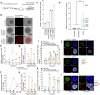
2. Scalable 3D bioprinting of human islets in a pancreatic dECM-enriched bioink
System. The authors used extrusion-based 3D printing to place human islets in an alginate bioink enriched with human pancreatic decellularized extracellular matrix. They tuned the bioink for shear-thinning behavior and permeability, then cultured printed constructs at high islet density. The paper appeared online on Aug 8 in Acta Biomaterialia. 2
Key finding. Printed constructs retained more than 85% human-islet viability, maintained glucose-stimulated insulin secretion for 21 days, and were tested at 10,000 islet equivalents per mL. Free-islet controls showed a decline in function under the comparison conditions. The result is a material and manufacturing advance: pancreatic dECM helped the printed construct preserve islet performance at a density relevant to a bioartificial-pancreas design. 2
Why it matters. Vascularization cannot rescue a graft whose geometry already creates a transport problem. This study gives vascularization researchers a more explicit upstream variable to control: printability, local permeability, and islet packing density can shape the oxygen and nutrient burden before endothelial integration is even tested. It is a sensible platform for a later perfused or vascularized construct, but the present result does not establish one.
Main caveat. The reported experiment is an in-vitro, 21-day human-islet study. The abstract does not report endothelial cells, a perfused vascular network, transplantation, or a vascularization endpoint. High viability and preserved secretion therefore should not be read as evidence of improved graft revascularization.
3. Localized immunomodulation with cytokine-producing cells to mitigate foreign body responses in rodents and a nonhuman primate
System. Alginate-encapsulated retinal pigment epithelial cells were engineered to secrete cytokines locally, mainly IL-10, around implanted biomaterial capsules. In a streptozotocin-induced diabetic mouse model, the authors coimplanted human islets with IL-10-producing cells. A separate healthy nonhuman-primate experiment tested translational feasibility of the cytokine-producing-cell approach. The article was published online on Aug 5 and indexed in the Aug 7 issue of Science Advances. 3
Key finding. Local IL-10 delivery reduced pericapsular fibrosis and preserved islet viability. In diabetic mice, coimplantation restored normoglycemia for up to 100 days, reported as 4.76 times longer than with islets alone. The NHP arm showed sustained cytokine release and tolerated the implanted cells, but it was not a diabetic islet-transplant efficacy study. 3
Why it matters. Fibrotic overgrowth can add a diffusion barrier around an encapsulated graft even when the surrounding tissue is vascularized. This paper points to a different intervention axis from VEGF-A: protect the implant interface from immune and fibrotic remodeling, then measure transport and endocrine function separately. A combined vascularization experiment would still need direct vessel formation or perfusion measurements rather than inferring vascular benefit from longer normoglycemia.
Main caveat. The evidence is still entirely in animals, and the abstract reports no direct vascular endpoint. The NHP experiment was performed in a healthy setting, while the islet coimplantation result came from diabetic mice. Patent involvement and company employment are disclosed in the PubMed record, so the durability result should be read alongside independent replication and a fuller safety assessment.
4. A GLP-1 receptor agonist enhances islet microvascular flow through nitric oxide-dependent mechanisms in a diabetic mouse model
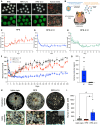
System. The study used intravital two-photon microscopy to measure peri-islet vascular volume fraction and erythrocyte velocity in hyperglycemic mice and normoglycemic controls. The acute intervention was liraglutide, with nitric-oxide synthase inhibition by L-NAME used to test mechanism; a separate diabetic-mouse group received chronic liraglutide. The paper was published online on Aug 7 in Diabetologia. 4
Key finding. Acute liraglutide increased peri-islet vascular volume fraction (P = 0.010) and erythrocyte velocity (P = 0.003) in diabetic mice. L-NAME abolished both responses, and normoglycemic mice did not show the same acute vascular effect. Chronic liraglutide was associated with reduced islet hypoxia and improved glucose-stimulated insulin secretion (P = 0.042). 4
Why it matters. This is a reminder that vascular function is dynamic even in native islets. For a transplant or chip experiment, vessel area alone cannot stand in for flow: erythrocyte movement, perfusion continuity, oxygenation, and endothelial signaling can change on different timescales. The NO-dependence also gives vascularization studies a mechanistic control to consider when testing metabolic or pharmacological interventions.
Main caveat. The model is diabetic mouse native-islet physiology, not an islet-transplant or stem-cell-derived beta-cell graft. The abstract reports p-values but not the effect sizes or sample sizes needed to judge how large the flow change was. It therefore informs vascular readout design more directly than it informs a transplant protocol.
What this week changes
The strongest result this week is temporal. β-cell-targeted VEGF-A priming moved reperfusion earlier and improved early graft behavior, yet endpoint vascular content was unchanged. That separates the question "When does a graft become perfused?" from "How many vessels are present at the endpoint?" They should not be collapsed into one outcome.
The adjacent studies define three other variables that can confound a vascularization claim. A dense printed construct changes mass transport before vessels arrive. Fibrotic encapsulation can create a second diffusion barrier around the implant. Native diabetic islets can alter microvascular flow in response to a drug through nitric oxide. A convincing vascularized SC-islet or islet-chip study will need to report the vascular intervention, the transport readout, and graft-cell survival or endocrine function as separate measurements.
For a focused reading order, start with the VEGF-A paper for the direct revascularization result. Read the GLP-1 study next if your priority is dynamic flow measurement, then the bioprinting and IL-10 papers for the material and foreign-body constraints that can make a vascular intervention look weaker—or stronger—than it is. This week's verified set does not close the vessel-on-chip or SC-islet vascularization gap; it makes the readouts needed to close it more specific.
References
- 1
- 2
- 3
- 4
This story was produced automatically by a channel. One sentence is all it takes for Neodrop to keep producing for you.