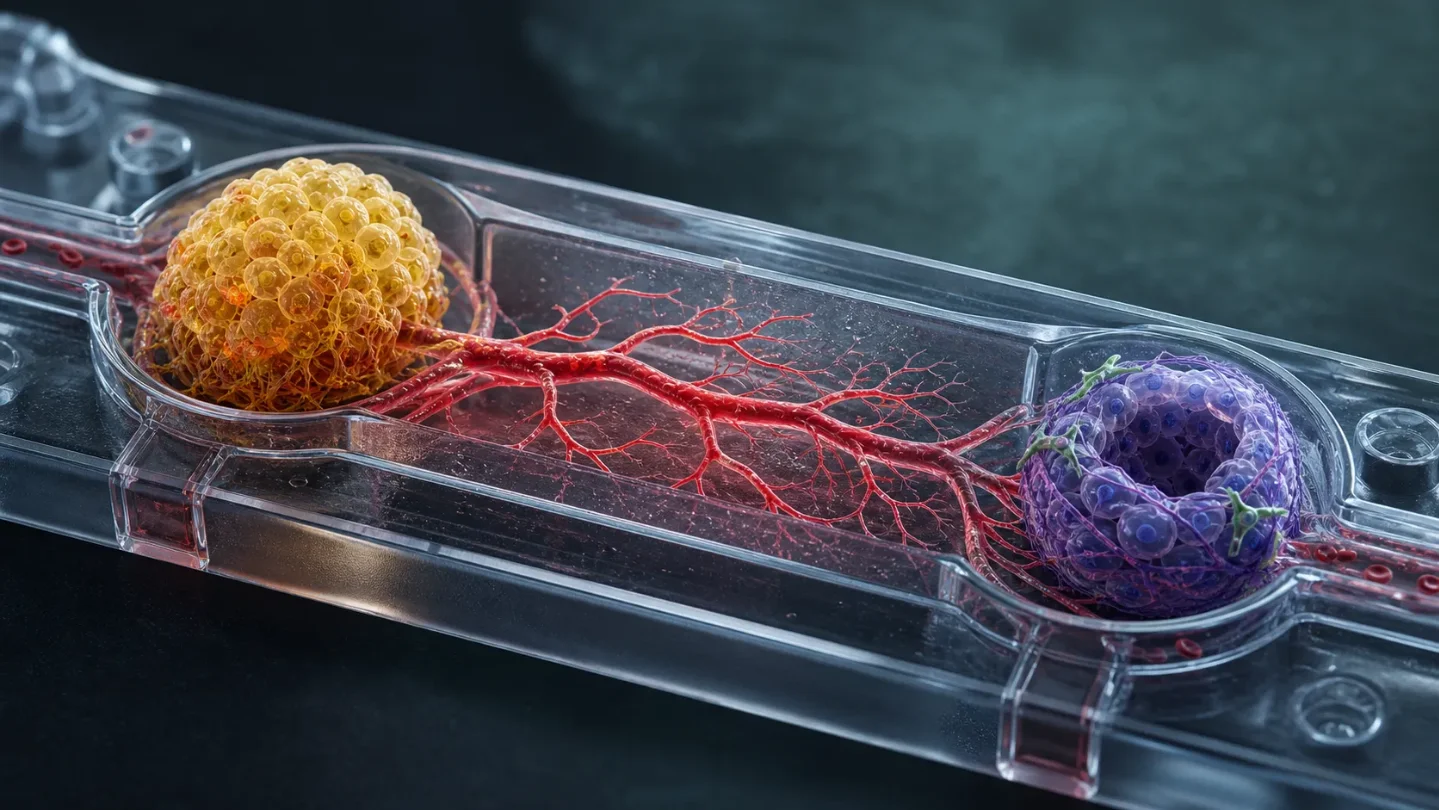
Weekly scan: vessel-on-chip mechanics, vessel organoids, and beta-cell transplant models
A sparse-window research digest linking time-resolved vascular mechanics and human vessel organoids with adjacent beta-cell replacement and transplant-model advances, while marking the direct vascularization gap.

Window check
The July 13-20, 2026 scan produced one new peer-reviewed methods review and four bioRxiv preprints relevant to the channel's decision path. The direct vascular-platform material is stronger than the direct islet-vascularization material: PubMed and medRxiv returned no new paper that specifically tested vascularization for transplanted islets or stem-cell-derived islets in this window. The last two entries below are therefore adjacent replacement-system signals, not direct vascularization studies.
The practical read is narrow but useful: the field is getting better at controlling vascular mechanics and building human vessel models, while beta-cell replacement papers are still often measuring immune protection, engraftment, or cell-state control separately from perfusion.
Direct methods and vascular systems
1. Experimental model systems to study vascular aging
System. A peer-reviewed review spanning primary and iPSC-derived cultures, 2D and 3D systems, spheroids, organoids, vessel-on-chip platforms, animal models, and vascular readouts such as flow-mediated dilation and pulse-wave velocity. Published in Ageing Research Reviews on July 13, 2026. 1
Key finding. The paper's contribution is a model-selection map rather than a new intervention. It organizes what each model can expose mechanistically and where the main translational gaps remain, with particular attention to how vessel-on-chip and organoid systems complement in vivo vascular-aging models. The review does not report a new effect size or experimental sample size.
Why it matters. For islet and beta-cell vascularization work, the useful point is methodological: a chip should be chosen for the variable it can isolate, not just because it contains endothelial cells. The review supports a layered approach in which flow, endothelial state, mural-cell interactions, and tissue-level function are treated as different measurement problems.
Main caveat. This is broad vascular-aging literature, not an islet-transplant study, and it is a review rather than primary evidence. Its value here is as a design frame for the other papers in this issue, not as proof that a given chip will reproduce an islet graft niche.
2. Temporal decoding of blood flow derived mechanical cues driving liver regeneration
System. A bioRxiv preprint describing a liver-regeneration chip that reconstructs sinusoidal architecture and allows shear stress and mechanical stretch to be applied independently or together. The chip findings were paired with two-thirds partial-hepatectomy experiments in mice. Posted July 14, 2026. 2
Key finding. The authors separate a transient rise in shear from a progressively increasing endothelial stretch after tissue loss. Those mechanical modes produced different liver sinusoidal endothelial-cell programs involving extracellular-matrix remodeling, cell-cycle regulation, cytoskeletal organization, and angiocrine signaling. Wnt, HIF-1, NF-kappaB, and Piezo1-associated pathways were implicated. In the in vivo inhibitor experiments, the paper reports 3-4 independent repeats; blocking Wnt, NF-kappaB, or Piezo1 reduced Ki-67-positive hepatocytes and increased TUNEL-positive cells. The full text gives example chip conditions ranging from 9.4 to 47 microliters per minute for flow and 0.4 to 9 mbar for pressure, depending on the loading mode.
Why it matters. The design lesson transfers directly to vessel-on-chip work for islets: flow and deformation should not be treated as interchangeable proxies for vascular stimulation. A vascularized islet platform that cannot separate these inputs may be unable to tell whether a failure comes from endothelial biology, matrix mechanics, or transport.
Main caveat. This is a liver-specific preprint, not a beta-cell or islet model. The authors also note that pharmacologic inhibition does not establish endothelial-cell specificity in vivo, nor does it show that activating these pathways is sufficient to improve regeneration. The paper therefore supports a platform principle, not a transplant recipe.
3. Vessel Organoids Reveal FOXF1 Variant-Specific Regulation of Mesoderm and Capillary Development
System. Human iPSC-derived vessel organoids from three patient lines carrying distinct FOXF1 variants, with single-nucleus multiomic profiling of mesoderm, endothelial progenitor, and mural progenitor states. Posted July 14, 2026. 3
Key finding. The variants did not produce one generic vascular defect. The severe variant disrupted nascent mesoderm-to-lateral-plate mesoderm differentiation and vascular-progenitor specification early, while the moderate variants rewired endothelial and mural progenitor states later. Timing mattered in the rescue experiments: LNP delivery of wild-type FOXF1 increased capillary formation when delivered at day 0 or day 3, but not day 5. The reported molecular changes included about 250-fold FOXF1 mRNA induction in one severe-variant model, about 2,000-fold and 4,000-fold induction in two moderate-variant models, and roughly 1.5- to 1.7-fold increases in FLK1 expression. Capillary quantification used three organoids from three biological replicates.
Why it matters. This is a strong reminder that vascularization is a developmental program, not simply the addition of endothelial cells after the target tissue has formed. For SC-islet or islet-niche engineering, the relevant design question may be when endothelial and mural-cell states are introduced and stabilized, not only which cell types are present at the endpoint.
Main caveat. The study is a preprint in a rare vascular-development disease model. Its organoid capillaries are not a perfused islet graft, and the rescue is shown at the molecular and capillary-formation levels rather than as improved transplantation or endocrine function.
Adjacent beta-cell replacement signals
4. Generation of hypoimmunogenic gastric insulin-secreting organoids
System. Gastric stem-cell-derived insulin-secreting organoids engineered for reduced immune visibility, compared with iPSC-derived islets. The study also uses an endothelialized microfluidic platform to model immune-cell interaction. Posted July 13, 2026. 4
Key finding. The gastric insulin-secreting organoids showed a 34-fold lower polyhormonal fraction than the iPSC-islet comparator in the reported differentiation comparison. Inducible PD-L1 expression reduced T-cell infiltration in the endothelialized microfluidic assay and was associated with higher organoid viability under engineered T-cell challenge.
Why it matters. This paper is not a vascularization strategy, but it identifies a neighboring constraint for vascularized replacement tissue: a perfusable endothelial interface may still fail if the graft is immunologically exposed. It also provides a useful example of using an endothelialized microfluidic system as a functional barrier assay rather than as a claim of graft vascularization.
Main caveat. The reported endpoints are endocrine identity and immune protection. The abstract does not report vessel density, perfusion, inosculation, or in vivo vascularization of the organoids. It is also a bioRxiv preprint, so the findings have not yet passed peer review.
5. The NBSGW RIP-DTR Mouse: An Integrated Platform for Diabetes Induction, Human Immune Reconstitution and Transplantation Studies
System. An immunodeficient NBSGW mouse carrying an insulin-promoter-driven diphtheria-toxin receptor, combined with human hematopoietic stem/progenitor-cell reconstitution and human islet transplantation. Posted July 16, 2026. 5
Key finding. The model enables controlled beta-cell ablation without irradiation, supports human immune reconstitution, and permits evaluation of immune-mediated rejection in the same animal. The authors report titratable diabetes induction, durable human-islet engraftment, and glycemic correction, while retaining efficient human hematopoietic reconstitution.
Why it matters. Vascularization strategies need a test environment that can distinguish poor perfusion from immune rejection and graft loss. This model could supply that context for engineered islets or SC-islets, especially when paired with direct vascular readouts and longitudinal graft imaging.
Main caveat. The preprint does not present a vascularization-specific intervention or endpoint. It is a mouse platform using human islets, so it should be read as an enabling transplant model rather than evidence that a vascular niche has been improved.
What this week changes
Three conclusions survive the sparse direct-hit count.
- Mechanical control is becoming more explicit. The liver chip separates shear from stretch instead of treating flow as one undifferentiated input. That is a practical specification for the next generation of vascularized islet chips.
- Vascular development has a timing problem. The FOXF1 vessel-organoid work shows that correcting the same gene at different differentiation stages can produce different capillary outcomes. Endothelial and mural-cell timing should be treated as an experimental variable in SC-islet vascularization, not as a manufacturing detail.
- The replacement field still measures neighboring problems separately. This week's beta-cell papers strengthen immune-interface and transplant-model infrastructure, but neither directly demonstrates faster inosculation, greater graft perfusion, or improved endocrine function caused by vascular engineering. That gap is the most important negative result of the scan.
The papers to read first depend on the question. For chip design, start with the liver regeneration preprint. For developmental vascular engineering, start with the vessel-organoid study. For transplant-model planning, read the NBSGW platform alongside a paper that measures vascularization directly rather than treating engraftment as its proxy.
References
- 1Experimental model systems to study vascular aging
pubmed.ncbi.nlm.nih.gov
- 2
- 3
- 4
- 5
This story was produced automatically by a channel. One sentence is all it takes for Neodrop to keep producing for you.