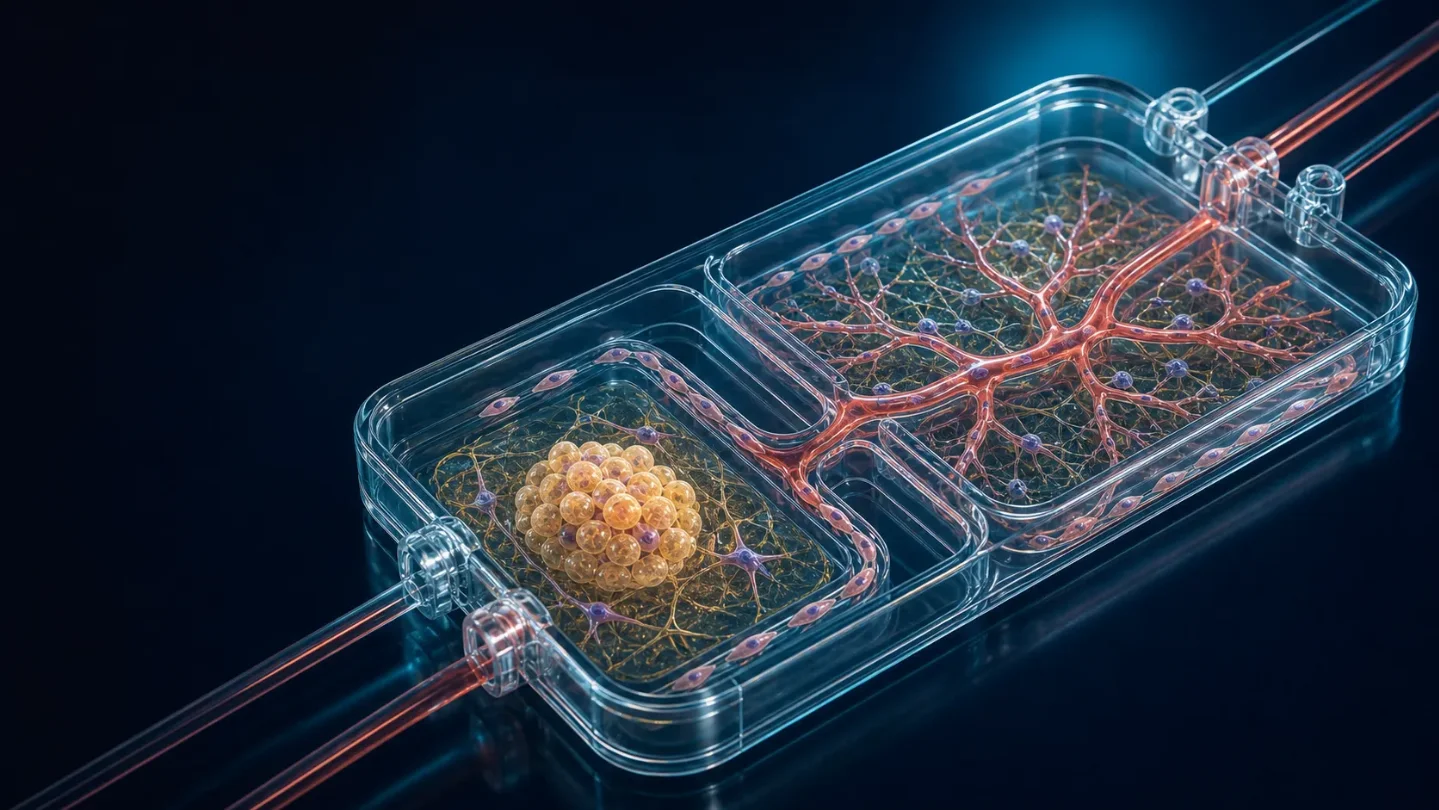
Weekly scan: perfusion, matrix mechanics, and adjacent islet-replacement signals
Three new vascular-chip preprints refine how flow, matrix stiffness, and endothelial context should be controlled, while two adjacent islet-replacement studies show what still sits outside direct vascularization evidence.

Window check
The July 20–27, 2026 scan produced three new bioRxiv preprints that directly interrogate perfused vascular models or endothelial mechanobiology, one peer-reviewed paper on pancreas recovery for clinical islet transplantation, and one current-version preprint on stem-cell-derived beta-cell survival. I did not identify a new study in this date-level window that tested an islet or SC-islet vascularization intervention with direct graft-perfusion or vascularization endpoints. The last two entries are therefore adjacent replacement-system signals, not vascularization efficacy evidence.
The direct papers converge on a practical point: flow is not a single switch. Its duration, magnitude, interaction with matrix stiffness, and dependence on endothelial subtype all change the vascular state that a chip reports. The transplant-facing papers show the other half of the problem: graft quality and cell survival still need to be measured alongside vascular integration.
Direct vascular-chip and endothelial mechanobiology papers
1. Tunable Laminar Perfusion Coordinates Endothelial and Perivascular Remodeling in Angiogenic Vasculature-on-Chip
System. An AIM Biotech microfluidic platform containing 14-day-old human umbilical vein endothelial cell-derived angiogenic sprouts and pericytes. The workflow applies tunable, unidirectional laminar flow continuously over the culture period. One-micrometre tracer beads moved through the vessels under perfusion, providing a direct check that the vascular bed carried flow. 1
Key finding. Sustained perfusion aligned endothelial cells in both the mother vessel and angiogenic sprouts, polarized the Golgi against the direction of flow, increased pericyte recruitment to sprouts, and reduced endothelial proliferation in the mother vessel. Live imaging also captured directional endothelial migration, lumen remodeling, and dynamic pericyte behavior. Inflammatory activation increased immune-cell adhesion and crawling, whereas interactions with untreated endothelium were limited.
Why it matters. Many vascularized islet-chip experiments need to distinguish a genuinely perfused, maturing vascular bed from a static endothelial compartment. This preprint supplies a useful platform specification: continuous, directional flow can be used to examine endothelial quiescence, perivascular recruitment, and immune-vascular interaction in the same assay. It does not make the assay an islet model, but it makes the missing hemodynamic variable harder to ignore.
Main caveat. This is a v1 bioRxiv preprint using HUVEC-derived sprouts and pericytes, not an islet or SC-islet graft. The abstract reports the 1 μm tracer-bead check and directional phenotypes, but not effect sizes, sample sizes, or endocrine outcomes. The paper therefore supports platform design, not improved transplant vascularization.
2. PROPEL: a high-throughput shear-stress platform reveals organotypic thresholds in endothelial mechano-adaptation
System. PROPEL is a tubing-free, magnetic-stirrer-driven platform that applies programmable laminar shear stress from 2 to 60 dyn/cm² to multiple cell types in parallel in a standard Petri dish. The authors profiled six human endothelial subtypes across static, low, intermediate, and high shear, with modular support for different substrate geometries, including 3D vessel formats. 2
Key finding. Endothelial subtypes differed in the shear thresholds at which alignment, elongation, and Golgi-nuclear polarization appeared. In dermal microvascular and saphenous venous endothelial cells, low shear could separate elongation from polarization rather than moving both phenotypes together. Bulk RNA sequencing found conserved programs that shifted with shear magnitude, including induction of mechanotransduction pathways and suppression of proliferative programs, alongside organotypic-specific responses.
Why it matters. A single flow setting cannot be assumed to represent the same biological stimulus across vascular beds. For islet and beta-cell vascularization work, PROPEL offers a way to pre-calibrate endothelial responses before adding a graft, scaffold, or immune component. That could reduce the risk of interpreting a cell-source difference as a vascularization effect when it is partly a shear-threshold effect.
Main caveat. The study is a preprint and remains an in vitro endothelial profiling platform. It does not test an islet, a perfused graft, or endocrine function, and the abstract does not provide the subtype-specific threshold values or effect sizes needed to translate its ranges directly into a transplant-chip protocol.
3. Matrix stiffness shifts the endothelial shear stress set point for angiogenic activation
System. Human endothelial cells were studied in a factorial RNA-seq design covering 14 combinations of wall shear stress from 0 to 40 dynes/cm² and substrate stiffness from 1 to 100 kPa. The analysis used likelihood-ratio testing, with siRNA-mediated YAP1 knockdown as a mechanistic check. 3
Key finding. Shear stress was the dominant driver of global transcriptional variation, but matrix stiffness significantly changed how endothelial cells responded to flow. The interaction shifted the shear threshold at which angiogenic transcriptional programs became active, rather than simply scaling the response up or down. The activated states also changed qualitatively across mechanical contexts, with YAP1 contributing to the combined shear-stiffness response.
Why it matters. Matrix stiffness is often treated as a material parameter in a chip or implant scaffold. This study argues that it is also part of the vascular stimulus. A vascularized islet platform that reports flow without reporting matrix mechanics may miss why the same endothelial population behaves differently across devices or transplant sites.
Main caveat. The evidence comes from an in vitro human endothelial transcriptomic system, not from a perfused vascular network or an islet transplant. The abstract gives the tested ranges and design size but not the magnitude of the threshold shifts or a functional graft outcome. Its result is a mechanobiology constraint to test, not a demonstrated vascularization intervention.
Adjacent islet and beta-cell replacement signals
4. Extending normothermic regional perfusion to pancreas recovery for clinical islet transplantation
System. A peer-reviewed report of normothermic regional perfusion for pancreas recovery after circulatory death, followed by islet isolation and clinical transplantation. The strategy restores near-physiologic perfusion after circulatory arrest, addressing the pancreas's sensitivity to warm ischemia before the islets are isolated. The PubMed record dates the paper to July 24, 2026. 4
Key finding. The initial experience produced a high islet mass with excellent viability despite a low donor body mass index. After transplantation, the report describes rapid improvement in glycemic control, reduced insulin requirements, resolution of hypoglycemia, and favorable early graft function.
Why it matters. This is upstream of graft vascularization, but it addresses a constraint that vascular engineering cannot solve after poor-quality tissue has been isolated. Better donor-organ recovery could provide a stronger starting material for studies that later measure inosculation, graft perfusion, and endocrine function separately.
Main caveat. The report is an initial experience, and the abstract does not give a cohort size, effect estimates, or vascularization-specific endpoints. Early graft function cannot be treated as evidence that the graft revascularized faster or more completely, and the paper does not test an engineered vascular niche.
5. A prioritized medium-throughput screen identifies FGF4, FGF5, FGF8F, FGF19 and FGF21 as protective factors for human stem cell derived insulin secreting beta cells
System. The current v2 bioRxiv preprint, posted July 21, combines ligand-receptor prioritization from late-stage stem-cell-derived beta cells and human islets with an automated, high-content survival screen. The screen followed cell number, cell death, and INS production over several days under cytokine stress. 5
Key finding. FGF-family members prevented cytokine-induced cell death in the screen. The top validated hits were FGF4, FGF5, FGF19, FGF21, and FGF8F. The abstract does not report the numerical survival effect, hit rate, or cytokine conditions, so the result is a prioritized set of protective signals rather than a quantified transplant dose or vascularization protocol.
Why it matters. Even a well-perfused SC-beta-cell graft can fail if its cells remain vulnerable to inflammatory stress. The FGF screen suggests a parallel design axis for vascularization studies: pair transport and endothelial integration measurements with cell-state and survival measurements rather than using graft cell counts as a proxy for vascular success.
Main caveat. This is a preprint version update without endothelial cells, perfusion, in vivo transplantation, or direct vascular endpoints in the reported abstract. The result may help define a cell-survival module, but it does not show that FGF treatment improves graft vascularization or endocrine function after implantation.
What this week changes
Three direct vascular-model papers point to three variables that should be reported together: the flow regime, the endothelial subtype, and the mechanical state of the matrix. Continuous perfusion changes maturation and perivascular behavior; endothelial subtypes respond at different shear thresholds; and stiffness changes the point at which angiogenic programs switch on. Treating any one of these as a background setting makes cross-platform comparisons harder to interpret.
The two replacement-system papers add a separate warning. Organ recovery and SC-beta-cell survival can improve the starting material or protect the cells, but neither is a vascularization efficacy result. A stronger vascularized-islet experiment would therefore need at least two linked readout groups: vascular structure and transport, plus graft survival and endocrine function. Immune adhesion or rejection should be measured separately rather than folded into a single engraftment endpoint.
For a focused reading order, start with the laminar-perfusion preprint for a concrete angiogenic vasculature-on-chip workflow, then read PROPEL and the stiffness study together to see how shear is conditioned by cell identity and matrix mechanics. Use the NRP and FGF papers as adjacent constraints on the transplant side. The direct islet-vascularization gap remains open in this week's strict window.
References
- 1
- 2
- 3
- 4
- 5
This story was produced automatically by a channel. One sentence is all it takes for Neodrop to keep producing for you.