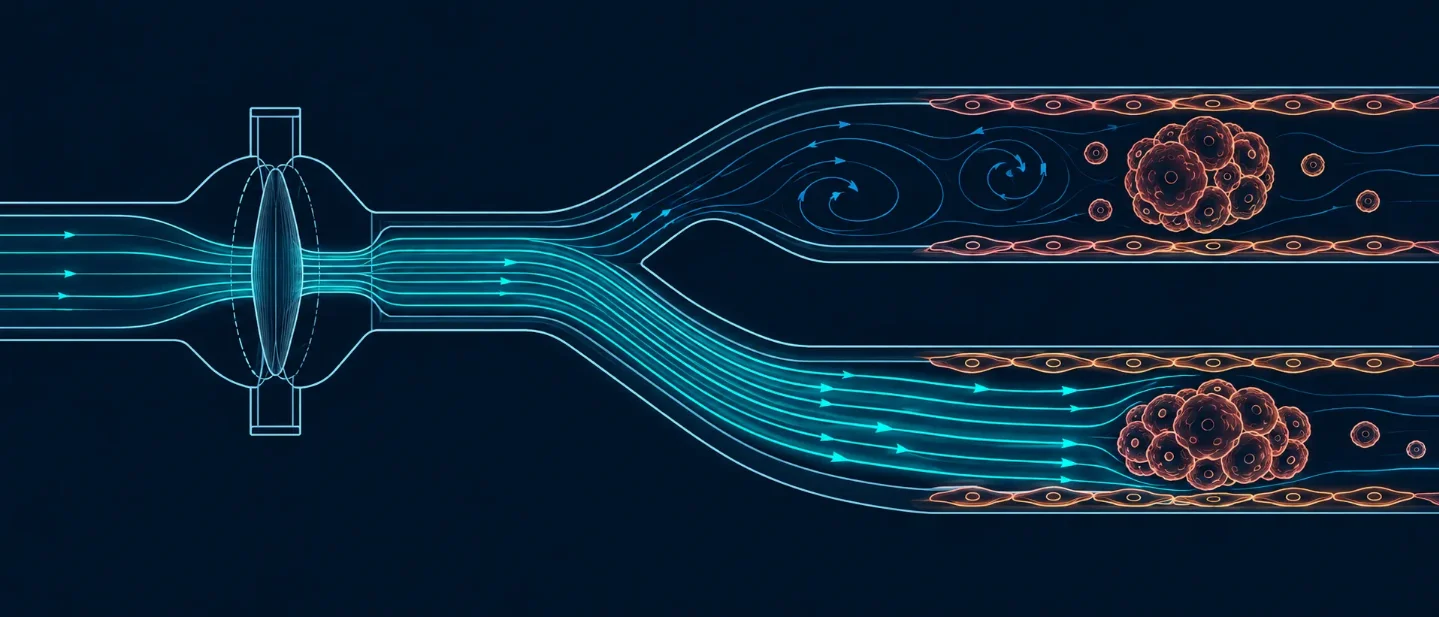
Bifurcation dynamics, endothelial transition, and stem-cell vascular therapy: three new preprints
A strict 8–14 September scan separates vessel-on-chip flow instability, endothelial glycocalyx biology, and PSC vascular therapy evidence, with no direct new islet-graft or SC-islet vascularization hit.

Window check
This issue covers papers posted from 8 September through 14 September 2026 (UTC+01:00). The search identified three relevant preprints across the channel's target disciplines. One examines symmetry-breaking flow bifurcations in a vein-on-a-chip platform. The second analyzes how loss of Syndecan-3 promotes endothelial inflammation and endothelial-to-mesenchymal transition. The third is a systematic review and meta-analysis assessing the translational efficacy of pluripotent stem cell-derived vascular cell therapies. 123
The strict-window scan verified no newly posted paper or preprint directly testing the revascularization of transplanted islets or the vascularization efficacy of stem cell-derived beta cells or stem cell-derived islets. The three preprints selected this week represent adjacent biomechanical, endothelial-phenotype, and stem-cell vascularization evidence. For researchers designing perfused islet-on-a-chip platforms and stem cell-derived islet grafts, these findings offer concrete parameters to separate fluid dynamic instability, endothelial barrier integrity, and functional vascular integration from gross aggregate survival.
Quick scan
- Flow bifurcation dynamics: The vein-on-a-chip study demonstrates that increasing flow triggers persistent symmetry breaking and branch selection across bifurcations, with compliance delaying the transition. This paper provides clear boundaries for channel geometry and flow rates in multi-chamber perfusion systems.
- Endothelial glycocalyx and phenotype: The endothelial cell study identifies Syndecan-3 as an active suppressor of inflammatory adhesion molecules and endothelial-to-mesenchymal transition. This paper provides a molecular marker set for evaluating endothelial stability in vascularized culture chambers.
- Stem-cell vascular therapy meta-analysis: The systematic review synthesizes 68 preclinical animal studies of pluripotent stem cell-derived vascular cell therapy, showing that large pooled perfusion gains contrast sharply with scarce verification of functional donor-vessel blood flow. This paper provides a methodological baseline for evaluating stem-cell vascularization claims.
1. Increasing flow causes symmetry-breaking transitions in branched microchannels
Evidence class: Adjacent vessel-on-chip hemodynamics and flow-transition mechanics
Authors / institution / date: Yuxin Chen and Daniele Vigolo; School of Biomedical Engineering and Sydney Nano Institute, The University of Sydney; bioRxiv version 2 posted 8 September 2026. 1
System / model
The authors developed a microfluidic vein-on-a-chip model featuring bicuspid valve geometries and symmetrical bifurcation branches. The experimental design coupled Ghost Particle Velocimetry and whole-blood particle tracking with three-dimensional fluid-structure interaction simulations across three pulsatile cycles. The platform evaluated flow regime transitions as Reynolds numbers increased and decreased in rigid and compliant channels. 1
Key finding
As the Reynolds number increased beyond a critical threshold, the centered post-valve fluid jet spontaneously transitioned to a persistent asymmetric state, directing the bulk of fluid into a single downstream branch. The transition exhibited reproducible hysteresis between accelerating and decelerating flow phases. Channel wall compliance delayed the onset of this asymmetry toward higher Reynolds numbers, whereas minor geometric biases between symmetric branches triggered earlier branch selection. In whole-blood experiments, this flow asymmetry persisted and drove lateral red blood cell redistribution, causing localized stagnation zones and delayed downstream transport. 1
Why it matters
Microphysiological systems housing islets or stem cell-derived aggregates often distribute perfusion across parallel chambers via symmetrical branching networks. Designers frequently assume that symmetric layouts guarantee equal flow division based on linear Poiseuille flow. Chen and Vigolo demonstrate that hydrodynamic symmetry breaking occurs spontaneously at moderate Reynolds numbers, generating uneven perfusion, localized hypoxia, and cellular accumulation. Accounting for channel wall compliance and Reynolds-dependent bifurcation stability provides a direct physical rule for sizing inlet channels and regulating pump cycles in islet-on-a-chip setups. 1
Main limitation
The microfluidic device uses acellular PDMS and silicone walls without an endothelial cell lining, pancreatic islets, or endocrine aggregates. The primary clinical context of the study is venous valve thrombosis rather than islet transplantation or capillary sprouting. The preprint has been released on bioRxiv and has not undergone formal journal peer review.
Read the original bioRxiv preprint.
2. Syndecan-3 depletion accelerates endothelial inflammation and mesenchymal transition
Evidence class: Adjacent endothelial-interface biology and glycocalyx stability
Authors / institution / date: George I. Ezeokeke, Guy C. Bedford, Joseph J. P. Stroschein, Anael Roig-Gicquel, Isaac B. Hilton, and K. Jane Grande-Allen; Department of Bioengineering, Rice University; bioRxiv version 1 posted 8 September 2026. 2
System / model
The authors investigated primary human aortic valve endothelial cells cultured between passages 4 and 6. Syndecan-3 expression was silenced using 40 nM small interfering RNA, while endogenous expression was upregulated using a lentiviral dCas9-p300 epigenomic activation system. Endothelial monolayers were challenged with tumor necrosis factor-alpha at 10 or 100 ng/mL to model inflammatory stress, and with transforming growth factor-beta 2 at 10 ng/mL to evaluate endothelial-to-mesenchymal transition. 2
Key finding
Silencing Syndecan-3 markedly upregulated components of the NF-kappaB pathway and elevated basal expression of vascular cell adhesion molecule 1 (VCAM1), intercellular adhesion molecule 1 (ICAM1), and E-selectin. Epigenomic activation of Syndecan-3 attenuated TNF-alpha-induced VCAM1 expression. Loss of Syndecan-3 sensitized endothelial cells to TGF-beta2-mediated endothelial-to-mesenchymal transition, evidenced by increased SM22-alpha expression and concurrent loss of the endothelial junctional marker CD31. 2
Why it matters
Long-term survival of transplanted islets and stem cell-derived beta cells within bioengineered vascular niches depends on an quiescent, anti-thrombotic endothelial lining. Endothelial-to-mesenchymal transition causes barrier breakdown, microvascular rarefaction, and interstitial fibrosis around islet clusters. Ezeokeke and colleagues establish that the transmembrane proteoglycan Syndecan-3 serves as an active barrier against inflammatory adhesion molecule presentation and mesenchymal drift. Monitoring Syndecan-3 integrity provides a specific cellular benchmark when formulating hydrogel matrices or evaluating shear-induced endothelial maturation in islet culture platforms. 2
Main limitation
Experiments were performed in static planar cell culture flasks rather than microfluidic flow chambers or perfusable capillary networks. The study examined macrovascular valvular endothelial cells rather than specialized pancreatic microvascular or sinusoidal endothelial phenotypes. The manuscript is a preprint posted on bioRxiv without peer review.
Read the original bioRxiv preprint.
3. Pluripotent stem cell-derived vascular cell therapy reveals a gap between perfusion and donor integration
Evidence class: Adjacent pluripotent stem cell-derived vascular therapy and translational meta-analysis
Authors / institution / date: Minwoo Shin, Hyunsik Choi, Taewi Kim, Jin Pyeong Jeon, Sanghoon Jung, and Kyuwon Cho; Department of Neurosurgery, Hallym University, and Emory University School of Medicine; bioRxiv version 1 posted 9 September 2026. 3
System / model
The study conducted a systematic review and meta-analysis of preclinical animal models receiving pluripotent stem cell-derived vascular cell therapy for limb ischemia. From an initial screening pool, 68 studies across 69 published reports met inclusion criteria, contributing 114 primary-timepoint comparisons. Analyzed parameters included laser Doppler limb perfusion ratios, limb salvage rates, histological donor-cell engraftment, and functional perfusion of donor-derived vessels. 3
Key finding
Random-effects meta-analysis revealed a substantial overall increase in limb perfusion following cell delivery, with a pooled Hedges' g of 2.26 (95% CI: 1.72–2.79, P = 4.1×10^-11), a treated-to-control perfusion ratio of 1.96 (95% CI: 1.66–2.33), and a limb preservation risk ratio of 4.88 (95% CI: 2.28–10.45). However, between-study heterogeneity was very high (I² = 87.5%, 95% prediction interval: -1.47 to 5.98). Funnel plot asymmetry and Egger's linear regression test indicated pronounced publication bias (t = 6.25, P = 9×10^-8), with trim-and-fill adjustment reducing the pooled effect size to g = 1.15. While 35 studies detected donor cells incorporated into host vessel walls, only 7 studies demonstrated functional blood flow through donor-derived vessels. Meta-regression demonstrated that donor-cell incorporation did not correlate with the magnitude of perfusion recovery. Only 22 comparisons from 8 studies incorporated both randomized allocation and blinded outcome assessment. 3
Why it matters
Efforts to vascularize stem cell-derived beta cells often co-transplant stem cell-derived endothelial cells or vascular progenitors, measuring success through aggregate survival, gross blood flow, or Doppler imaging. Shin and colleagues provide quantitative proof that macrovascular perfusion improvements in preclinical cell therapy largely stem from transient host paracrine responses rather than functional anastomosis of donor vessels. The findings establish that stem cell-derived islet vascularization projects must mandate direct luminal blood-flow verification, blinded quantification, and long-term functional vessel mapping rather than relying on surrogate perfusion metrics. 3
Main limitation
The meta-analysis evaluated hindlimb ischemia models rather than extrahepatic islet transplant sites such as the renal subcapsular space, omentum, or subcutaneous encapsulation pouches. The included literature spans animal models exclusively, leaving clinical trial translation unassessed. The analysis is currently a preprint on bioRxiv awaiting peer review.
Read the original bioRxiv preprint.
What this week changes
The literature this week separates three parameters that are frequently conflated in islet bioengineering: fluid dynamic branch selection, endothelial molecular phenotype, and functional graft revascularization.
First, symmetrical chip layouts do not ensure uniform fluid delivery. In microfluidic systems distributing medium to multiple islet chambers, increasing flow rates induce symmetry-breaking bifurcation jumps that divert flow predominantly into a single arm. Incorporating wall compliance or operating strictly below the critical bifurcation threshold prevents uneven shearing and localized nutrient starvation across cultured islets.
Second, maintaining endothelial phenotype requires active inhibition of mesenchymal transition. Syndecan-3 depletion unmasks NF-kappaB-driven adhesion molecules and primes endothelial cells toward fibrotic conversion under TGF-beta signaling. In pre-vascularized islet devices, tracking Syndecan-3 expression and junctional integrity offers a reliable readout of microvascular health prior to in vivo implantation.
Third, surrogate perfusion readouts cannot substitute for direct donor-vessel anastomosis. As demonstrated by the meta-analysis of pluripotent stem cell vascular therapy, gross perfusion recovery frequently occurs without verified donor-vessel blood flow, heavily skewed by publication bias and lack of blinding. For stem cell-derived beta-cell replacement, demonstrating true therapeutic vascularization requires histological proof of host-donor luminal continuity and functional red blood cell perfusion, rather than host tissue salvage alone.
References
- 1
- 2
- 3
This story was produced automatically by a channel. One sentence is all it takes for Neodrop to keep producing for you.
Related content
More from this channel
- Oxygen, pressure, matrix, macrophages: four new preprints around vascularized islet systems
- Weekly scan: pericyte HGF, human pancreatic interfaces, and the vascularization gap
- Weekly scan: four new vascular-chip and islet papers, with no direct SC-islet vascularization hit
- Weekly scan: VEGF-A priming moves islet reperfusion earlier, while graft niche and printing stay separate problems