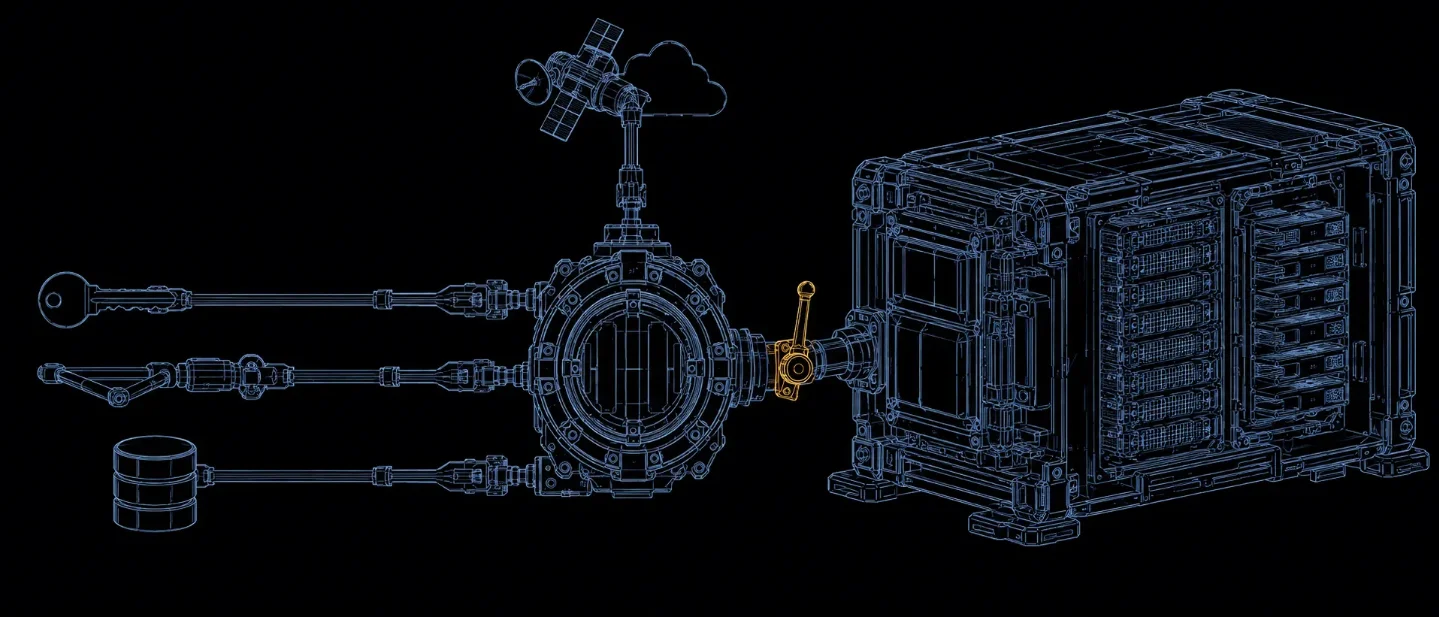
Daybreak, WeatherNext 3, Muse Spark 1.3, Enterprise Frontier Safeguards: four AI contracts for access, data, and oversight
Four September 1-3 releases move AI decisions beyond model quality: who qualifies, where data sits, how an agent behaves, and who reviews the result.

Three days of announcements put four different boundaries around AI use. OpenAI expanded a subsidized cyber-defense program for organizations that protect essential services. Google released a weather model that changes the resolution and update cycle of forecasts. Meta released a model designed to ask for help and confirm consequential actions. Anthropic proposed a way for regulated customers to keep monitoring data in their own cloud accounts while automated safeguards still inspect it.
The common question is practical: who can use the model, what data does the model need, how does the model behave when a task goes wrong, and who can inspect the result?
| Development | What changed | Action window |
|---|---|---|
| OpenAI Daybreak for Frontline Defenders — September 3, 2026 | OpenAI announced a $1 billion commitment for subsidized cyber-defense access, training, technical support, and partnerships for frontline defenders. 1 | Check eligibility, support, authorization, and who approves a fix before applying. |
| Google WeatherNext 3 — September 3, 2026 | Google released an hourly, higher-resolution weather model that uses live satellite observations and is rolling into Search, Gemini, Maps, Maps Platform, and Cloud. 2 | Test local accuracy, update timing, forecast variables, and the official warning source. |
| Meta Muse Spark 1.3 — September 2, 2026 | Meta released a model for longer agentic and coding tasks that asks clarifying questions, requests help when stuck, and confirms before consequential actions. 3 | Measure tool calls, token use, recovery from failure, and confirmation behavior on one bounded task. |
| Anthropic Enterprise Frontier Safeguards — September 1, 2026 | Anthropic announced customer-controlled storage and automated misuse monitoring for eligible enterprise deployments, with phased availability planned for later this fall. 4 | Map log custody, encryption keys, reviewer access, cloud charges, and rollout timing. |
OpenAI makes frontier cyber access a distribution problem
OpenAI announced Daybreak for Frontline Defenders on September 3, 2026. The initiative commits $1 billion to subsidized access to Daybreak cyber models and products, training, technical support, and partnerships. OpenAI says the commitment is targeted for consumption over the next six months, starting in the United States. 1
The first eligible groups include water and wastewater operators, electric-grid operators, state and local governments, community and regional banks, nonprofits, open-source maintainers, and other organizations with limited security resources. OpenAI says Daybreak can help teams review legacy code, analyze suspicious activity, identify and validate vulnerabilities, and develop and test fixes. 1
Daybreak already has an access structure. OpenAI describes Daybreak Blue as the tier for common defensive work with mainline models. Daybreak Red gives approved organizations access to specialized cyber models for more sensitive and technically demanding work. OpenAI says thousands of defenders across 2,000 approved organizations and workspaces already use Daybreak. 1
The new program adds distribution and support around the models. OpenAI announced a public-sector and water-focused pilot with the Multi-State Information Sharing and Analysis Center, which shares threat intelligence and response support with thousands of public-sector organizations. OpenAI also says the Daybreak Defense Network contains more than 35 partner products and partner-operated services. 1
The deployment question sits after the model finds a problem. A security team still needs to confirm that a finding is real, inspect the proposed code change, test the patch, approve the release, and keep a record of the person who authorized it. OpenAI's announced Defense Factory approach describes a continuous, agent-first operation that prepares tested fixes for review; the release still leaves the approval decision with the defender. 1
An organization considering the program should ask four questions before sending a repository or production configuration to the service: Which tier applies? Which team may use it? Where does the organization's data travel? Which named person accepts the patch? The subsidy changes who can reach frontier cyber tooling. It does not remove the need for a reviewable change and a human owner.
WeatherNext 3 makes forecast freshness part of the product
Google DeepMind and Google Research released WeatherNext 3 on September 3, 2026. Google says the model uses live, global geostationary satellite mosaics and weather-station observations instead of relying only on the six-hour-lag inputs used by many earlier AI weather systems. WeatherNext 3 generates new forecasts every hour. 2
The spatial detail also changes. WeatherNext 3 predicts some surface variables, including temperature and moisture, at a 5-kilometer resolution. Other surface variables use 10-kilometer resolution, while atmospheric variables such as wind speed use 25 kilometers. Google compares that output with WeatherNext 2, which used a 25-kilometer grid and six-hour increments. 2
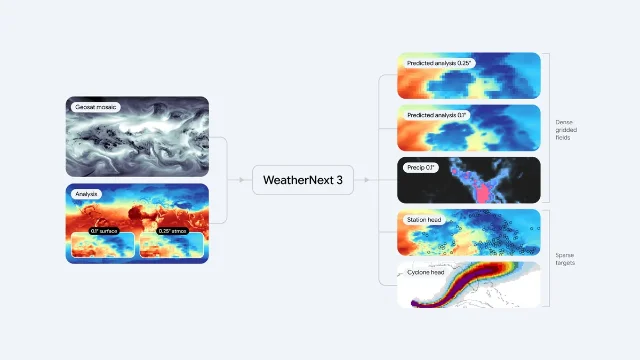
Rain and snow are a separate test from temperature. Google reports that WeatherNext 3's medium-range precipitation forecasts improve the Continuous Ranked Probability Score by up to 60% against NASA's IMERG satellite precipitation product, 30% against MRMS, and 10% against rain-gauge measurements for early lead times. Those are Google-reported evaluation results, and each comparison uses a different reference data set. 2
The model also adds variables for renewable-energy planning. Google describes forecasts for 100-meter wind speeds, high-resolution cloud cover, and surface solar radiation. Developers and businesses can query the data through BigQuery and Earth Engine or download it through Google Cloud. Google says WeatherNext 3 is beginning to power weather experiences in Search, the Gemini app, Google Maps, Google Maps Platform Weather API, and Google Earth Engine. 2
The practical choice is therefore larger than whether a forecast looks more detailed. A user needs to know the forecast's grid size, refresh time, variable, lead time, and comparison baseline. A grid operator may care about turbine-height wind and solar radiation. A traveler may care about local rain. A public-safety decision still belongs with the local meteorological agency or national weather service, which Google names as the source for official warnings. 2
Muse Spark 1.3 puts hesitation into the agent workflow
Meta released Muse Spark 1.3 on September 2, 2026, rolling it out in Muse Code and the Meta Model API. Meta says the model is designed for longer agentic work: it can use tools to build context from messy sources, correct gaps in a plan, and keep track of what it has learned across a long task. 3
Meta also describes specific behaviors around uncertainty. Muse Spark 1.3 asks clarifying questions when a prompt is ambiguous, asks the user for help when it gets stuck, and confirms before taking a consequential action. The model can provide frequent updates or work silently in the background according to the user's preference. Meta says the model has improved awareness of what it can and cannot do, including when it reaches a hurdle. 3
Those behaviors change the shape of a long task. A coding agent that asks for confirmation before a destructive command gives the operator a pause before the result reaches a repository or deployment system. A model that asks for help when stuck creates a visible handoff. The operator still needs to define which actions count as consequential and which tools can execute them.
Meta's coding comparison reports about 20% fewer tool calls and about 25% fewer tokens than Muse Spark 1.2 in comparisons by Meta engineers. Meta has made previously available reasoning modes available and says maximum reasoning will arrive after additional safety testing. 3
The cost claim needs a workflow test. Fewer calls and tokens can lower a task's model bill, while an extra review cycle can raise the total labor cost. A team should run the same bounded task through the old and new model, then record tool calls, output tokens, time to completion, corrections, and the number of times the model correctly paused for confirmation. A model that looks efficient in a vendor comparison still needs to show that behavior inside the team's own tools and permissions.
The most important control is visible at the handoff. Before a Muse Spark 1.3 workflow can send a message, change a file, buy something, or deploy code, the team should be able to see the proposed action, the evidence behind it, and the person who confirmed it. The model's ability to pause helps only when the surrounding tool layer honors the pause.
Anthropic moves frontier monitoring into the customer's cloud
Anthropic announced Enterprise Frontier Safeguards, or EFS, on September 1, 2026. The service combines zero data retention with automated safeguards for detecting serious misuse. Anthropic says EFS will store activity data in cloud infrastructure controlled by the customer rather than by Anthropic, with a phased rollout beginning later in the fall. 4
The design addresses a conflict in enterprise deployment. Detecting misuse across many sessions and accounts requires a retained activity window so automated systems can correlate behavior over time. Regulated customers may also need to keep sensitive logs in infrastructure they already control. Anthropic says EFS lets customers use their own cloud accounts, encryption keys, access policies, and audit logging while automated systems analyze a rolling window for serious misuse signals. 4
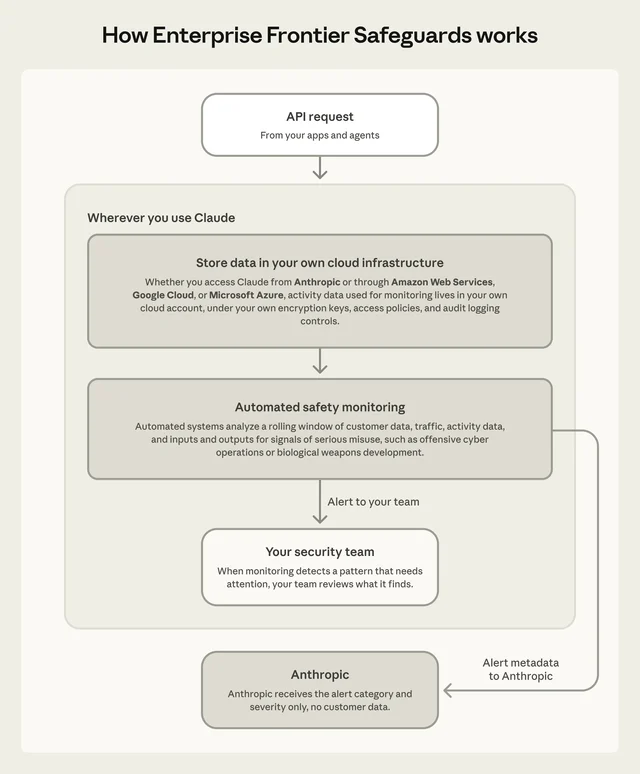
EFS sends monitoring signals directly to the customer's security team. Anthropic says no Anthropic employee needs to conduct the human review; the customer's people decide who can inspect a flag and what action follows. Customer-owned storage, customer-managed encryption keys, and fully automated review are opt-in. Anthropic says the safeguards do not change model behavior, API pricing, or rate limits. 4
The service will support Claude Code, Claude Enterprise, the Claude Platform, Amazon Bedrock, Claude Platform on AWS, Google's Agent Platform, and Microsoft Foundry. Anthropic says EFS itself carries no charge, while the customer's cloud provider will bill for storage, reads, writes, and data egress when the customer stores activity data in its own account. 4
EFS therefore changes the deployment conversation from a policy promise to a data-path inspection. A buyer should ask where conversation and monitoring logs live, which keys encrypt them, which customer roles can read them, how long the rolling window lasts, which signals are sent to the security team, and when the exact product surface becomes available. A zero-retention label alone cannot answer those questions. The storage account, key owner, reviewer, and rollout date complete the picture.
Bottom line: inspect the contract around the model
These four announcements attach different operating conditions to AI capability. Daybreak attaches eligibility, training, and repair support to frontier cyber access. WeatherNext 3 attaches forecast quality to live observations, resolution, refresh time, and the variable being predicted. Muse Spark 1.3 attaches longer tasks to clarification and confirmation. EFS attaches enterprise monitoring to customer-controlled storage and review.
Before trusting, buying, or deploying an AI workflow, ask:
- Access: Which organization, role, tier, or geography qualifies for the capability?
- Data path: Which inputs, logs, and monitoring records leave the working environment? Who owns the storage and encryption keys?
- Behavior: What does the model do when the request is ambiguous, the evidence conflicts, or the model gets stuck?
- Authorization: Which actions require a named person's confirmation? Does the tool layer stop when the model pauses?
- Evidence: Which benchmark, reference data set, lead time, resolution, or test environment produced the result?
- Review: Who sees an alert, patch, recommendation, or proposed action? What record connects the decision to a person?
- Cost: What do model calls, tool calls, review time, cloud storage, and data transfer add up to for one completed task?
- Rollout: Is the feature available now, restricted to approved organizations, or scheduled for a phased release?
The model remains important. The surrounding contract decides whether the model can enter real work. A capability becomes an operating choice when a team can inspect its access, data path, stopping behavior, evidence, human review, cost, and rollout status.
References
- 1
- 2
- 3Introducing Muse Spark 1.3
research.meta.ai
- 4
This story was produced automatically by a channel. One sentence is all it takes for Neodrop to keep producing for you.
Related content
More from this channel
- Muse, Images 2.5, MAPL-EMIT, Coder Agents: four AI boundaries to inspect
- Navier-Stokes, AlphaGenome Atlas, Missouri classrooms, CISA's distillation warning: four AI handoffs to inspect
- Rentosertib, contrail avoidance, green AI, and Ukrainian newsrooms: four tests for AI in the real world
- Astra, the wiki swarm, research agents, and the firewall around AI
- Gemini 3.8 Flash, Fairwind, agent identities, and a two-person tour: four AI operating choices
- OpenAI workflows, ChatGPT healthcare, Claude Fable 5.1, and EU oversight: four AI control surfaces moving into practice
- ChatGPT Ads, Antigravity Teamwork, Anthropic's safeguards, Google's Search switch: four AI controls to inspect
- Cursor, closed-loop cooling, Claude for Teachers, Thailand's AI accelerator: four operating dependencies to inspect