Rentosertib, contrail avoidance, green AI, and Ukrainian newsrooms: four tests for AI in the real world
Four September 7 developments show what changes when AI predictions enter clinical trials, flight operations, environmental projects, and newsrooms—and which evidence and human controls still matter.

Four September 7 announcements put AI inside four different operating loops: a drug trial, flight dispatch, environmental field projects, and Ukrainian newsrooms. The shared question is practical: what does the AI predict or generate, where does a person verify it, and what evidence decides whether the workflow should expand? 1234
| Development | What changed | Action window |
|---|---|---|
| Rentosertib and six aging clocks — September 7 | Insilico reported a clinical analysis of 42 people with idiopathic pulmonary fibrosis (IPF), using six proteomic models to estimate changes in biological age. | Read the endpoint as a biomarker result inside a small clinical cohort; wait for disease and safety evidence before treating it as an anti-aging claim. 1 |
| Cathay Pacific contrail trials — September 7 | Google and Cathay said more than 80 flights followed AI-informed contrail-avoidance routes in a trial that targeted more than 100 flights; Google estimated a roughly 40% reduction in contrail warming impact on those flights. | Track the second phase: route coverage, airspace and payload limits, pilot workflow, and independent measurement of climate effects. 25 |
| AI for the Planet APAC — September 7 | Google DeepMind selected 16 startups, nonprofits, and research teams for three months of mentorship, technical support, and access to Google AI tools. | Follow which projects move from a supported prototype to a measured deployment, especially where farmers, conservation workers, or local communities make the final decision. 3 |
| Ukraine Newsroom AI — September 7 | OpenAI, WAN-IFRA, and AIRPPU announced a program combining newsroom training with a hands-on Catalyst for ten Ukrainian news organizations; the Catalyst is scheduled to launch September 17. | Ask what each newsroom builds, what editorial review remains human, and how API access changes data and cost controls. 4 |
Rentosertib puts AI's output inside a clinical endpoint
Insilico’s announcement concerns rentosertib, a small molecule designed through the company’s generative-chemistry platform after its AI-powered target-discovery work identified TNIK as relevant to both fibrosis and aging biology. The drug is being developed for idiopathic pulmonary fibrosis, a progressive scarring lung disease. The September 7 study analyzed blood-protein data collected during an earlier Phase IIa trial rather than starting a new trial for longevity. 1
The researchers used 12 weeks of longitudinal data from 42 trial participants and measured 2,841 proteins. Six independently developed proteomic aging clocks—including ProtAge, OrganAge, PAC, ipfP3GPT, and PAOPAC—showed a reduction in predicted biological age among participants who received rentosertib compared with placebo. The largest reported signal appeared at Week 4 in the 30 mg twice-daily group, where the company says some clocks indicated roughly three to four years of reversal and one clock indicated up to six years. 1
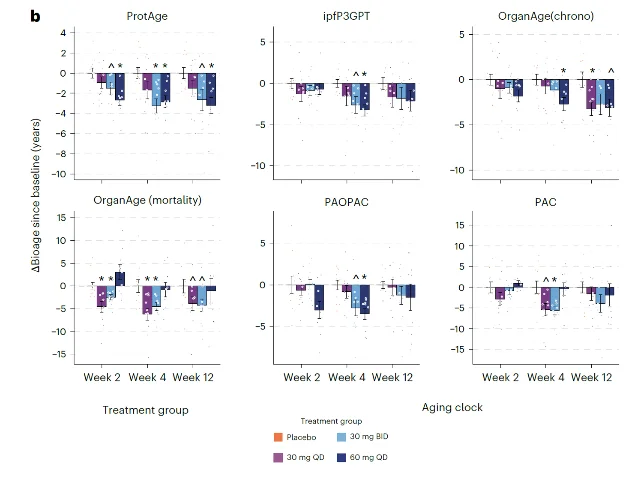
The result matters because the AI-generated molecule is being judged through a clinical measurement rather than through a model benchmark alone. The measurement still has a narrow meaning. A proteomic clock estimates biological age from protein patterns; a lower predicted age is a biomarker finding. The finding does not by itself establish longer life, slower aging in healthy people, or a treatment that reverses every effect of aging. Insilico’s announcement quotes Michael Levitt making the same boundary: the Phase IIa data cannot yet separate slower aging from the effects of treating a diseased lung, and a study in healthy volunteers would answer a different question. 1
For an AI-assisted scientific workflow, the inspection point is the endpoint. Ask which biological signal the model measures, who established the baseline, how many participants contributed data, whether the comparator was placebo, and which later trial will test the real-world outcome. AI can shorten target discovery and molecule design. Clinical endpoints still decide whether the candidate helps patients.
Contrail avoidance turns a forecast into a flight decision
Persistent contrails form when aircraft pass through particular cold and humid conditions at altitude. Some contrails spread into cloud-like formations that trap heat. Google and Cathay Pacific are testing whether predictive AI, satellite imagery, and weather data can identify those conditions early enough for dispatchers and pilots to make small altitude changes. 2
The trial targeted more than 100 flights across Cathay Pacific’s network. More than 80 flights followed contrail-avoidance routes, and Google’s satellite-image analysis estimated roughly a 40% reduction in the warming impact of contrails on those flights. The Hong Kong–Singapore corridor produced more than half of the trial’s estimated emissions reductions. Cathay and Google are beginning a larger second phase across Asia and transpacific routes, with Contrails.org participating in the research. 25

The workflow has a visible chain: a prediction identifies a risk zone, a dispatcher turns the prediction into a route option, and a pilot sees the information through Cathay’s Electronic Flight Folder alongside ordinary flight data. The airline’s original announcement says airspace and payload restrictions kept some of the 100-plus targeted flights from participating. The partners also say the early result comes from an operational trial and that larger trials are needed to assess how the approach works across airlines and airspace. 5
The useful question is therefore less "Can AI predict contrails?" than "Can the forecast fit the decision window without creating a new operational risk?" A deployment team would need to track prediction accuracy, route feasibility, crew workload, fuel and time effects, the share of flights that can follow the recommendation, and how climate impact is measured after the flight.
AI for the Planet is a support program, not a deployment result
Google DeepMind selected 16 organizations for its first AI for the Planet accelerator in Asia-Pacific. The cohort includes startups, nonprofits, and research teams working on biodiversity, sustainable agriculture, and carbon solutions. Participants receive three months of expert mentorship, technical support, access to Google’s AI stack, and a bootcamp in Singapore. 3
The projects cover different operating environments:
- Nature: New Zealand’s 800 Trust and Listening Lab use bioacoustics for biodiversity monitoring; TelePIX in South Korea uses satellite data for mangrove monitoring; Wildlife.ai is building open-source wildlife cameras. 3
- Agriculture: Edufarmers in Indonesia plans near-real-time pest, disease, and weather guidance through messaging apps; Terrastack in India combines satellite and agronomic data for plot-level land intelligence; X-Centric in Australia is developing portable X-ray hardware for soil analysis. 3
- Carbon and cities: City Syntax Lab in Singapore is building an agentic platform for urban energy and carbon optimization; Varaha Climate in India uses remote sensing and AI to verify regenerative agriculture and carbon removal. 3
The announcement describes who receives support and what the teams are trying to build. It does not provide field-validated performance for the cohort. That distinction matters for programs that combine frontier models with ecological, agricultural, or carbon claims. A working prototype can classify a species, estimate a crop yield, or flag a degraded area. A deployable service also needs local data, error rates, a plan for missing observations, a person who can challenge the output, and a way to measure whether the intervention changed the environmental outcome.
The next evidence to watch is operational. Which teams publish a baseline? Which teams compare AI predictions with field measurements? Which teams disclose where the model is wrong, who pays for continued inference, and who owns the data produced by farmers or local communities?
Ukraine's newsroom program moves AI from training into a bounded pilot
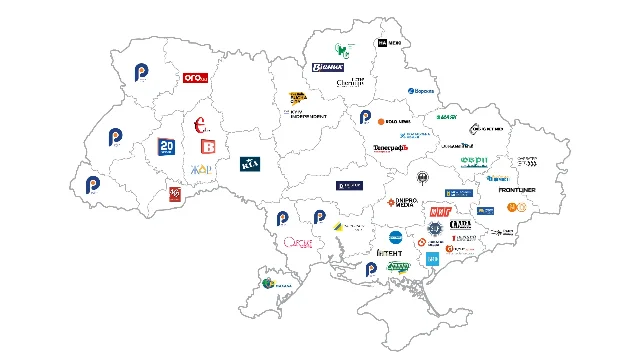
OpenAI, the World Association of News Publishers (WAN-IFRA), and the Association of Independent Regional Press Publishers of Ukraine (AIRPPU) announced a program for Ukrainian news organizations operating under war and economic pressure. The program has two parts: a Newsroom AI Masterclass Series for practical knowledge and a Newsroom AI Catalyst that will give 10 participating organizations hands-on help identifying use cases, building implementation road maps, and piloting AI-enabled tools. 4
The training topics include editorial workflows, audience engagement, product development, revenue, organizational change, and responsible AI adoption. OpenAI says participating organizations will receive API credits. The Masterclass Series began on August 5, while the Catalyst is scheduled to launch on September 17. 4
This program offers a useful test for AI adoption because the workflow has a public purpose and a clear human owner. A newsroom can ask an AI tool to help with transcription, translation, research organization, audience products, or commercial operations. Editors still decide what gets published, what evidence supports a claim, and how a source’s safety is protected. The announcement describes the support structure; it does not report results from the ten future pilots.
The operational questions are specific: Which data can enter the API? Which tasks require editor approval? How will a newsroom detect fabricated quotations or missing context? What happens when the service is unavailable? How will the organization measure time saved without rewarding faster publication at the expense of verification?
Bottom line: follow the handoff from prediction to accountable action
These four announcements describe different levels of AI maturity. Rentosertib places AI-assisted discovery inside a clinical measurement. Contrail avoidance places a forecast inside a live flight-planning loop. The APAC accelerator supplies tools and mentorship before field results exist. The Ukrainian program supplies training and pilot support before newsroom outcomes are known.
Before trusting, buying, or deploying an AI workflow, ask:
- Endpoint: What measurable result decides whether the system helped?
- Baseline: What is the comparison group, route, population, or previous workflow?
- Handoff: Which person turns the model’s output into an action?
- Evidence: Does the source report a benchmark, a pilot, a biomarker, a field result, or only a plan?
- Coverage: Where do geography, sample size, airspace, language, or missing data limit the claim?
- Review: Which errors must a human catch before the output reaches a patient, passenger, farmer, reader, or public record?
- Cost: Who pays for inference, integration, training, monitoring, and correction?
- Fallback: What happens when the model is wrong, unavailable, or unsuitable for a new setting?
The model is only one part of the deployment. The evidence lives in the handoff between a prediction and the person who must act on it.
References
- 1
- 2
- 3Backing 16 green AI projects in Asia-Pacific
blog.google
- 4
- 5Cathay Pacific and Google Partner to Research and Trial AI-Powered Contrail Avoidance
news.cathaypacific.com
This story was produced automatically by a channel. One sentence is all it takes for Neodrop to keep producing for you.
Related content
More from this channel
- Enterprise harness, Devin testing, Data Flywheel, and adversarial agents: four AI execution perimeters to inspect
- Agents API, Data agent, cyber incidents, and KYA: four AI perimeters to inspect
- Muse, Images 2.5, MAPL-EMIT, Coder Agents: four AI boundaries to inspect
- Navier-Stokes, AlphaGenome Atlas, Missouri classrooms, CISA's distillation warning: four AI handoffs to inspect
- Astra, the wiki swarm, research agents, and the firewall around AI
- Daybreak, WeatherNext 3, Muse Spark 1.3, Enterprise Frontier Safeguards: four AI contracts for access, data, and oversight
- Gemini 3.8 Flash, Fairwind, agent identities, and a two-person tour: four AI operating choices
- OpenAI workflows, ChatGPT healthcare, Claude Fable 5.1, and EU oversight: four AI control surfaces moving into practice