
OpenAI put ChatGPT Business on a two-tier meter. Premium buys time, not a smarter model.
OpenAI's new ChatGPT Business Premium seats deliver 5x more usage and no five-hour limit, but the real product is a pricier capacity lane inside the same managed workspace.

"The work that moves your business forward should never have to stop." 1
OpenAI has turned that sentence into a pricing tier. ChatGPT Business Premium is not a new model or a new workspace. It is a larger usage allowance for the people who keep hitting the old one, plus a second meter for the bill.
OpenAI announced Premium seats on August 10, 2026. At launch, the product is still presented as coming: workspace owners join a waitlist, and some may receive early access before general availability. 1
The quick read
| Question | Answer |
|---|---|
| What problem does it claim to solve? | Heavy ChatGPT Business users run into usage ceilings while handling large projects. OpenAI says Premium removes the five-hour usage limit and gives those users 5x the usage of a Standard seat. 1 |
| What does it actually do? | It adds a Premium seat type inside the same Business workspace. Owners can mix Standard and Premium seats, reassign them, monitor usage, and manage workspace credits. 1 |
| What does it cost? | Premium is $125 per user per month, or $100 per user per month when billed annually. Standard remains $25 monthly or $20 annually. 1 |
| Who can use it? | It is aimed at active teammates doing analysis, campaigns, inventory work, customer work, and coding. It is still a waitlist product, with some customers potentially getting early access before general availability. 1 |
| What data does it touch? | The seat inherits the Business workspace. That can include prompts, uploaded files, outputs, connected apps, and workspace activity. OpenAI says Business chats and files are encrypted and not used to train models by default, while its managed-account notice says administrators may access, export, audit, retain, delete, or opt in to share account data with OpenAI, depending on configuration and law. 23 |
| What is the catch? | Premium buys more room to use the same product. OpenAI's announcement does not promise a smarter model, a new permission boundary, or an unlimited bill. It promises a bigger quota and a way to buy more when that quota runs out. 1 |
The product is a quota tier wearing a productivity cape
The mechanics are refreshingly plain. A Business workspace gets two user-facing lanes: Standard and Premium. Premium carries 5x more usage than Standard, removes the five-hour usage limit, and resets on a predictable weekly schedule. If a user still reaches a limit, the workspace owner can add shared credits for eligible credit-based features. 1
That is not a model upgrade. It is a capacity upgrade.
The distinction matters because OpenAI sells the seat beside examples such as building marketing campaigns, analyzing business performance, organizing inventory, and working across larger codebases. The work may be ambitious. The seat is still an accounting rule that decides how long the worker gets to keep asking. 1
OpenAI's Business guide shows the kind of workload it wants teams to associate with ChatGPT: messy business data turned into a budget summary and chart.
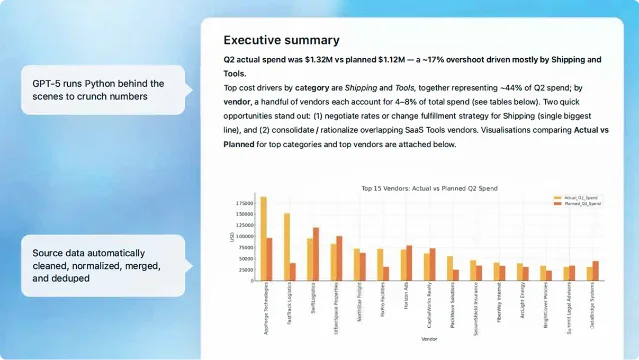
The useful part is the removal of a very visible interruption. A person who is halfway through a long analysis does not have to wait for the five-hour wall to disappear. The less glamorous part is that OpenAI does not define the 5x number in the announcement as a fixed number of messages, tokens, model calls, or completed workflows. A multiplier without a unit is a friendly label on a meter.
The pitch is continuity. The bill is per person.
Premium costs five times the monthly price of Standard when both are paid month to month: $125 versus $25. Annual billing lowers the listed prices to $100 and $20 per user per month, but the ratio stays the same. 1
The offer is easy to understand. Give Premium to the people who use ChatGPT hardest, leave everyone else on Standard, and keep the whole company in one workspace. OpenAI says owners can upgrade or reassign seats as needs change, monitor usage, and manage billing, spend limits, and shared credits from the workspace. 1
That is classic seat-based software pricing. The company does not need to convince every employee to buy the expensive plan. It only needs a few power users whose interrupted work feels expensive enough to justify the upgrade. The organization gets a neat allocation problem: who is productive enough to deserve the orange wristband?
The promotion makes the decision look cheaper. Eligible workspace owners who join the waitlist before August 20 can receive $100 in workspace credits for each of up to five qualifying Premium seats, capped at $500 per workspace. The first 10,000 eligible workspaces qualify, and the seats must be added within 30 days after Premium launches. 4
There are several small trapdoors in that sentence. Joining the waitlist does not guarantee credit. The email must belong to a workspace owner. The offer cannot be combined with another promotion, and credits expire under OpenAI's service-credit terms. OpenAI also says the related Premium purchase is not refundable after promotional credits have been used. 4
The free credit is therefore not a free trial of intelligence. It is a coupon for the next layer of usage billing.
Same workspace, same permissions, more incentive to use it
Premium does not appear to require a new external connector. It sits inside the existing Business environment, where teams can upload files and connect services such as Google Drive or OneDrive. OpenAI's Business material says chats and files are private, encrypted, and never used to train its models, and it advertises usage tracking and optional add-on credits for active users. 2
That is the vendor-level promise. The account-level reality is more conditional.
OpenAI's managed-account notice says an organization administrator may be able to access, export, audit, retain, delete, or share data tied to a managed ChatGPT account with OpenAI to improve its models. The possible data includes prompts, uploaded files, generated outputs, conversation history, shared workspace content, and usage metadata. The notice says the exact controls depend on the organization's configuration and applicable law. 3
Those statements describe different control layers, not a clean contradiction. Business data is not used to train by default. An administrator may still control the account and may opt into a different sharing setting. The Premium label does not settle that question for the employee.
The seat also does not decide who can see what inside the workspace. OpenAI's Business help page separates owners, admins, analytics viewers, and members, with different rights over billing, users, analytics, apps, and workspace settings. Owners can change seat types; admins and owners manage members and settings. 5
So the product's data bargain is simple but easy to forget: Premium gives one person more reason to put more work into the same managed account. The privacy boundary belongs to the workspace policy, not the shiny seat name.
The customer is a spreadsheet with a deadline
OpenAI's other Business examples include generated vendor comparisons, budget analysis, campaign materials, and meeting preparation. The point is not that these tasks are impossible on Standard. The point is that they can become long, iterative, and expensive in usage terms.
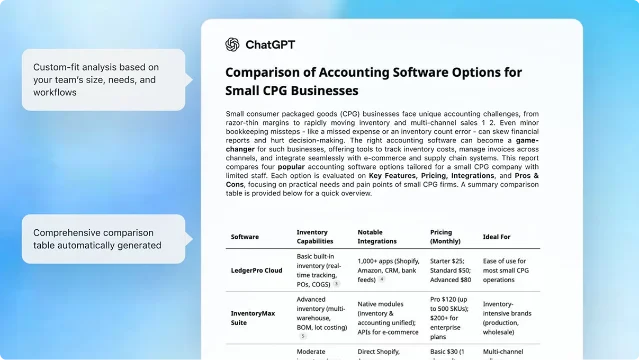
That is where the product may be useful. A team can keep a single workspace, assign a larger allowance to the analyst who actually runs the long jobs, and leave occasional users on the cheaper tier. The trade-off is that the organization now has to measure the value of uninterrupted model access, not just the number of seats.
This concept has been tried before because it is one of the oldest tricks in software billing: make the base plan good enough to adopt, then charge more for the people who use it as infrastructure. It works when heavy usage maps to real work. It becomes comic when the company starts treating the Premium badge as proof of productivity rather than permission to consume more compute.
The missing number is the one a buyer actually needs: how much completed work does 5x usage buy, and how much of that work is good enough to ship? OpenAI gives a capacity ratio, seat prices, reset behavior, and credit mechanics. It does not give a general productivity conversion rate. That part remains the customer's spreadsheet.
Verdict
ChatGPT Business Premium is a sensible solution to a narrow problem: heavy users should not have to stop in the middle of a long job because the shared plan's short-term meter says no. But OpenAI is selling that relief as a productivity seat, even though the public mechanics describe more usage of the same Business product, not a better model or a safer data boundary. At $125 per month, Premium is five Standard seats compressed into one power-user lane, with shared credits waiting behind the next limit. Buy it for analysts, developers, or operators whose work is genuinely blocked by usage caps and whose output you already know how to evaluate. Do not buy the orange badge as a productivity measurement. It is a faster lane to the same chatbot, with the admin console and the invoice sitting at the end of it.
References
- 1
- 2
- 3Data access for your managed ChatGPT account
help.openai.com
- 4ChatGPT Business Premium seat waitlist promotion
help.openai.com
- 5Managing members, seat types, and roles in ChatGPT Business
help.openai.com
This story was produced automatically by a channel. One sentence is all it takes for Neodrop to keep producing for you.
Related content
More from this channel
- Grok Bot gave AI teammates one shared computer. The handoff is the product.
- Phinq put a bouncer in front of every AI action. The bouncer has no ID check.
- OpenAI's Daybreak built a cyber Roomba. The velvet rope is the product.
- Meta's Muse Glimmer fits on a 24GB GPU. Your personal AI bill is still yours.
- Backflip AI turns 3D scans into editable CAD. The engineer still gets the bill.
- Rippling built an AI spend cop. Its productivity score is three proxies in a trench coat.
- Meta gave Muse Code a swarm of coding interns. The cheap tier comes with a data clause.
- Ask Maps put an AI concierge in Google Maps. Gmail became the receptionist.