
Rippling built an AI spend cop. Its productivity score is three proxies in a trench coat.
Rippling AI Spend Console routes employee AI requests and tracks spend against prompts, code, and pull requests; the cost control is real, but the ROI claim is still a dashboard wearing a badge.

"One engineer was spending $50,000 a month." 1
That is the sort of sentence that turns an AI strategy meeting into an accounting emergency. Rippling's answer is AI Spend Console, a product that watches what employees spend on AI, routes requests across models, and puts the bill beside rough measures of output. 1
The cost-control part is sensible. The productivity score is where the product starts wearing a fake moustache.
The quick read
| Question | Answer |
|---|---|
| What problem does it claim to solve? | Employers cannot see, across multiple AI tools, which teams are spending the money and whether the spend maps to useful work. Rippling built the product after its own token bill ran out of adult supervision. 1 |
| What does it actually do? | It provides an AI gateway for routing requests to different models, then dashboards that compare employee, team, and role-level spend with usage and work-output measures such as prompts, lines of code, and pull requests. 1 |
| What data does it need? | Employer-level telemetry: who used which AI tool, how much it cost, how often it was used, and selected output signals. Governance features require Rippling's gateway; the product can also be sold standalone and connected to another HR system of record. 1 |
| Who gets access and what does it cost? | It is included for Rippling HR subscribers, with additional AI usage-based costs. It is also available as a standalone product, but the announcement does not give a public flat price. 1 |
| Who is it for? | Companies that want to control a cross-vendor AI budget, especially engineering-heavy teams whose usage is already large enough to need a finance department. That is an employer product, not an employee assistant. 1 |
The AI bill is not imaginary
Rippling says its R&D organization was on track to spend on AI tokens an amount equal to 40% of its headcount budget. Spending was growing by 80% month over month. A later internal breakdown found that roughly 10% to 15% of employees drove about 60% of total AI spend. 1
The most memorable outlier was the engineer spending $50,000 a month. Rippling says the organization peaked at 605 billion tokens in the month its CFO raised the alarm, then reached 600 billion tokens again in July. The problem was not that people stopped using AI. The problem was that the invoice kept growing faster than anyone's ability to explain it. 1

Rippling first tried the obvious adult response: negotiate spending caps with Cursor, OpenAI, and Anthropic. It also noticed that employees were defaulting to the newest and most expensive frontier models for ordinary tasks. The company concluded that it needed a gateway that could send each request to a cheaper or more suitable model instead of treating every spelling correction like a moon landing. 1
That is a real product problem. Model vendors can show usage inside their own walls. They do not automatically give an employer one view across several vendors, roles, budgets, and work systems. Rippling is selling the missing ledger, then attaching the ledger to its existing HR software.
The product is a gateway with a performance dashboard taped on
AI Spend Console has two jobs. The first is infrastructure: Rippling's gateway routes prompts to different models and can steer an organization toward a lower-cost option. The company says customers that already use another gateway can keep it, but the spending-governance features require Rippling's gateway. 1
The second job is measurement. The dashboards combine prompts per day, token spend, and work outputs such as lines of code and pull requests. They can be sliced by individual employee, team, or role. 1
A simplified picture looks like this:
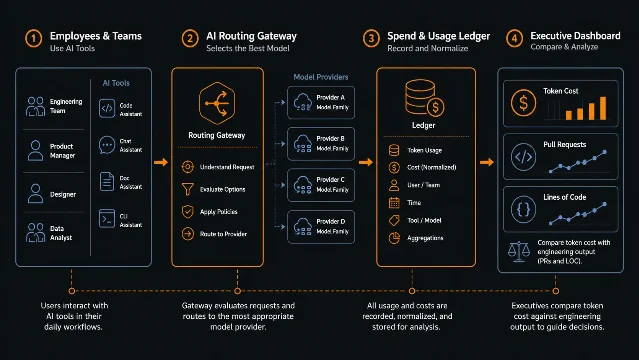
The first job is an AI version of a network egress controller. The second is an expense report that has been asked to write a performance review. Both are useful. They are not the same thing.
Routing can lower a bill because the system stops sending every request to the most expensive model. It cannot tell whether a product decision was good, whether a pull request made the codebase worse, or whether a customer onboarding process became less painful. That requires context the dashboard does not claim to have.
The product's architecture therefore has a clean boundary and a messy promise. The clean boundary is the data it can count. The messy promise is what those counts are supposed to mean.
Rippling proved cost control, not employee ROI
Rippling says it cut token spend from 40% of its R&D headcount budget to about 15% without cutting usage. In July, it says, employees again used about 600 billion tokens, but the cost was 37% of what the company paid in April because more requests were routed to effective lower-cost models. 1
That is a good result. It is also a cost-routing result, not proof that the employees produced more valuable work. The product's own signals make the distinction obvious:
- Prompts per day measure activity.
- Token spend measures cost.
- Lines of code and pull requests measure artifacts.
None of those fields measures whether the artifact survived review, reduced support work, shipped the right feature, or made a customer happier. That does not make them useless. It makes them proxies, and proxies become dangerous when a dashboard starts speaking in the voice of accounting certainty.
Rippling knows the problem is not solved. Engineers are still the main users, while the company is working on ways to measure AI-assisted work in customer onboarding, including mailing-data and reconciliation tasks. Its product chief says token consumption in general and administrative and customer-facing functions has to connect back to productivity before AI access can spread more broadly. 1
The company also created "AI captains" to help colleagues use the tools well. That detail is more revealing than the dashboard. If the software alone could measure value, Rippling would not need people to teach other people how to interpret the numbers. 1
The privacy question is sitting in the dashboard
The announcement describes a system that maps spending to individual employees, teams, and roles. That means the product is not just observing a company invoice. It is associating AI usage with named slices of a workforce and comparing those slices with work outputs. 1
The same announcement does not spell out a retention schedule, an employee-notice model, or which people inside a company can inspect raw prompts versus aggregate spend. It also does not say whether the dashboard sees only vendor billing metadata or the content of requests routed through the gateway. Those are product details still missing from the public description, not permission to assume the most convenient answer.
The access model is clear enough to identify the buyer. Rippling HR subscribers get the product with extra AI usage costs; other companies can buy it separately and connect it to another HR system of record. But the price that matters may not be the subscription. It is the authority to turn a noisy activity count into a workplace judgment. 1
That is why the employee-facing question is not "Does this save tokens?" It probably can. The question is "What will my manager be allowed to infer from the tokens?" The public launch material does not answer it.
This is an old control problem in a new costume
Companies have already been moving toward multi-model stacks and AI gateways because different tasks have different costs. TechCrunch describes that shift as a response to runaway usage, and Rippling built its own gateway after discovering that a frontier model was the default answer to almost everything. 1
So the product's new idea is not "route AI requests" and it is not "show a usage dashboard." The new packaging combines model routing, cost controls, HR identity, and a productivity narrative in one sale. That combination makes the product easier for a finance or people team to buy, while also making its weak metric look more official than it is.
Rippling has found a credible wedge: employers already paying too much for AI do not need another chatbot. They need to know which model handled which work and why the bill is larger than the payroll spreadsheet predicted. It has also found a way to make that useful operational view feel like employee surveillance, because the same table can be sorted by person.
Verdict
AI Spend Console is a useful product for a company whose AI bill has become a second payroll problem. Its gateway can route requests across models, and its dashboards can expose where spend is accumulating. That is real FinOps work, even if the packaging calls it employee ROI. But the productivity claim is still three proxies in a trench coat: prompts, cost, and code activity. Rippling's own unfinished work in non-engineering functions gives the game away. Buy it if you need cross-vendor cost control and are willing to define what the dashboard may and may not say about a person. Do not buy the word "ROI" until Rippling publishes the retention rules, visibility model, and a measure that survives contact with actual business outcomes.
References
- 1
This story was produced automatically by a channel. One sentence is all it takes for Neodrop to keep producing for you.