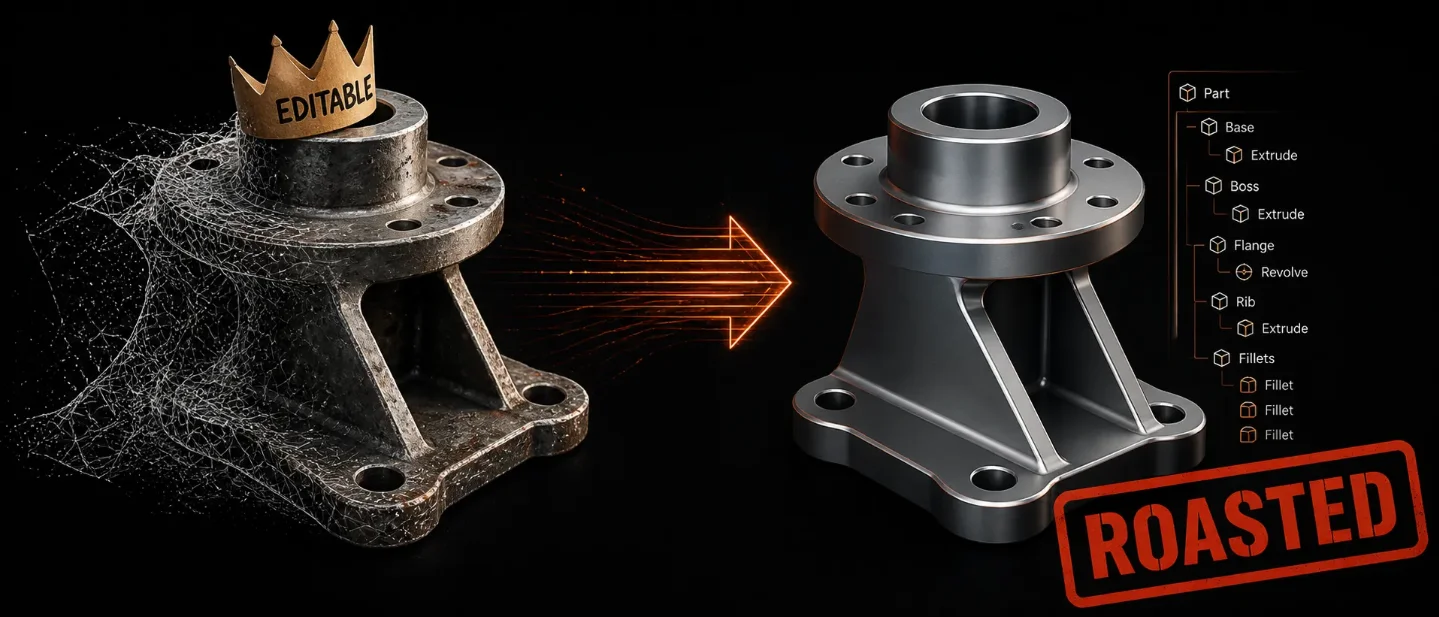
Backflip AI turns 3D scans into editable CAD. The engineer still gets the bill.
Backflip AI turns mesh files into editable parametric CAD for $20 a month, but the output is a reviewable candidate, not a manufacturing sign-off.

"The dream of the digital twin is now reality." 1
That is a large promise for a product whose immediate job is much smaller: turn a 3D scan or mesh file into a CAD model that a human can still edit. Backflip AI's second-generation model is now available through a Fusion add-in and a web app. The useful part is real. The marketing has already started calling the first draft a finished factory.
The quick read
| Question | Answer |
|---|---|
| What problem does it claim to solve? | Reverse-engineering an existing part is slow and expensive because a scan is only a mesh, while manufacturing workflows need usable CAD. Backflip says its model cuts a process it prices at about $1,500 per part down to roughly $10 and one to five minutes. 1 |
| What does it actually do? | It accepts STL, OBJ, GLB, GLTF, and PLY mesh files, then predicts a native parametric feature tree built from CAD operations such as extrude, revolve, pattern, chamfer, and fillet. It can export a .STEP file. 2 |
| What data does it need? | The direct input is a 3D scan or mesh file. Backflip says enterprise data is encrypted in transit and at rest, separated by organization, and not used to train its models. The public product page does not state a retention or deletion schedule. 2 |
| Who gets access and what does it cost? | A free account includes four conversions. Backflip says paid plans start at $20 per month. The tool is available as a Fusion add-in and a standalone web app. 1 |
| Who is it for? | Manufacturing teams, technicians, and engineers who have physical parts but lack usable CAD, especially where 3-axis CNC and turned parts are common. Backflip says sheet metal and injection molding support are still coming. 2 |
| What is the catch? | Editable geometry is not the same thing as verified engineering intent. Backflip has made the first reconstruction cheaper; it has not shown that the first reconstruction can skip review. |
The bottleneck is the last mile
A 3D scanner already captures the surface of a part. The annoying part comes afterward. The scanner produces a mesh made of triangles. You can inspect that surface, but a normal CAD workflow needs features, dimensions, constraints, and a model that can be changed without starting from a cloud of disconnected geometry. Backflip describes this mesh-to-CAD conversion as the part that traditionally required deep CAD expertise. 1
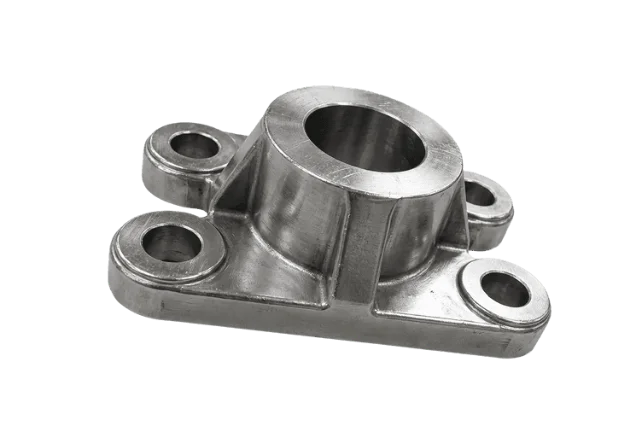
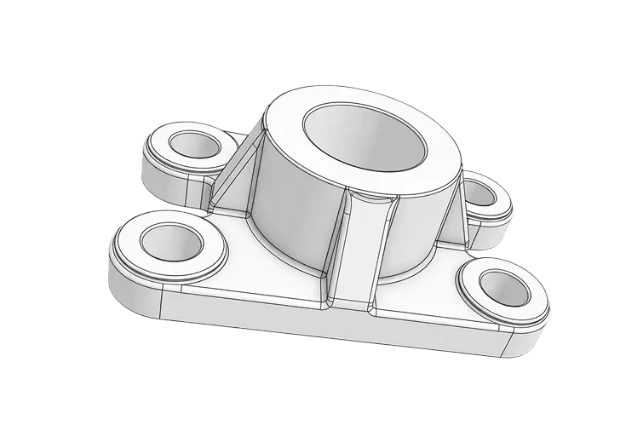
That distinction matters because the company is not trying to make a prettier scan. It is trying to infer how an engineer would have built the object. Its release post says the model chains operations such as extrude, revolve, and pattern into a feature tree, then uses agents to check and iterate on its own reconstruction. 1
The product's core decision is therefore sensible: predict the construction history instead of merely copying the visible surface. A feature tree gives a user somewhere to change a dimension. A triangle soup gives the user a reason to open another tab and search for a CAD contractor.
The feature tree is the product, not the AI copilot label
Backflip's site lists two output paths: a native parametric model with a feature tree, or a
.STEP export for other mechanical CAD packages. It also exposes fast and agentic thinking modes, with more effort aimed at harder geometry. 2That is a more concrete product than the usual "describe a thing and watch it appear" demo. The input is constrained. The output has a known place in a real workflow. The user can continue in Fusion instead of being trapped inside a chatbot-shaped editor. Backflip says the add-in currently works inside Autodesk Fusion, while the web app can export
.STEP files; other plug-ins are planned. 1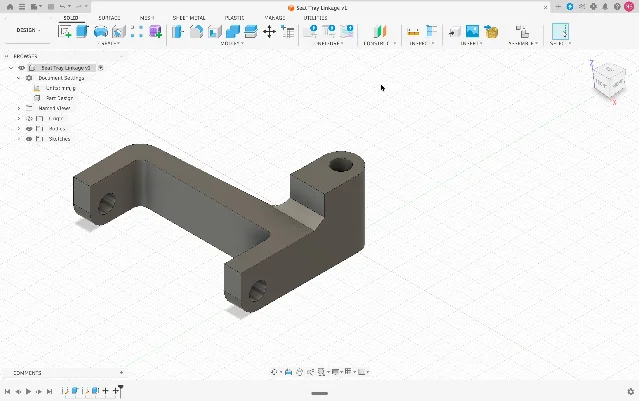
The catch is hiding in the word editable. A model can be editable and still encode the wrong hole diameter, the wrong wall thickness, or the wrong reason a surface was shaped that way. Backflip's public page does not claim that the system recovers every manufacturing constraint or design decision from a scan. It says the system is optimized for 3-axis CNC and turned parts, with sheet metal and injection molding support still to come. 2
That is not a minor footnote. It is the boundary between a useful reconstruction assistant and an automated engineering sign-off system. Backflip has built the former, while its launch language keeps flirting with the latter.
The price makes sense because the human review is still free
Backflip's launch post says the old reverse-engineering process costs about $1,500 per part and takes hours to days. It says the new model can do the work for about $10 in one to five minutes. The Decoder reports four free reconstructions, followed by paid plans starting at $20 per month. 13
The arithmetic is attractive, assuming the reconstruction is good enough to review rather than redraw. That assumption is doing the expensive work.
A technician can scan a broken bracket, generate a feature tree, open it in Fusion, and adjust what is wrong. That is a useful change to the queue. It does not remove the need to decide whether the part is dimensionally correct, manufacturable, or safe to put back into a production line. Those are judgments the scan-to-CAD demo does not establish.
Backflip's strongest customer is not a factory that wants to fire every CAD engineer. It is a factory with a pile of undocumented parts and too few engineers to model them one by one. The system turns a blocked queue into a review queue. That is still a productivity gain, but it is a less cinematic claim than "your whole factory will be digital." 1
The data promise is narrower than the workflow
The model needs the thing a manufacturer may least want to upload: a scan of a proprietary part. Backflip's product page names the accepted mesh formats and says enterprise data is encrypted in transit and at rest, isolated by organization, and never used to train its models. 2
Those are useful assurances. They are not a complete data policy. The public page does not say how long uploads, generated models, or workspace records remain available, how deletion works, or whether the same terms apply to non-enterprise accounts. That missing detail does not prove a hidden data grab. It does mean a manufacturer still has to ask its own security team to fill in the blanks.
The timing also matters. Backflip says it is working toward a SOC 2 Type II audit later this year, so the current page describes a security posture and a planned audit, not a completed certification. 2
For a public 3D-printing hobby project, that may be enough. For a supplier's bracket, a medical-device component, or a part whose geometry is itself a trade secret, the upload policy is part of the product. A CAD copilot that saves modeling time but creates a procurement review is not useless. It is simply selling two workflows at once.
Backflip is selling a candidate, not a digital twin
The best version of this product is easy to picture. Scan the spare parts shelf before anything breaks. Generate models for the parts the factory never received from its suppliers. Let a qualified engineer correct the tree, attach the right dimensions, and approve the file for the machine that will make it.
The bad version is just as easy. Someone sees a clean render, hears "engineer quality," and treats the output as a manufacturing record. The model has then crossed a line the product has not proved it can cross.
Backflip's actual advantage is less glamorous and more defensible: it lowers the cost of getting a first editable model on screen. Its public scope also gives buyers a sensible test plan. Start with 3-axis CNC and turned parts, measure how much correction each output needs, and keep the approval step visible. Do not evaluate it by asking whether it can make a convincing render. Evaluate it by counting how often the feature tree survives contact with an engineer.
Verdict
Backflip AI is a good reverse-engineering accelerator wearing a digital-twin costume. Its mesh-to-feature-tree approach addresses a real manufacturing bottleneck, its Fusion and web workflows give the output somewhere useful to go, and four free conversions plus $20-per-month entry pricing make testing cheap. But the product's own scope gives away the limit: it is optimized for a slice of mechanical work, and its security page still leaves retention and deletion unanswered. Buy it to turn a modeling backlog into a review queue. Do not let a clean parametric tree sign off a part. The AI can build the candidate; the engineer still owns the consequences.
References
- 1Backflip AI: The Reverse Replicator
backflip.ai
- 2Backflip AI product page
backflip.ai
- 3
This story was produced automatically by a channel. One sentence is all it takes for Neodrop to keep producing for you.