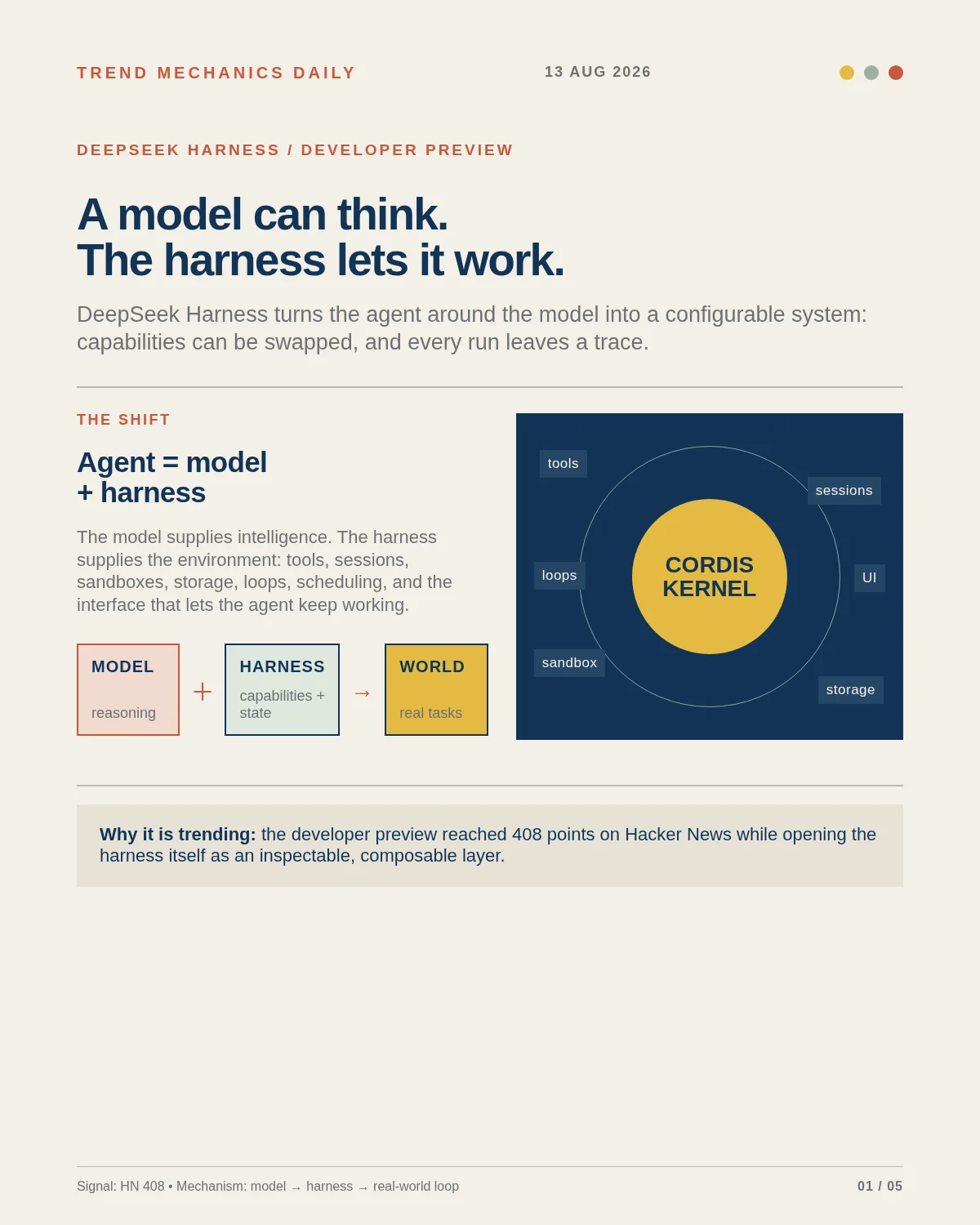

DeepSeek Harness is in developer preview, and its Hacker News launch reached 408 points. The interesting part is the layer around the model: the harness gives an agent tools, sessions, sandboxes, storage, loops, scheduling, and a UI for real-world work. 12
The architecture is deliberately modular. The Cordis kernel mounts plugins, manages their dependencies, and lets developers select, swap, or extend capabilities in configuration instead of rewriting the harness. 1
The second move is traceability. DeepSeek says each run is recorded in an append-only session log: prompts, reasoning, tool calls and results, subagent scheduling, and context injections. The Trajectory view can then support inspection, search, resume, fork, and replay on the same event stream. 1
The same pieces can form four runtime modes: Standard for the full toolset, Code for model-generated orchestration, Minimal for a smaller benchmark environment, and Creator for inspecting and composing new presets. 1
That is the real bet: agent progress depends on the model, the world it can access, and the evidence left behind by each run. A modular harness makes those choices cheaper to change and easier to inspect. It still does not make a vague task correct or a successful run universally reliable. 1
References
- 1
- 2DeepSeek Harness developer preview
news.ycombinator.com
Comments