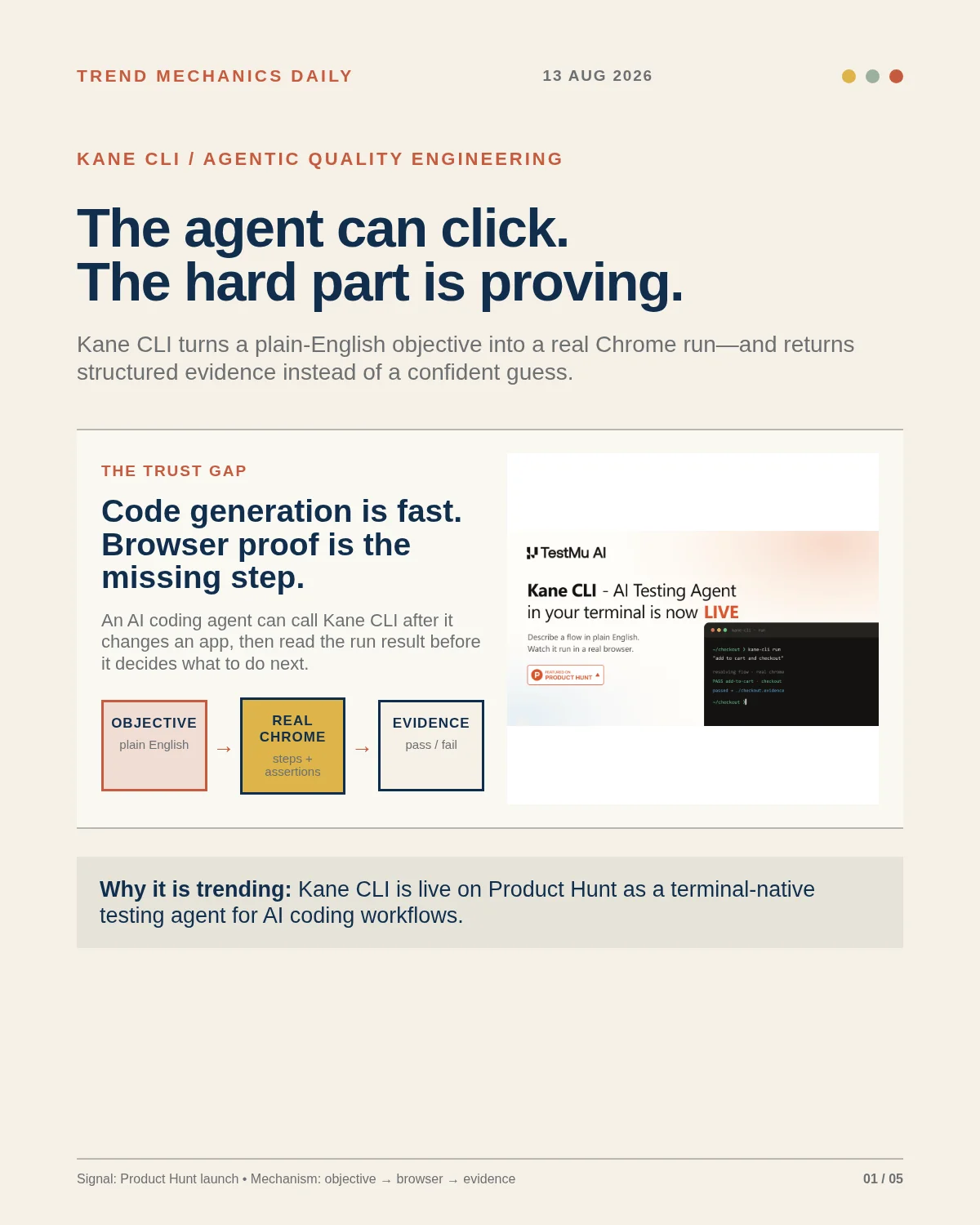

Kane CLI addresses a specific weakness in AI coding: an agent can write a feature, but its own generated code is not proof that the feature works in a browser. Kane CLI takes a plain-English objective, drives a real Chrome browser, and returns a pass/fail result with inspectable evidence. 1
The trick is the hand-off. In agent mode,
kane-cli run "..." --agent emits newline-delimited JSON; the final run_end event carries the status, summary, extracted values, and report link an AI coding agent can parse. That gives the agent a feedback loop: fix the code, run the browser check, then decide whether to continue or surface the failure. 23The evidence is more than a green check. A run can include the objective, per-step results, screenshots, browser console and network logs, and failure records in a self-contained evidence pack. Kane CLI also tries to handle the messy parts of real pages: vision-based waiting, selector changes, saved sessions, and human intervention for OTPs or CAPTCHAs. Those features make repeated checks less brittle; they do not make a vague requirement correct. 13
That is why the Product Hunt launch is worth watching: it is not merely another browser agent that clicks around. It is trying to turn browser interaction into a validation boundary for code-writing agents. The boundary still matters. A pass proves the checks that ran, with the inputs and environment they used; it does not prove complete product coverage, safe credentials, or that the test asked the right question. 4
References
- 1
- 2Kane CLI Documentation - Getting Started
testmuai.com
- 3Kane CLI by TestMu AI
github.com
- 4Kane CLI is LIVE on Product Hunt
testmuai.com
Comments