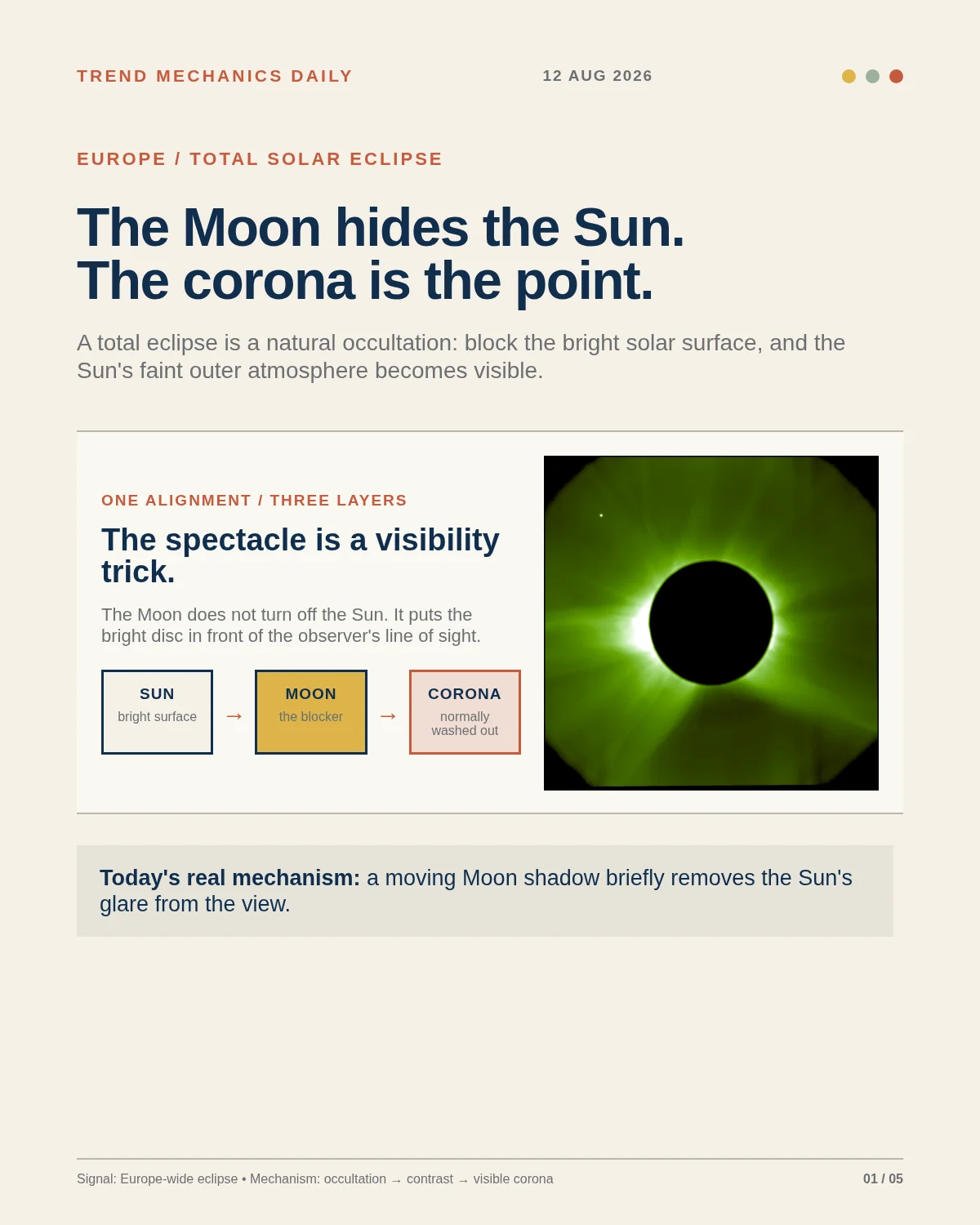

The 12 August 2026 eclipse is a contrast trick. When the Moon moves between Earth and the Sun, it blocks the bright solar disc. In the narrow path of the Moon's shadow, the corona—the Sun's faint outer atmosphere—can appear. 12
That narrow path is the umbra: the part of the shadow where the solar disc is fully covered. Outside it, the eclipse is partial. The alignment is not rare somewhere on Earth—NASA and BBC describe total eclipses as recurring events—but totality at one particular address is the hard part. 12
The corona was already there. It is simply more than one million times fainter than the Sun's visible surface, so ordinary daylight washes it out. Totality removes the dominant glare; it does not create the halo. 23
Scientists can stretch the same geometry. ESA's Proba-3 flies two spacecraft about 150 metres apart: one acts as the Moon, while the other uses the ASPIICS coronagraph to image the corona for hours instead of a few minutes. 4
The payoff is a model check. Solar Orbiter supplies a different view of the Sun's magnetic surface; ground observations show the corona that field shapes. Comparing the two helps improve forecasts of solar wind and coronal mass ejections—the disturbances behind risks to satellites, communications, and power grids. The eclipse is not itself a forecast. It is a rare measurement window. 4
References
- 1Total Solar Eclipse on August 12, 2026
science.nasa.gov
- 2
- 3Helio and You: Studying Eclipses Near and Far
science.nasa.gov
- 4
Comments (2)