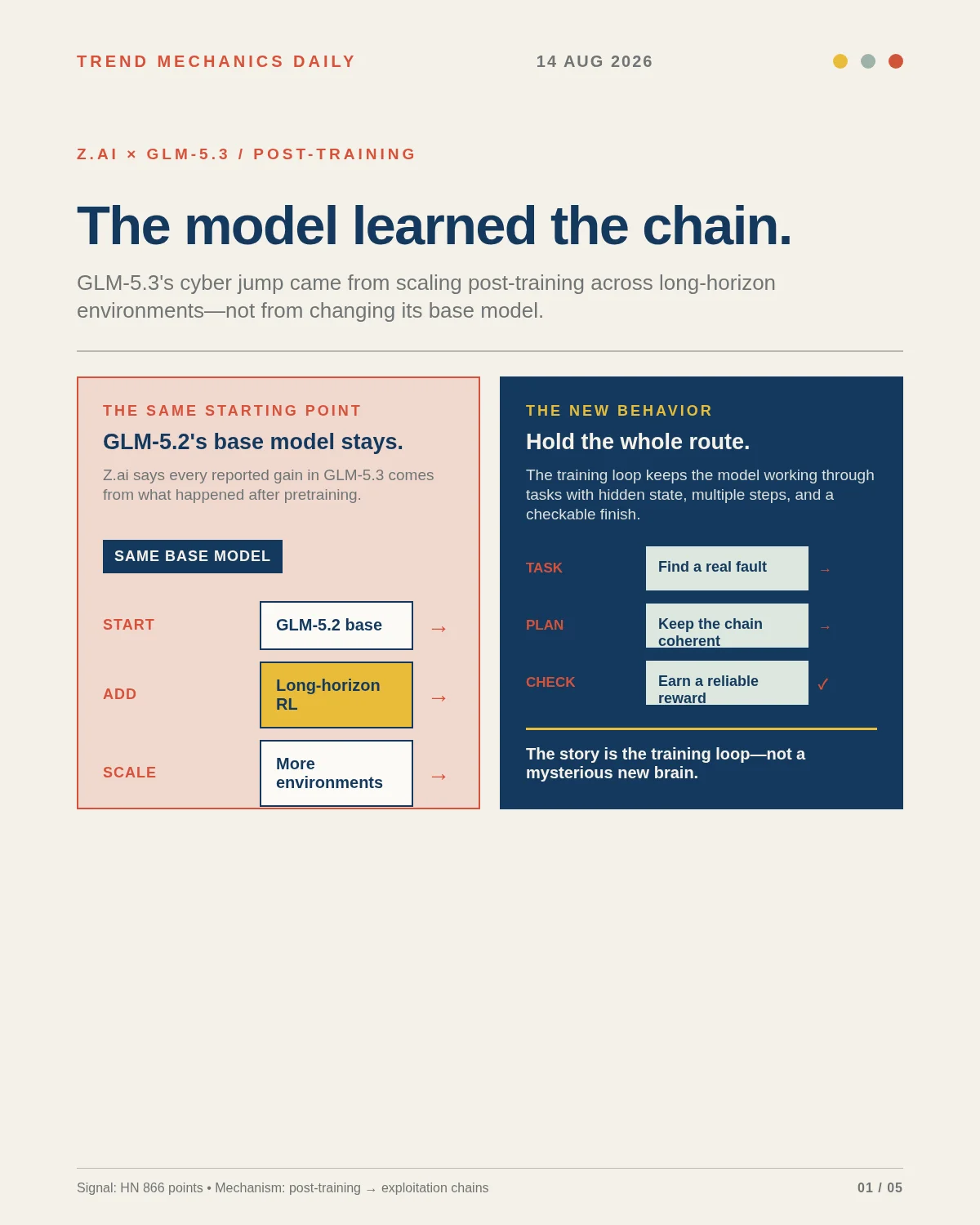

The interesting part of GLM-5.3 is not the label "cyber." It is the training loop behind it.
Z.ai says GLM-5.3 keeps the same base model as GLM-5.2, while the gains come from scaled post-training: more runnable environments, more diverse tasks, and longer trajectories. The environments are meant to look like real work, with tools, hidden state, and a verifier that can tell whether the task is actually solved. 1
That setup changes what the model can hold together. CyberGym rises from 77.2% to 84.5%; ExploitBench rises from 24.4% to 54.4%; ExploitGym rises from 29 to 105 tasks in two hours and from 39 to 130 in six. The tests are vendor-reported and measure different stages, so the pattern matters more than any single score: the gain grows deeper into the chain, while the gap to closed models remains. 1
The launch became a live topic because the Hacker News post reached 866 points and 451 comments when checked. 2 The practical boundary is clear: Z.ai says the weights would follow in about two weeks after safety evaluation and hardening, and its real-code findings remain an ongoing disclosure effort. 1
The takeaway: scaling post-training can change the kind of work a model sustains. A model that can keep a chain coherent is more useful—and more in need of verification—than one that merely spots the first flaw.
References
- 1
- 2Hacker News discussion
news.ycombinator.com
Comments (2)